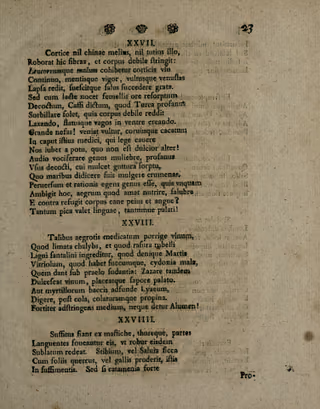
XXVIIII.

Poet
Christian Tobias Ephraim Reinhard
Book
Medicus poeta , 1762
Form
Not identifiable from book
Open the page in the book
The pages this poem fills. Each opens in the Medicus poeta reader.

Hover or tap a word to see its match.

Part 1

XXVIIII.

Let fumigations be made from mastic and frankincense, let the languishing

Parts be fomented with them, so that the lost strength

May return to the same. Antimony, or dry sage

With oak leaves, or gall-nuts will be beneficial, in those

Fumigations. But if by chance the catamenia

Suffitus fiant ex maſtiche, thureque, partes

Languentes foueantur eis, vt robur eisdem

Sublatum redeat. Stibium, vel Saluia ſicca

Cum foliis quercus, vel gallis proderit, iſtis

In ſuffimentis. Sed ſi catamenia forte

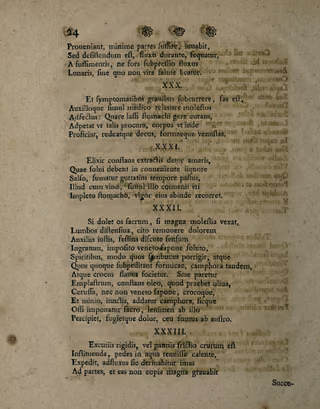
Pro-

Part 2

come forth, it will by no means be helpful to fumigate the parts,

But one must desist, while the flux lasts,

From fumigations, lest perhaps a suppression of the monthly flux should follow,

Without which life is not blessed with health.

Proueniant, minime partes ſuffire, iuuabit,

Sed deſiſtendum eſt, fluxu durante, ſequatur,

A ſuffimentis, ne fors ſubpreſſio fluxus

Lunaris, ſine quo non vita ſalute beatur.
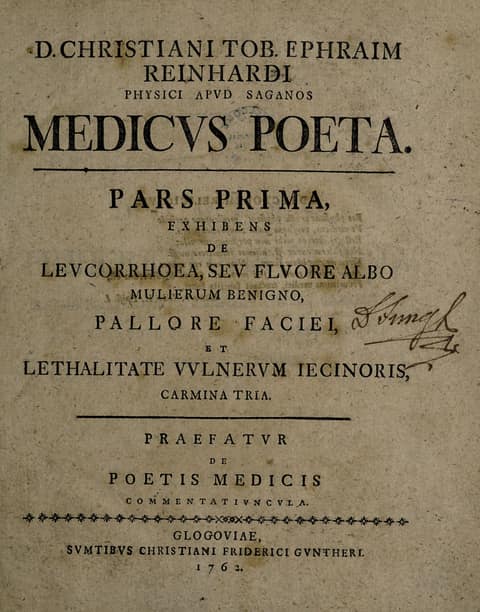
Title page of Medicus poeta
Title page of Medicus poeta , 1762

About this text

Provenance

This edition uses the Wellcome Collection copy, catalogued as _Medicus poeta. Pars prima, exhibens de leucorrhoea, pallore faciei, et lethalitate vulnerum jecinoris, carmina tria_ (b30503395). Scans 1 to 4 are the front cover and flyleaves with handwritten notes. Scan 5 is the title page. Scans 75 to 80 are blank leaves and the back cover.

Rights

The work is in the public domain by age. Wellcome Collection marks this copy with Public Domain Mark 1.0. Credit Wellcome Collection. Poet Doctor is a non-commercial site.

Original scans: Wellcome Collection ( Public Domain Mark 1.0 ).

Historian’s note. This text records the medicine of its own time, and later evidence has replaced most of it. It is not medical advice. We read it as history, and we ask what, if anything, connects it to medicine today. More on how we read old medical books