Hover or tap a word to see its match.
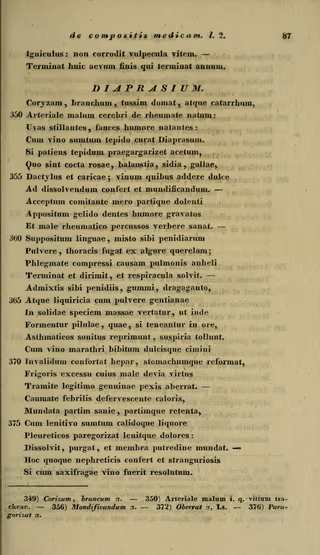
It subdues coryza, hoarseness, cough, and catarrh,
the arterial affliction born from a rheum of the brain:
dripping uvulas, throats swimming with humor:
taken with warm wine, *Diaprasum* cures.
If the patient first gargles with warm vinegar,
in which roses, balaustine flowers, pomegranate peel, gallnuts have been cooked,
dates and figs; to which to add sweet wine
is helpful for dissolving and cleansing. —
Taken with accompanying unmixed wine and applied
to the ailing part, it heals teeth weighed down by cold humor
and badly struck by a rheumatic blow. —
Placed under the tongue, with powder of penidia
mixed into it, it puts to flight the complaint of the chest arising from cold;
it ends and resolves the cause of a panting lung
compressed by phlegm, and frees the breathing passages. —
With penidia, gum, dragaganto mixed into it,
and licorice, with powder of gentian,
let it be turned into the form of a solid mass, so that from it
pills may be formed, which, if held in the mouth,
repress asthmatic sounds, remove shortness of breath.
Drunk with wine of fennel and of sweet cumin,
it comforts a weak liver, and restores the stomach,
whose power, wandering badly astray due to an excess of cold,
departs from the lawful path of genuine pexis. —
With the cauma of feverish heat dying down,
with the morbid matter partly cleansed away, and partly retained,
taken with a soothing and warm liquid,
it soothes pleureticos and alleviates their pains:
It dissolves, purges, and cleanses the limbs of putrefaction. —
This also is beneficial to nephritics and those suffering from strangury,
if it has been dissolved with wine of saxifrage.
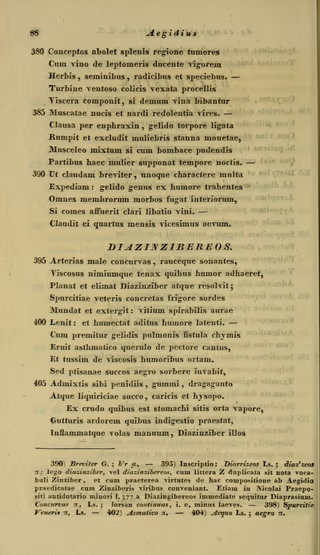
It abolishes tumors conceived in the region of the spleen
With wine drawing its strength from fine-particled
Herbs, seeds, roots, and spices. —
It settles the bowels troubled by the windy whirlwind
With colic storms, if finally wines are drunk
Smelling of the powers of nutmeg and nard. —
It breaks open and drives out the tin of the female coin,
Closed by obstruction, bound by cold torpor,
If a woman applies this to her private parts
At nighttime, mixed with musk oil using cotton. —
To conclude briefly, and to explain many things
With a single character: it puts to flight all diseases
Of the internal members deriving their origin from a cold humor,
If a libation of clear wine is present as a companion. —
The twenty-fourth month closes its lifespan.
Coryzam, branchum, tussim domat, atque catarrhum,
Arteriale malum cerebri de rheumate natum:
Uvas stillantes, fauces humore natantes:
Cum vino sumtum tepido curat Diaprasum.
Si patiens tepidum praegargarizet acetum,
Quo sint cocta rosae, balaustia, sidia, gallae,
Dactylus et caricae; vinum quibus addere dulce
Ad dissolvendum confert et mundificandum. —
Acceptum comitante mero partique dolenti
Appositum gelido dentes humore gravatos
Et male rheumatico percussos verbere sanat. —
Suppositum linguae, misto sibi penidiarum
Pulvere, thoracis fugat ex algore querelam;
Phlegmate compressi causam pulmonis anheli
Terminat et dirimit, et respiracula solvit. —
Admixtis sibi penidiis, gummi, dragaganto,
Atque liquiricia cum pulvere gentianae
In solidae speciem massae vertatur, ut inde
Formentur pilulae, quae, si teneantur in ore,
Asthmaticos sonitus reprimunt, suspiria tollunt.
Cum vino marathri bibitum dulcisque cimini
Invalidum confortat hepar, stomachumque reformat,
Frigoris excessu cuius male devia virtus
Tramite legitimo genuinae pexis aberrat. —
Caumate febrilis defervescente caloris,
Mundata partim sanie, partimque retenta,
Cum lenitivo sumtum calidoque liquore
Pleureticos paregorizat lenitque dolores:
Dissolvit, purgat, et membra putredine mundat. —
Hoc quoque nephreticis confert et stranguriosis
Si cum saxifragae vino fuerit resolutum.
Conceptos abolet splenis regione tumores
Cum vino de leptomeris ducente vigorem
Herbis, seminibus, radicibus et speciebus. —
Turbine ventoso colicis vexata procellis
Viscera componit, si demum vina bibantur
Muscatae nucis et nardi redolentia vires. —
Clausa per enphraxin, gelido torpore ligata
Rumpit et excludit muliebris stanna monetae,
Musceleo mixtum si cum bombace pudendis
Partibus haec mulier supponat tempore noctis. —
Ut claudam breviter, unoque charactere multa
Expediam: gelido genus ex humore trahentes
Omnes membrorum morbos fugat interiorum,
Si comes affuerit clari libatio vini. —
Claudit ei quartus mensis vicesimus aevum.