Hover or tap a word to see its match.
Hippocrates, the greatest authority of medicine,
Sets down uses for the medicine of leek in many conditions.
He himself gave its juice to be drunk by itself
To the sick who throw up spittle or blood,
Whom the Greeks are accustomed to call *emotoicos*.
With gall-nut they give it, or with the meal of garlic or frankincense,
Or to two drachmas of leek seed they add one
Of myrrh, and, pounded, they dissolve them in wine.
Before all others they say these things taken thus are helpful.
And you can check the flowing blood of the nose
If you anoint the inside of the nostrils with such a medicine.
And they say that if it is often drunk with wine,
A leaden complexion departs and a better one is restored.
With the same juice you will cure injured wombs.
Chewed very often, it renders girls fertile.
Pounded with honey and applied, it helps wounds.
If a distillation of the humors of the head occurs,
Harming the lung and chest, and the melodious voice,
And from it a cough arises, hurting the vitals,
It will help to sip the juice of leek with ptisan;
And even by itself alone it is beneficial for all these things.
If you boil the white parts of leek with wine
So that you change the first water and add a second,
Its water becomes a useful drink for a hard belly.
This same water, with wine, is said to bind the belly.
With wine, leek is given to those whom a snake has harmed,
Or any animal pouring forth deadly poison;
It is beneficial for all these if you apply it upon the wounds.
Leek kneaded with honey [acts] like a plaster for this.
The juice of leek mixed with woman's milk
And drunk is said to soothe an old cough
And the same helps various ailments of the lung.
It subdues the pain of the ear with goat's gall.
The same excels equally mixed with mead and to the ear
Poured warm: if it is chewed, it opposes mushrooms.
Let a third part of honey be joined to its juice
And thus by pouring it warm through the nostrils or ears
It will be able to soothe an immense pain of the head.
Let him whom pain of the loins torments drink this with wine;
They say nothing is more useful for such a pain.
It quickly consolidates fractures and repels hardnesses
And applied with salt it quickly closes a fresh wound.
If it is taken raw it relieves drunkenness
And stimulates the belly: thus it softens a hard bowel.
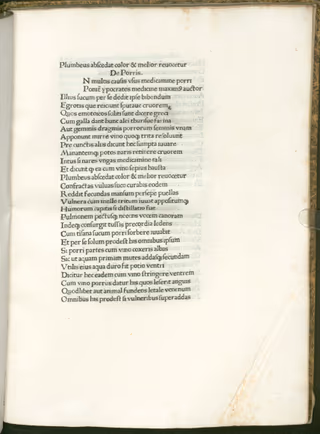
N multis cauſis vſus medicamine porri
Ponit̄ ypocrates medicine maximꝰ auctor
Illius ſucum per ſe dedit ipſe bibendum
Egrotis que reiciunt ſputaue cruorem
Quos emotoicos ſoliti ſunt dicere greci
Cum galla dant hunc alei thuriſue farina
Aut geminis dragmis porrorum ſeminis vnam
Apponunt mirre vino quoqꝫ trita reſoluunt
Pre cunctis aliis dicunt hec ſumpta iuuare
Manantemqꝫ potes naris retinere cruorem
Intus ſi nares vngas medicamine tali
Et dicunt ꝙ ea cum vino ſepius hauſta
Plumbeus abſcedat color & melior reuocetur
Confractas vuluas ſuco curabis eodem
Reddit fecundas manſum perſepe puellas
Vulnera cum melle tritum iuuat appoſitumqꝫ
Humorum capitis ſi diſtillatio fiat
Pulmonem pectuſqꝫ nocens vocem canoram
Indeqꝫ conſurgit tuſſis precordia ledens
Cum tiſana ſucum porri ſorbere iuuabit
Et per ſe ſolum prodeſt his omnibus ipſum
Si porri partes cum vino coxeris albas
Sic ut aquam primam mutes addaſqꝫ ſecundam
Vtilis eius aqua duro fit potio ventri
Dicitur hec eadem cum vino ſtringere ventrem
Cum vino porrus datur his quos leſerit anguis
Quodlibet aut animal fundens letale venenum
Omnibus his prodeſt ſi vulneribus ſuperaddas
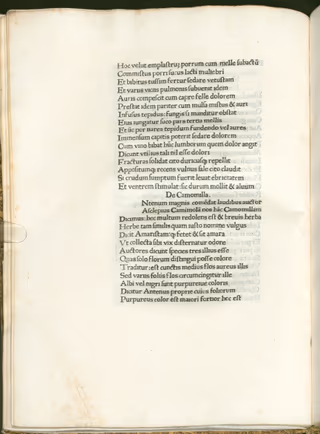
Hoc velut emplaſtruꝫ porrum cum melle ſubactū
Commiſtus porri ſucus lacti muliebri
Et bibitus tuſſim fertur ſedare vetuſtam
Et variis viciis pulmonis ſubuenit idem
Auris compeſcit cum capre felle dolorem
Preſtat idem pariter cum mulſa miſtus & auri
Infuſus tepidus: fungis ſi manditur obſtat
Eius iungatur ſuco pars tertia mellis
Et ſic per nares tepidum fundendo vel aures
Immenſum capitis poterit ſedare dolorem
Cum vino bibat hūc lumborum quem dolor angit
Dicunt vtilius tali nil eſſe dolori
Fracturas ſolidat cito duriciaſqꝫ repellit
Appoſitumqꝫ recens vulnus ſale cito claudit
Si crudum ſumptum fuerit leuat ebrietatem
Et ventrem ſtimulat: ſic durum mollit & aluum