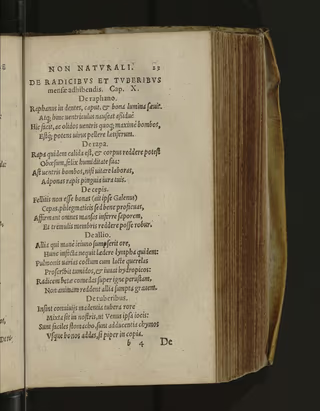
De allio.

Poet
Pictorius
Form
Elegiac couplet
Open the page in the book
The page this poem fills. Each opens in the Sanitatis tuendae methodus reader.

Hover or tap a word to see its match.

He who consumes garlic in the morning on an empty stomach,

even infected water cannot harm him:

Cooked with milk, it banishes various complaints of the lungs,

and aids swollen dropsical ones:

You should eat the root of a beet roasted over a fire,

consumed garlic will not render the breath heavy.

Allia qui manè ieiuno ſumpſerit ore,

Hunc infecta nequit lædere lympha quidem:

Pulmonis uarias coctum cum lacte querelas

Proſcribit tumidos, & iuuat hydropicos:

Radicem betæ comedas ſuper igne peruſtam,

Non animam reddent allia ſumpta grauem.
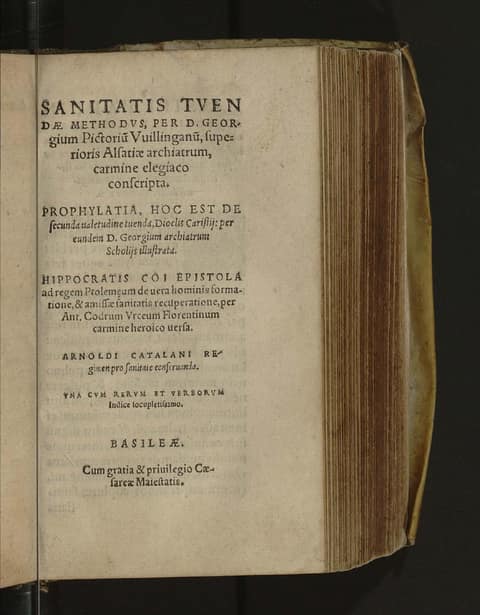
Title page of Sanitatis tuendae methodus
Title page of Sanitatis tuendae methodus , 1561

About this text

Provenance

This digital edition is derived from the Jagiellonian Digital Library copy of Georg Pictorius's 1561 _Sanitatis tuendae methodus_, a Latin verse collection on preserving health.

Methodology

Each scan is treated as a page-level unit. The page image remains the authority for the edition. Local Kraken OCR used the Reichenau Latin early-print model as a reading aid, then Gemini generated scan-grounded Latin transcription and scholarly English translation from the images, the OCR aid, and the approved glossary. Word links connect the English translation to the Latin transcription and locations on the scans. 25 uncertain word-link decisions remain unlinked. Some links highlight only the text because the source word could not be located on the scan.

Rights

The Jagiellonian Digital Library metadata declares the digital surrogate public domain. Poet Doctor's presentation adds generated OCR, transcription, translation, navigation metadata, and editorial context.

Original scans: Jagiellonian Digital Library ( Public domain ).

Historian’s note. This text records the medicine of its own time, and later evidence has replaced most of it. It is not medical advice. We read it as history, and we ask what, if anything, connects it to medicine today. More on how we read old medical books