Hover or tap a word to see its match.
The windpipes badly curved, and sounding hoarsely,
To which a viscous and excessively tenacious humor adheres,
*Diazinziber* smooths, files down, and resolves;
It cleanses and wipes away the dirt of old impurity
Congealed by cold: it soothes the defect of the breathable
Air: and moistens the passages with a hidden moisture. —
When the pipe of the lung is pressed by cold humors,
It roots out the asthmatic songs from the complaining chest,
And the cough arisen from viscous humors.
But it will help the sick person to sip the juices of ptisana,
Mixed with penidions, gum, tragacanth
And juice of licorice, figs, and hyssop.
Those to whom thirst has arisen from a crude vapor of the stomach,
To whom indigestion furnishes a burning of the throat,
And inflames the palms of the hands, *Diazinziber* those
It cures, taken with fennel-flavored wine
Or one in which anise, mastic, and dill have boiled.
It stimulates the function of coitus, and restores the lost
Rights of heat, raises up digestion lying in rawness,
And beautifies the face with pallor driven away. —
Taken with ptisana, the proper form of which
The oft-remembered description has very often expressed,
When pus has already formed, with the framework of the tumor broken,
It prohibits the worst contagions of pleuritic disease. —
*Diazinziber* can scarcely pass beyond its first year.
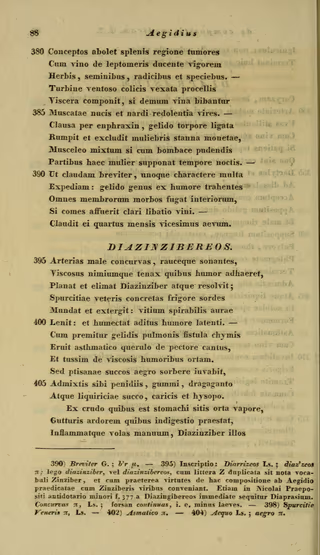
Arterias male concurvas, rauceque sonantes,
Viscosus nimiumque tenax quibus humor adhaeret,
Planat et elimat Diazinziber atque resolvit;
Spurcitiae veteris concretas frigore sordes
Mundat et extergit: vitium spirabilis aurae
Lenit: et humectat aditus humore latenti. —
Cum premitur gelidis pulmonis fistula chymis
Eruit asthmatico querulo de pectore cantus,
Et tussim de viscosis humoribus ortam.
Sed ptisanae succos aegro sorbere iuvabit,
Admixtis sibi penidiis, gummi, dragaganto
Atque liquiriciae succo, caricis et hysopo.
Ex crudo quibus est stomachi sitis orta vapore,
Gutturis ardorem quibus indigestio praestat,
Inflammatque volas manuum, Diazinziber illos
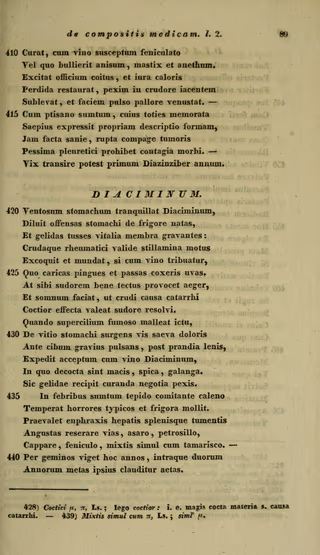
Curat, cum vino susceptum feniculato
Vel quo bullierit anisum, mastix et anethum.
Excitat officium coitus, et iura caloris
Perdita restaurat, pexim in crudore iacentem
Sublevat, et faciem pulso pallore venustat. —
Cum ptisano sumtum, cuius toties memorata
Saepius expressit propriam descriptio formam,
Jam facta sanie, rupta compage tumoris
Pessima pleuretici prohibet contagia morbi. —
Vix transire potest primum Diazinziber annum.