Hover or tap a word to see its match.
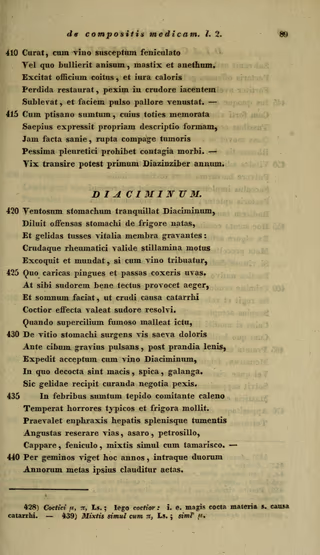
*Diaciminum* calms a windy stomach,
Washes away the ailments of the stomach born from cold,
And cold coughs burdening the vital members:
And it forcefully concocts and cleanses the raw drippings
Of rheumatic motion, if it is administered with wine,
In which you have cooked plump figs and raisins.
But let the sick man, well covered, provoke sweat for himself,
And induce sleep, so that the cause of the raw catarrh,
Rendered more concocted, may be able to be resolved by sweat.
When the fierce force of pain rising from a defect of the stomach
Hammers the eyebrow with a smoky blow,
Pulsating more heavily before food, gentle after meals,
*Diaciminum* taken with wine is useful,
In which mace, spikenard, and galangal have been decocted.
Thus cold digestion undertakes the business to be cured.
Taken in fevers with warm Calenian wine accompanying,
It moderates periodic rigors and softens chills.
It prevails in unsealing the narrow pathways of an obstruction
Of the liver and swollen spleen, with asarum, parsley,
Caper, and fennel, mixed together with tamarisk. —
This is potent for two years, and within the bounds
Of two years its age is closed.
Ventosum stomachum tranquillat Diaciminum,
Diluit offensas stomachi de frigore natas,
Et gelidas tusses vitalia membra gravantes:
Crudaque rheumatici valide stillamina motus
Excoquit et mundat, si cum vino tribuatur,
Quo caricas pingues et passas coxeris uvas.
At sibi sudorem bene tectus provocet aeger,
Et somnum faciat, ut crudi causa catarrhi
Coctior effecta valeat sudore resolvi.
Quando supercilium fumoso malleat ictu,
De vitio stomachi surgens vis saeva doloris
Ante cibum gravius pulsans, post prandia lenis,
Expedit acceptum cum vino Diaciminum,
In quo decocta sint macis, spica, galanga.
Sic gelidae recipit curanda negotia pexis.
In febribus sumtum tepido comitante caleno
Temperat horrores typicos et frigora mollit.
Praevalet enphraxis hepatis splenisque tumentis
Angustas reserare vias, asaro, petrosillo,
Cappare, feniculo, mixtis simul cum tamarisco. —
Per geminos viget hoc annos, intraque duorum
Annorum metas ipsius clauditur aetas.