Hover or tap a word to see its match.
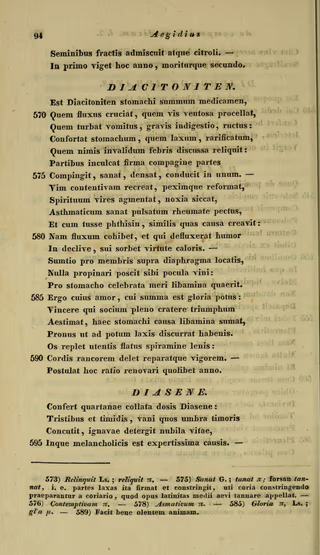
*Diacitoniten* is the supreme medicine for the stomach,
Which a flux torments, which a windy force batters,
Which vomiting, severe indigestion, and belching disturb:
It strengthens the stomach, which relaxed, rarefied,
Which excessively weak a dispelled fever has left:
It presses parts upon parts with a firm connection,
It binds, heals, thickens, and gathers into one. —
It restores the retentive force, and reforms the *pexis*,
It augments the powers of the spirits, dries up noxious things,
It heals an asthmatic chest battered by rheum,
And phthisis with a cough, which a similar cause has created:
For it restrains the flux, and the humor which had flowed down
Into the decline, it absorbs by the virtue of its heat. —
Consumption for members located above the diaphragm,
Demands no cups of wine to be served to it:
For the stomach it seeks celebrated libations of unmixed wine.
Therefore he whose love, whose highest glory is drink:
Who considers it a triumph to defeat a companion with a full bowl,
Let him take these libations for the sake of the stomach,
So that he may run forward inclined to drink with loose reins.
It fills the mouth of the user with the exhalation of a gentle breath:
It destroys the rancor of the heart and restores its vigor. —
Reason demands this to be renewed in any given year.
Est Diacitoniten stomachi summum medicamen,
Quem fluxus cruciat, quem vis ventosa procellat,
Quem turbat vomitus, gravis indigestio, ructus:
Confortat stomachum, quem laxum, rarificatum,
Quem nimis invalidum febris discussa reliquit:
Partibus inculcat firma compagine partes
Compingit, sanat, densat, conducit in unum. —
Vim contentivam recreat, peximque reformat,
Spirituum vires agmentat, noxia siccat,
Asthmaticum sanat pulsatum rheumate pectus,
Et cum tusse phthisin, similis quas causa creavit:
Nam fluxum cohibet, et qui defluxerat humor
In declive, sui sorbet virtute caloris. —
Sumtio pro membris supra diaphragma locatis,
Nulla propinari poscit sibi pocula vini:
Pro stomacho celebrata meri libamina quaerit.
Ergo cuius amor, cui summa est gloria potus:
Vincere qui socium pleno cratere triumphum
Aestimat, haec stomachi causa libamina sumat,
Pronus ut ad potum laxis discurrat habenis.
Os replet utentis flatus spiramine lenis:
Cordis rancorem delet reparatque vigorem. —
Postulat hoc ratio renovari quolibet anno.