Hover or tap a word to see its match.
To what it yields more devotedly and serves,
to what it more complies with, it draws its name for itself from the stomach,
*Stomaticon*, although lengthening relaxes it itself,
shortness contracts this, but derivation alters the time
and changes the usage of the first origin.
It is divided into various species, which discordant virtue,
differently colored effect, disparate compounding renders
dissimilar; the distinction of things is clear from the title,
the form of the subject confesses the merit of the duty.
There is one that comforts, one that relaxes, or one that
increases and sharpens heat, one that tempers and remits it.
To the soft and tender, whom by its very name
a potion terrifies, whom it upsets and ruins by its mere odor,
whose delicacies, unless a flavor congruent to our mouth
and pleasant, stinging and sharpening the palate,
the *Stomaticon*, which claims for itself the use of relaxing,
plays upon more pleasingly and earns pardon by its flavor.
Lurking beneath the sweetness, the laxative force
mocks the delicacies of the proud mouth: thus food the hook,
Honey covers poison, just as the deceit of a feigned smile
Conceals and hides the clouds of a wicked mind.
A single sweet thing inserted among twin bitter ones
Destroys and excuses the harms of a sour taste.
Thus prudence covers error, grace covers blame,
Peace hatred, virtue vice, concord strife.
And not yet brought to its full course, the whole
Purgation is completed by this with a fitting end.
The comforting kind strengthens a raw belly,
Arouses a weak *pexis* and restores heat:
It dissipates the windy breezes enclosed within the bowels.
The *Stomaticon*, which coldness determines, relieves acute cases
And the phthisic, the thirsty, and the emaciated:
It tempers the burning of the stomach and the heat of a fever:
It restores strength to limbs weakened by *cauma*.
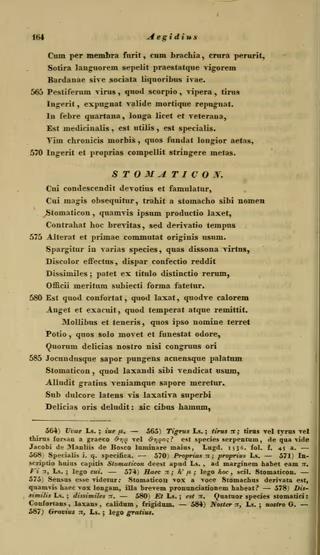
Cui condescendit devotius et famulatur,
Cui magis obsequitur, trahit a stomacho sibi nomen
Stomaticon, quamvis ipsum productio laxet,
Contrahat hoc brevitas, sed derivatio tempus
Alterat et primae commutat originis usum.
Spargitur in varias species, quas dissona virtus,
Discolor effectus, dispar confectio reddit
Dissimiles; patet ex titulo distinctio rerum,
Officii meritum subiecti forma fatetur.
Est quod confortat, quod laxat, quodve calorem
Auget et exacuit, quod temperat atque remittit.
Mollibus et teneris, quos ipso nomine terret
Potio, quos solo movet et funestat odore,
Quorum delicias nostro nisi congruus ori
Jocundusque sapor pungens acuensque palatum
Stomaticon, quod laxandi sibi vendicat usum,
Alludit gratius veniamque sapore meretur.
Sub dulcore latens vis laxativa superbi
Delicias oris deludit: sic cibus hamum,
Mel operit virus, sic pravae nubila mentis
Celat et occultat ficti fallacia risus.
Acribus inserta geminis res unica dulcis
Delet et excusat acidi nocumenta saporis.
Sic tegit errorem prudentia, gratia culpam,
Pax odium, vitium virtus, concordia litem.
Tota nec ad plenum nondum deducta tenorem
Ex hoc completur purgatio fine decenti.
Confortativum crudum corroborat alvum,
Excitat invalidam pexim recreatque calorem:
Clausas visceribus ventosas dissipat auras.
Stomaticon, quod frigiditas disponit, acutis
Subvenit et phthisicis, sitibundis, extenuatis:
Temperat ardorem stomachi febrisque calorem:
Vim reparat membris ex caumate debilitatis.