Hover or tap a word to see its match.
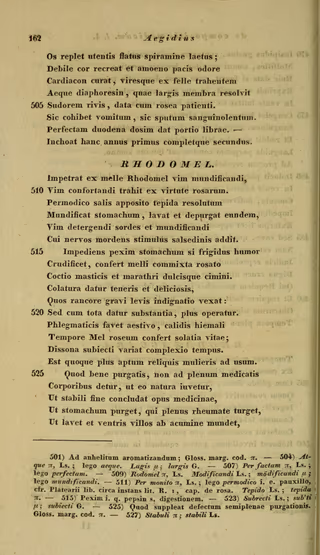
*Rhodomel* obtains from honey the power of cleansing,
It draws the power of comforting from the virtue of roses.
Dissolved in warm water with a very small amount of salt added,
It cleanses the stomach, washes and purges the same,
To which the bite of saltiness, stinging the nerves,
Adds the power of wiping away filth and of cleansing.
If a cold humor, hindering digestion, causes indigestion
In the stomach, a decoction of mastic, fennel, and sweet cumin
Mixed with rose honey is beneficial.
The strained liquid is given to the tender and delicate,
Whom a slight upset afflicts with severe rancor:
But when the whole substance is given, it is more effective.
Rose honey favors the phlegmatic in the summer time,
While in winter it brings the comforts of life to the hot-tempered;
The differing complexion of the subject varies the time.
It is also more suitable than the rest for a woman's use.
Let it be given to bodies well purged, but not fully
Medicated, so that nature may be helped by it,
So that it may conclude the work of medicine with a stable end,
So that it may purge the stomach, which swells full of rheum,
So that it may wash and cleanse the villi of the belly from acridity,
Because what is enclosed in the villi and cohering by an unequal lot
May produce the force of dysentery and the cause of ruin.
That a purgation does not keep its legitimate limit,
Will be able to become clear to a doubtful mind by these signs:
There arises a horrible taste on the tongue, a disturbance of taste,
Nausea, hiccups, rancidity, and tumult of the stomach,
Heaviness of the limbs, pricking of the anus, tenesmus,
Griping, rumbling, belching, burning of the throat:
The mouth is dry, turns bitter, is thirsty, the appetite languishes. —
In *Rhodomel* the dose equals a sixth part of a pound. —
The third year better integrates and completes this.
Impetrat ex melle Rhodomel vim mundificandi,
Vim confortandi trahit ex virtute rosarum.
Permodico salis apposito tepida resolutum
Mundificat stomachum, lavat et depurgat eundem,
Vim detergendi sordes et mundificandi
Cui nervos mordens stimulus salsedinis addit.
Impediens pexim stomachum si frigidus humor
Crudificet, confert melli commixta rosato
Coctio masticis et marathri dulcisque cimini.
Colatura datur teneris et deliciosis,
Quos rancore gravi levis indignatio vexat:
Sed cum tota datur substantia, plus operatur.
Phlegmaticis favet aestivo, calidis hiemali
Tempore Mel roseum confert solatia vitae;
Dissona subiecti variat complexio tempus.
Est quoque plus aptum reliquis mulieris ad usum.
Quod bene purgatis, non ad plenum medicatis
Corporibus detur, ut eo natura iuvetur,
Ut stabili fine concludat opus medicinae,
Ut stomachum purget, qui plenus rheumate turget,
Ut lavet et ventris villos ab acumine mundet,
Quod clausum in villis et inaequa sorte cohaerens
Vim dysenteriae pariat causamque ruinae.
Quod non legitimam teneat purgatio metam,
His poterit signis dubiae clarescere menti:
Fit linguae sapor horribilis, turbatio gustus,
Nausea, singultus, rancor, stomachique tumultus,
Membrorum gravitas, ani punctura, tenasmon,
Tortio, rugitus, ructatio, gutturis ardor:
Aret, amarescit, sitit os, languescit orexis. —
In Rhodomelle dosim librae pars sexta coaequat. —
Integrat hoc melius et complet tertius annus.