Hover or tap a word to see its match.
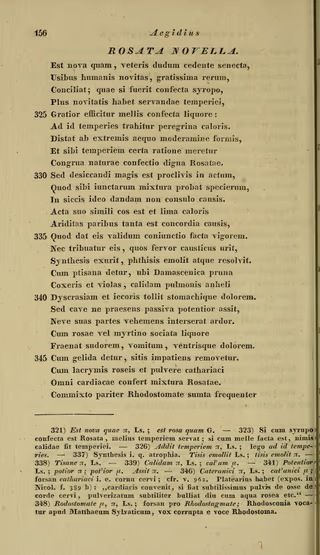
There is a new one which, the old age of the former one having long since yielded,
novelty, the most pleasing of things, commends to human uses;
which, if it has been prepared with syrup,
has more novelty for preserving its temperament,
it is made more pleasing when prepared with the liquor of honey:
to that end the foreign temperament of heat is drawn.
It stands apart from extreme forms by a fair moderation,
and the suitable preparation worthy of the nature of Rosata
merits for itself a temperament by a sure reason.
But it is more prone to the act of desiccating,
which the mixture of the species joined to it proves;
therefore I do not advise it to be given in dry cases.
Dryness driven by its like is the whetstone and file of heat;
so great is the concord in equal cases,
that the conjunction made gives them strong vigor.
Let it not be administered to those whom caustic fervor burns,
whom synthesis burns up, and phthisis grinds down and resolves.
Let it be given with ptisana, where you have cooked Damascene plums
and violets; it removes the hot dyscrasia of a panting lung
and the pain of the liver and stomach.
But beware lest the present passive quality be more powerful,
nor let vehement heat intersperse its parts.
Associated with the liquor of rose or myrtle,
it curbs sweat, vomiting, and pain of the belly.
When given cold, impatient thirst is removed.
With rose tears and the powder of *cathariacum*,
the mixture of Rosata is beneficial for every cardiac affection.
Taken frequently with *Rhodostoma* mixed in equally
It tempers those released from the snares of disease, with neither mediating,
And unblocks, strengthens, and restores. —
A year, in which its origin begins, ends it.
Est nova quam, veteris dudum cedente senecta,
Usibus humanis novitas, gratissima rerum,
Conciliat; quae si fuerit confecta syropo,
Plus novitatis habet servandae temperiei,
Gratior efficitur mellis confecta liquore:
Ad id temperies trahitur peregrina caloris.
Distat ab extremis aequo moderamine formis,
Et sibi temperiem certa ratione meretur
Congrua naturae confectio digna Rosatae.
Sed desiccandi magis est proclivis in actum,
Quod sibi iunctarum mixtura probat specierum,
In siccis ideo dandam non consulo causis.
Acta suo simili cos est et lima caloris
Ariditas paribus tanta est concordia causis,
Quod dat eis validum coniunctio facta vigorem.
Nec tribuatur eis, quos fervor causticus urit,
Synthesis exurit, phthisis emolit atque resolvit.
Cum ptisana detur, ubi Damascenica pruna
Coxeris et violas, calidam pulmonis anheli
Dyscrasiam et iecoris tollit stomachique dolorem.
Sed cave ne praesens passiva potentior assit,
Neve suas partes vehemens interserat ardor.
Cum rosae vel myrtino sociata liquore
Fraenat sudorem, vomitum, ventrisque dolorem.
Cum gelida detur, sitis impatiens removetur.
Cum lacrymis roseis et pulvere cathariaci
Omni cardiacae confert mixtura Rosatae.
Commixto pariter Rhodostomate sumta frequenter
A morbi laqueis neutro mediante solutos
Temperat, et reserat, corroborat atque reformat. —
Terminat hanc annus, in quo suus inchoat ortus.