Hover or tap a word to see its match.
That which is made from plums, which has the name *Diaprunis*,
Has a variable body, sometimes simple, sometimes it is made acute,
Sometimes it is warm with the sweetness of honey, sometimes it is tempered by
Sugar, which gives the seasoning of a mild flavor.
If simple, to which the pleasant temperance of an agreeable syrup
Allies itself, and joins in a friendly pact,
Let it be dissolved with hot water, in which you have decocted Damascene plums
And violet flowers: and let it be drunk in the morning.
In strongly burning and very acute fevers,
In tertians, synochas, and causon it provides a great
Support of health: for it tempers the sharpness of red bile
And restrains the fierce anger of the burning heat.
It casts out the burnt-up impurities from the weary body,
So that nature, assisted by such great benefits, with recovered
By its powers it might hasten to perform the critical labors.
It should be given to drink at midday, with fresh spring water.
But especially then, when the time, the disease, and the humor,
these, the food of burning heat, which provide nourishment for the flames,
the age, form, crasis, and region seem harmonious,
and they concur with one another, conforming in a similar connection,
they add straw to the fire, and oil to the lamp;
lest the fever ascend, the symptoms increase, and the incensive
force be able to reach the fourth degree:
if the disease should not become certain at such a time,
perhaps a repressive must be given then, when the febrile
impetus is sharper and the wrath of the heat rages more. —
To this medicine, so mild and so benign,
add the stimuli of diagridium: apply a spur
to a slow-moving horse: from a relaxed simplicity
it rises into the sharpness of laxative virtue,
from which, after five nights of febrile conflict
have passed, and the storm of the disease being unable to be resolved,
a suitable purgation in hemitriteis will be made,
rather in the winter season then, when the rebellious
matter and the humor do not thus obey nature.
That which is hot from honey, whether this is mild or acute,
is beneficial for phlegmatics; to those who have constriction of the belly,
it is more indulgent to these: but for those who are hot with the fire
of acute fever, it is exceedingly dreadful and highly harmful.
For honey, a stimulus of dyscrasia and tinder of fury,
accelerates the destruction of death and the ruin of life.
Therefore let them pay for their crime, and whatever perils of death
they often force others to incur through their fraud,
let them undergo these themselves, and repay death with death,
the pharmacopolae, who sell spices and aromatics,
who deal in drugs: who, while they alter their weights,
and deceive the scales, and the forms of preparation
they taint with the adulteration of fraud, while they compel
honey to supply the place of syrup, while they sell harmful things
and attest they are good, they first obscure the names of physicians
with shameful titles, and they cast down the health of men,
prolong diseases and for the sick fearful
deaths they hasten, and unseal wills.
Let death feed upon those wretches: let their bed be
the flame of Gehenna, unless with changed mind, deceitful
arts cast aside and betrayal abandoned,
they are called back to the right path by the love of virtue. —
Honey doubles the year for this one, for whom sugar halves the age.
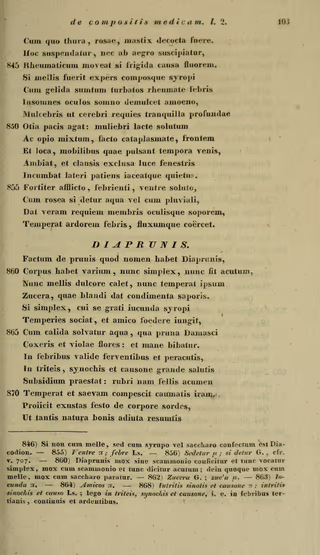
Factum de prunis quod nomen habet Diaprunis,
Corpus habet varium, nunc simplex, nunc fit acutum,
Nunc mellis dulcore calet, nunc temperat ipsum
Zucera, quae blandi dat condimenta saporis.
Si simplex, cui se grati iucunda syropi
Temperies sociat, et amico foedere iungit,
Cum calida solvatur aqua, qua pruna Damasci
Coxeris et violae flores: et mane bibatur.
In febribus valide ferventibus et peracutis,
In triteis, synochis et causone grande salutis
Subsidium praestat: rubri nam fellis acumen
Temperat et saevam compescit caumatis iram.
Proiicit exustas fesso de corpore sordes,
Ut tantis natura bonis adiuta resumtis
Viribus acceleret creticos celebrare labores.
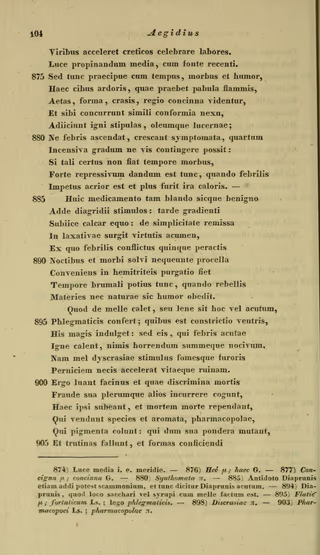
Luce propinandum media, cum fonte recenti.
Sed tunc praecipue cum tempus, morbus et humor,
Haec cibus ardoris, quae praebet pabula flammis,
Aetas, forma, crasis, regio concinna videntur,
Et sibi concurrunt simili conformia nexu,
Adiiciunt igni stipulas, oleumque lucernae;
Ne febris ascendat, crescant symptomata, quartum
Incensiva gradum ne vis contingere possit:
Si tali certus non fiat tempore morbus,
Forte repressivum dandum est tunc, quando febrilis
Impetus acrior est et plus furit ira caloris. —
Huic medicamento tam blando sicque benigno
Adde diagridii stimulos: tarde gradienti
Subiice calcar equo: de simplicitate remissa
In laxativae surgit virtutis acumen,
Ex quo febrilis conflictus quinque peractis
Noctibus et morbi solvi nequeunte procella
Conveniens in hemitriteis purgatio fiet
Tempore brumali potius tunc, quando rebellis
Materies nec naturae sic humor obedit.
Quod de melle calet, seu lene sit hoc vel acutum,
Phlegmaticis confert; quibus est constrictio ventris,
His magis indulget: sed eis, qui febris acutae
Igne calent, nimis horrendum summeque nocivum.
Nam mel dyscrasiae stimulus fomesque furoris
Perniciem necis accelerat vitaeque ruinam.
Ergo luant facinus et quae discrimina mortis
Fraude sua plerumque alios incurrere cogunt,
Haec ipsi subeant, et mortem morte rependant,
Qui vendunt species et aromata, pharmacopolae,
Qui pigmenta colunt: qui dum sua pondera mutant,
Et trutinas fallunt, et formas conficiendi
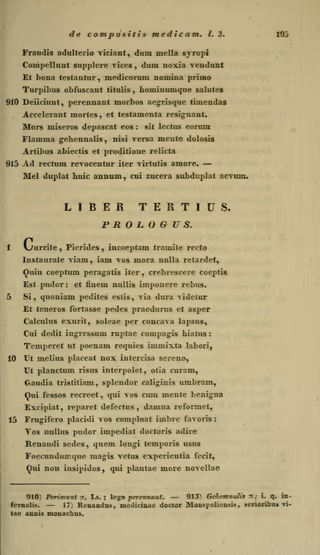
Fraudis adulterio viciant, dum mella syropi
Compellunt supplere vices, dum noxia vendunt
Et bona testantur, medicorum nomina primo
Turpibus obfuscant titulis, hominumque salutes
Deiiciunt, perennant morbos aegrisque timendas
Accelerant mortes, et testamenta resignant.
Mors miseros depascat eos: sit lectus eorum
Flamma gehennalis, nisi versa mente dolosis
Artibus abiectis et proditione relicta
Ad rectum revocentur iter virtutis amore. —
Mel duplat huic annum, cui zucera subduplat aevum.