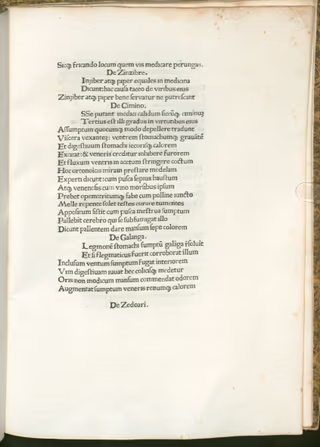
On Galangal.

De Galanga.

Poet
Macer
Form
Hexameter
Open the page in the book
The page this poem fills. Each opens in the De viribus herbarum reader.

Hover or tap a word to see its match.

Taken, galangal resolves an inflammation of the stomach,

and if one should be phlegmatic, it strengthens him.

Taken, it drives away enclosed internal wind,

it aids the digestive power and heals the colicky.

Chewed, it commends the odor of the mouth not a little.

Taken, it augments the heat of Venus and the kidneys.

F Legmonē ſtomachi ſumptū galāga r̄ſoluit

Et ſi flegmaticus fuerit corroborat illum

Incluſum ventum ſumptum fugat interiorem

Vim digeſtiuam iuuat hec coliciſqꝫ medetur

Oris non modicum manſum commendat odorem

Augmentat ſumptum veneris renumqꝫ calorem
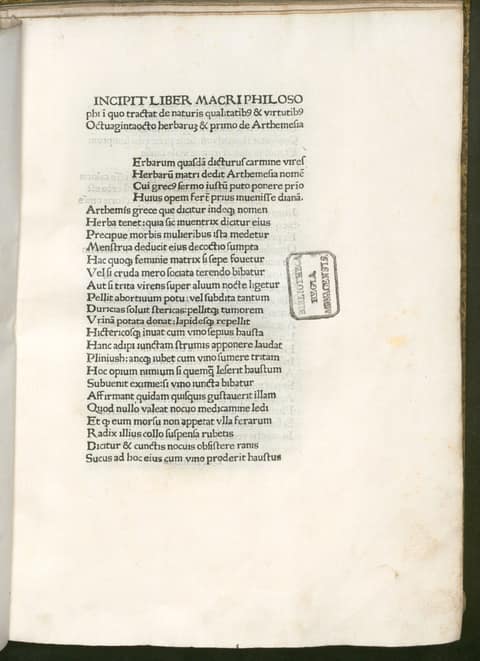
Title page of De viribus herbarum
Title page of De viribus herbarum , 1477

About this text

Provenance

This digital edition is derived from the Bayerische Staatsbibliothek digitization of an early printed edition of De viribus herbarum, the Latin herbal poem traditionally attributed to Macer Floridus or Odo of Meung.

Methodology

Each scan is treated as a page-level unit. The page image remains the authority for the edition. Local Kraken OCR was used as a reading aid, then Gemini generated scan-grounded Latin transcription and English translation from the images, the OCR aid, and the approved glossary. Word links connect the English translation to the Latin transcription and locations on the scans. 95 uncertain word-link decisions remain unlinked. Some links highlight only the text because the source word could not be located on the scan.

Rights

The BSB IIIF manifest declares the digital surrogate under the Public Domain Mark 1.0. Poet Doctor's presentation adds generated OCR, transcription, translation, navigation metadata, and editorial context.

Original scans: Bayerische Staatsbibliothek ( Public Domain Mark 1.0 ).

Historian’s note. This text records the medicine of its own time, and later evidence has replaced most of it. It is not medical advice. We read it as history, and we ask what, if anything, connects it to medicine today. More on how we read old medical books