Hover or tap a word to see its match.
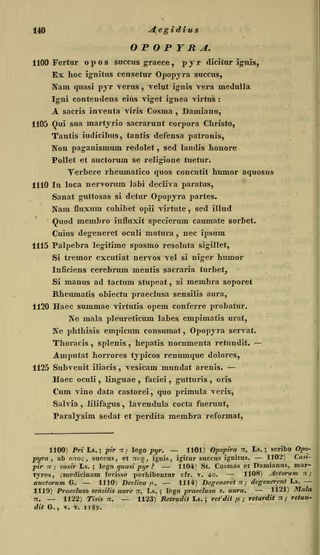
*opos* is said to mean juice in Greek, *pyr* is called fire,
From this Opopyra is reckoned as an ignited juice,
For like a true *pyr*, as if the true marrow of fire,
Its fiery virtue thrives, contending with fire:
Invented by the holy men Cosmas and Damian,
Who consecrated their bodies to Christ in martyrdom,
Defended by such great judges, such great patrons,
It does not reek of paganism, but is strong with the honor
Of praise and protects itself by the religion of its authors.
Those whom a watery humor shakes with a rheumatic scourge,
Ready to slip into the downward places of the nerves,
Opopyra heals the gouty parts if it is given.
For it restrains the flux by the virtue of opium, but that
Which has flowed into the limb it absorbs by the burning heat of the spices.
He whose eye movement degenerates, and the eyelid,
Relaxed by a spasm, does not properly seal it,
If a tremor shakes the nerves, or if a black humor
Infecting the brain disturbs the sanctuaries of the mind,
If the hand is numb to the touch, if the sensory breath,
Shut off by the obstacle of rheum, puts the limbs to sleep,
This is proven to bestow the help of the highest virtue.
Lest the evil ruin of an empyema burn the pleuritic,
Lest phthisis consume the empyemic, Opopyra saves.
It repels the harms of the chest, spleen, and liver. —
It cuts off periodic rigors and pains of the kidneys,
Relieves the iliacs, cleanses the bladder of sands. —
This, given with the wine of castoreum, in which cowslip,
Sage, lilifagus, and lavender have been cooked,
Soothes paralysis of the eye, tongue, face, throat, and mouth,
And restores lost limbs,
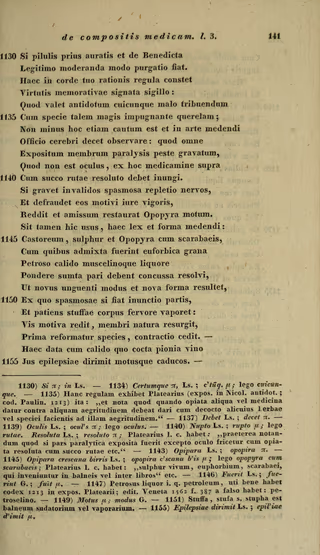
If first a purgation, to be regulated in a legitimate manner,
Should be done with gilded pills and *Benedicta*.
Let this rule of reason stand firm in your heart
Sealed with the seal of the memorative faculty:
That an antidote to be administered for whatever malady is effective
With a spice that more greatly attacks such a complaint;
Not less is this also made cautious and in the art of healing
It is fitting to observe for the office of the brain: that every
Exposed limb weighed down by the plague of paralysis,
Which is not an eye, ought to be anointed above with this medicine
Dissolved with the juice of rue.
If spasmodic repletion weighs down weak nerves,
And cheats them of their rightful motive vigor,
Opopyra returns and restores the lost motion.
Yet let there be this use, this law and form of healing:
Castoreum, sulfur, and Opopyra with scarabs,
With which euphorbia grains have been mixed,
Taken in equal weight, must be shaken and dissolved
In hot rocky and musky liquor,
So that a new measure and new form of ointment results,
From which if an anointing of the spasmodic part be done,
And the patient steams his body with the heat of a sweat-bath:
The motive force returns, the nature of the limb rises again,
The original appearance is reformed, the contraction yields. —
This, given with warm wine in which peony has been boiled,
Breaks the power of epilepsy and falling motions. —
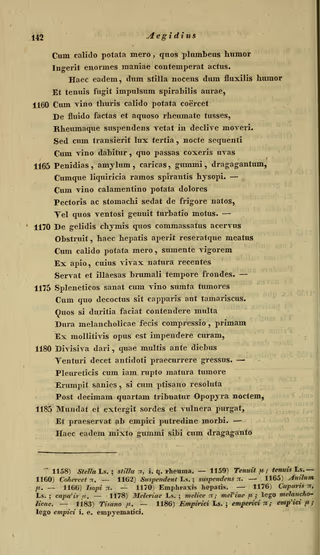
Drunk with warm unmixed wine, it moderates the enormous acts of mania
Which the leaden humor brings on.
This same, while the noxious dripping, while the flowing
And thin humor shuns the impulse of the breathable air,
Drunk with warm frankincense wine restrains
Coughs caused by fluid and watery rheum,
And suspending the rheum forbids it to move downwards.
But when the third day has passed, on the following night
It shall be given with wine, in which you have cooked raisins,
Penidia, starch, figs, gum, tragacanth,
And branches of fragrant hyssop along with licorice. —
Drunk with calamint wine, it soothes pains
Of the chest and stomach born from cold,
Or which the disturbance of windy motion has generated. —
It opens and unseals the passages of the liver
Which a clumped mass of cold humors obstructs,
Drunk with warm unmixed wine, taking its vigor
From celery, whose lively nature preserves its leaves
Fresh and uninjured in the winter time. —
It cures splenetic tumors when taken with wine
With which caper or tamarisk has been boiled down.
But if the hard compression of melancholic dregs
Makes them strive with much hardness, it is necessary
To apply the first care from emollients,
And to give dividing medicines, which it is fitting
To precede the steps of the coming antidote by many days. —
For pleurisy patients, when now, a mature tumor having ruptured,
The sanies bursts forth, if *Opopyra* dissolved with ptisan
Is administered after the fourteenth night,
It cleanses and wipes away the filth and purges the wounds,
And preserves from the putrefaction of the empyematic disease. —
This same, with gum mixed to it along with tragacanth
Formed into moderate spheres, and placed under the tongue
It no less blunts the harms of the same cause.
Let this opinion be fixed in your heart: no
antidote against spiritual causes
must be given without a lenitive medicine mixed in.
Those whom a windy whirlwind agitates with rapid storms,
Or whom a viscous and cold humor aggravates,
it cures the iliacs, consumes the winds and absorbs all
the remnants of the disease firmly adhering to the belly
after many cathartics, by the virtue of its heat,
when taken with the wine of Macedonian parsley
Or of Illyrian iris boiled under a similar weight.
But medical prudence decrees for it first a clyster
which may soften the belly, then secondly
a stronger, more biting one applied from *Benedicta*;
If the origin of the evil cause is devoted to heat
this method of healing will have to be suspended.
With divisives given beforehand, and the sick person placed
in a bath of sweet water, given with the wine of saxifrage
it dissolves the stones enclosed in the prison of the bladder. —
A poultice made from it with *musceleum*
moves difficult urine and forces it to be resolved
if, warm, it surrounds all the parts of the pubis.
With the wine of oak ferns and mercury
it calms colics with the peace of pleasant quiet.
A different effect, a dissonant force, a repugnant cause
forbid laxative drugs to be joined to opiates,
lest the mixture stir up battles in a rebellious belly.
Dissolved with the juice of *strutium* and the liquor of *piganum*
in typical fevers made from glassy phlegm,
Or which the humor of natural phlegm pours forth;
Also, when a patient suffering from true quartans is positioned
And placed over a basket, when drunk it releases
Copious streams of sweat from the sick person's body.
In many other cases *Opopyra* holds sway. —
A seven-year lifespan strengthens it with stable vigor.
Fertur *opos* succus graece, *pyr* dicitur ignis,
Ex hoc ignitus censetur Opopyra succus,
Nam quasi *pyr* verus, velut ignis vera medulla
Igni contendens eius viget ignea virtus:
A sacris inventa viris Cosma, Damiano,
Qui sua martyrio sacrarunt corpora Christo,
Tantis iudicibus, tantis defensa patronis,
Non paganismum redolet, sed laudis honore
Pollet et auctorum se religione tuetur.
Verbere rheumatico quos concutit humor aquosus
In loca nervorum labi decliva paratus,
Sanat guttosas si detur Opopyra partes.
Nam fluxum cohibet opii virtute, sed illud
Quod membro influxit specierum caumate sorbet.
Cuius degeneret oculi motura, nec ipsum
Palpebra legitime spasmo resoluta sigillet,
Si tremor excutiat nervos vel si niger humor
Inficiens cerebrum mentis sacraria turbet,
Si manus ad tactum stupeat, si membra soporet
Rheumatis obiectu praeclusa sensilis aura,
Haec summae virtutis opem conferre probatur.
Ne mala pleureticum labes empimatis urat,
Ne phthisis empicum consumat, Opopyra servat.
Thoracis, splenis, hepatis nocumenta retundit. —
Amputat horrores typicos renumque dolores,
Subvenit iliacis, vesicam mundat arenis. —
Haec oculi, linguae, faciei, gutturis, oris
Cum vino data castorei, quo primula veris,
Salvia, lilifagus, lavendula cocta fuerunt,
Paralysim sedat et perdita membra reformat,
Si pilulis prius auratis et de *Benedicta*
Legitimo moderanda modo purgatio fiat.
Haec in corde tuo rationis regula constet
Virtutis memorativae signata sigillo:
Quod valet antidotum cuicunque malo tribuendum
Cum specie talem magis impugnante querelam;
Non minus hoc etiam cautum est et in arte medendi
Officio cerebri decet observare: quod omne
Expositum membrum paralysis peste gravatum,
Quod non est oculus, ex hoc medicamine supra
Cum succo rutae resoluto debet inungi.
Si gravet invalidos spasmosa repletio nervos,
Et defraudet eos motivi iure vigoris,
Reddit et amissum restaurat Opopyra motum.
Sit tamen hic usus, haec lex et forma medendi:
Castoreum, sulphur et Opopyra cum scarabaeis,
Cum quibus admixta fuerint euforbica grana
Petroso calido muscelinoque liquore
Pondere sumta pari debent concussa resolvi,
Ut novus unguenti modus et nova forma resultet,
Ex quo spasmosae si fiat inunctio partis,
Et patiens stuffae corpus fervore vaporet:
Vis motiva redit, membri natura resurgit,
Prima reformatur species, contractio cedit. —
Haec data cum calido quo cocta pionia vino
Jus epilepsiae dirimit motusque caducos. —
Cum calido potata mero, quos plumbeus humor
Ingerit enormes maniae contemperat actus.
Haec eadem, dum stilla nocens dum fluxilis humor
Et tenuis fugit impulsum spirabilis aurae,
Cum vino thuris calido potata coërcet
De fluido factas et aquoso rheumate tusses,
Rheumaque suspendens vetat in declive moveri.
Sed cum transierit lux tertia, nocte sequenti
Cum vino dabitur, quo passas coxeris uvas
Penidias, amylum, caricas, gummi, dragagantum,
Cumque liquiricia ramos spirantis hysopi. —
Cum vino calamentino potata dolores
Pectoris ac stomachi sedat de frigore natos,
Vel quos ventosi genuit turbatio motus. —
De gelidis chymis quos commassatus acervus
Obstruit, haec hepatis aperit reseratque meatus
Cum calido potata mero, sumente vigorem
Ex apio, cuius vivax natura recentes
Servat et illaesas brumali tempore frondes. —
Spleneticos sanat cum vino sumta tumores
Cum quo decoctus sit capparis aut tamariscus.
Quos si duritia faciat contendere multa
Dura melancholicae fecis compressio, primam
Ex mollitivis opus est impendere curam,
Divisiva dari, quae multis ante diebus
Venturi decet antidoti praecurrere gressus. —
Pleureticis cum iam, rupto matura tumore
Erumpit sanies, si cum ptisano resoluta
Post decimam quartam tribuatur Opopyra noctem,
Mundat et extergit sordes et vulnera purgat,
Et praeservat ab empici putredine morbi. —
Haec eadem mixto gummi sibi cum dragaganto
Per modicos formata globos, submissaque linguae
Non minus eiusdem causae nocumenta retundit.
Fixa sit haec in corde tuo sententia: nullas
Antidotum causas adversum spirituales
Non mixto lenitivo medicamine dandum.
Quos agitat rapidis ventosus turbo procellis,
Aut quos viscosus incrudat et algidus humor,
Iliacos curat, ventos consumit et omnes
Morbi reliquias post multa cathartica ventri
Fortiter haerentes sorbet virtute caloris,
Sumta Macedonii cum vino petrosilli
Aut iris Illyricae simili sub pondere coctae.
Sed sibi clystere prius quod molliat alvum,
Physica decernit prudentia, deinde secundum
Fortius apposita mordacius ex *Benedicta*;
Si causae sit origo mali devota caloris
Suspendendus erit modus iste medendi.
Ante datis divisivis, aegroque locato
Dulcis aquae lavacro, cum saxifragae data vino
Dissolvit lapides vesicae carcere clausos. —
Difficilem movet urinam cogitque resolvi
Ex ipsa cum musceleo factum cataplasma
Si calidum partes pubis superambiat omnes.
Cum vino filicum quercus et mercurialis
Jocundae colicos tranquillat pace quietis.
Discolor effectus, vis dissona, causa repugnans
Laxativa vetat opiatis pharmaca iungi,
Praelia ne ventri moveat mixtura rebelli.
Cum strutii succo piganique soluta liquore
In febribus typicis vitreo de phlegmate factis,
Vel naturalis quas fundat phlegmatis humor;
In veris quoque quartanis patiente locato
Atque super cofinum posito, potata resolvit
Largos sudoris aegri de corpore rivos.
In multis aliis dominatur *Opopyra* causis. —
Firmat eam stabili septennis vita vigore.