Hover or tap a word to see its match.
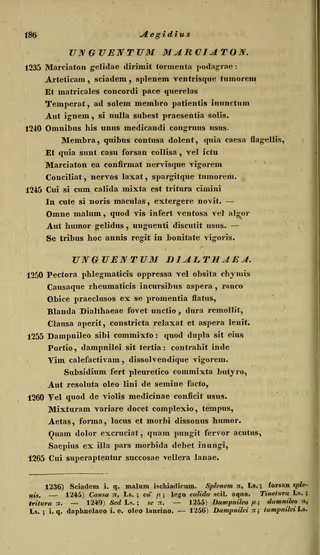
Chests oppressed or beset by phlegmatic humors,
And harsh because of rheumatic attacks, bringing forth from themselves
Breaths shut up by a hoarse barrier,
The soothing anointing of Dialthaea foments, it softens hard things,
Opens closed things, relaxes constricted things, and smooths harsh things.
With Dampnileum mixed into it: such that its portion is double,
And that of Dampnileum is a third: from this it draws
Heating power, and the vigor of dissolving.
Mixed with butter it brings aid to the pleuritic patient,
Or dissolved with oil made from flax seed,
Or [the oil] that the practice of medicine prepares from violets.
Complexion, time, age, shape, location,
And the discordant humor of the disease teach one to vary the mixture.
The sick part which pain torments, which sharp heat stings,
Ought to be anointed more often with it,
And to it should be applied fleeces of juicy wool.
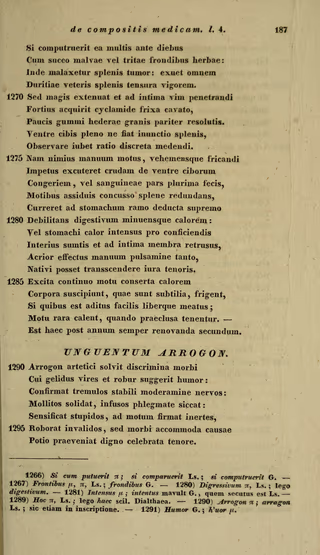
If it has putrefied with it for many days beforehand
With the juice of mallow or the ground leaves of the herb:
Then let the tumor of the spleen be softened: the tension of the spleen
Will strip off all the force of the old hardness.
But it thins it out more and acquires more strongly
The power of penetrating to the inmost parts, having been fried with a hollowed cyclamen,
With a few grains of ivy gum likewise dissolved.
Let the anointing of the spleen not be done with a belly full of food,
A prudent method of healing bids this to be observed.
For the excessive movement of the hands, and the violent
Impulse of rubbing would shake out the raw mass of foods
From the belly, or the greatest part of the bloody dregs,
Overflowing from the spleen shaken by continuous movements,
Would run to the stomach, drawn down by the highest branch,
Weakening and diminishing the digestive heat:
Or the intense heat of the stomach for concocting
What has been taken inward, and thrust back to the innermost limbs,
Made sharper by such beating of the hands,
Could overstep the laws of its native condition.
Dense bodies, excited by continuous movement,
Receive heat, those which are subtle, grow cold,
If for them the approach is easy and the passage free;
Rare things grow warm by motion, when they are held closed off. —
This is always to be renewed after the second year.
Pectora phlegmaticis oppressa vel obsita chymis
Causaque rheumaticis incursibus aspera, rauco
Obice praeclusos ex se promentia flatus,
Blanda Dialthaeae fovet unctio, dura remollit,
Clausa aperit, constricta relaxat et aspera lenit.
Dampnileo sibi commixto: quod dupla sit eius
Portio, dampnilei sit tertia: contrahit inde
Vim calefactivam, dissolvendique vigorem.
Subsidium fert pleuretico commixta butyro,
Aut resoluta oleo lini de semine facto,
Vel quod de violis medicinae conficit usus.
Mixturam variare docet complexio, tempus,
Aetas, forma, locus et morbi dissonus humor.
Quam dolor excruciat, quam pungit fervor acutus,
Saepius ex illa pars morbida debet inungi,
Cui superaptentur succosae vellera lanae.
Si computruerit ea multis ante diebus
Cum succo malvae vel tritae frondibus herbae:
Inde malaxetur splenis tumor: exuet omnem
Duritiae veteris splenis tensura vigorem.
Sed magis extenuat et ad intima vim penetrandi
Fortius acquirit cyclamide frixa cavato,
Paucis gummi hederae granis pariter resolutis.
Ventre cibis pleno ne fiat inunctio splenis,
Observare iubet ratio discreta medendi.
Nam nimius manuum motus, vehemensque fricandi
Impetus excuteret crudam de ventre ciborum
Congeriem, vel sanguineae pars plurima fecis,
Motibus assiduis concusso splene redundans,
Curreret ad stomachum ramo deducta supremo
Debilitans digestivum minuensque calorem:
Vel stomachi calor intensus pro conficiendis
Interius sumtis et ad intima membra retrusus,
Acrior effectus manuum pulsamine tanto,
Nativi posset transscendere iura tenoris.
Excita continuo motu conserta calorem
Corpora suscipiunt, quae sunt subtilia, frigent,
Si quibus est aditus facilis liberque meatus;
Motu rara calent, quando praeclusa tenentur. —
Est haec post annum semper renovanda secundum.