Hover or tap a word to see its match.
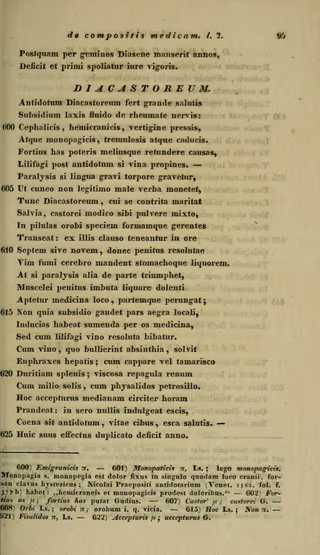
The antidote *Diacastoreum* brings a great aid of health
To nerves relaxed by fluid rheum:
To the cephalic, the hemicranic, those oppressed by vertigo,
And the monopagic, the trembling, and the epileptic.
You will be able to beat back these causes more strongly and better,
If you administer wines of sage after the antidote. —
If the tongue is weighed down by the heavy torpor of paralysis,
So that, as with an improper die, it coins words poorly,
Then let *Diacastoreum*, to which bruised sage weds itself,
With a moderate powder of castoreum mixed in,
Pass into pills bearing the appearance and shape of the bitter vetch:
Let seven or nine of these be held in the closed mouth,
Until, entirely dissolved,
They send the force of their vapor to the brain and their liquor to the stomach.
But if paralysis triumphs in another part,
Let the medicine, entirely imbued with the liquor of *musceleum*,
Be applied to the painful place, and let it anoint the part;
Not because the sick part rejoices in a local aid,
Should the medicine to be taken by mouth have a respite,
But let it be drunk dissolved with wine of sage.
With wine in which wormwood has boiled, it resolves
The *enphraxes* of the liver; with caper or tamarisk
The hardness of the spleen; the viscous blockages of the kidneys
With gromwell, with *physalis*, with rock-parsley.
The one about to take this should dine around the middle hour:
In the evening let him indulge in no foods,
Let the antidote be his supper, the food of life, the morsel of health. —
Its effect fails in its doubled year.
Antidotum Diacastoreum fert grande salutis
Subsidium laxis fluido de rheumate nervis:
Cephalicis, hemicranicis, vertigine pressis,
Atque monopagicis, tremulosis atque caducis.
Fortius has poteris meliusque retundere causas,
Lilifagi post antidotum si vina propines. —
Paralysis si lingua gravi torpore gravetur,
Ut cuneo non legitimo male verba monetet,
Tunc Diacastoreum, cui se contrita maritat
Salvia, castorei modico sibi pulvere mixto,
In pilulas orobi speciem formamque gerentes
Transeat: ex illis clauso teneantur in ore
Septem sive novem, donec penitus resolutae
Vim fumi cerebro mandent stomachoque liquorem.
At si paralysis alia de parte triumphet,
Muscelei penitus imbuta liquore dolenti
Aptetur medicina loco, partemque perungat;
Non quia subsidio gaudet pars aegra locali,
Inducias habeat sumenda per os medicina,
Sed cum lilifagi vino resoluta bibatur.
Cum vino, quo bullierint absinthia, solvit
Enphraxes hepatis; cum cappare vel tamarisco
Duritiam splenis; viscosa repagula renum
Cum milio solis, cum physalidos petrosillo.
Hoc accepturus medianam circiter horam
Prandeat: in sero nullis indulgeat escis,
Coena sit antidotum, vitae cibus, esca salutis. —
Huic suus effectus duplicato deficit anno.