Hover or tap a word to see its match.
From diacastoreum pills dissolved in wine
Or in warm juice of cabbage or liquor of rue
Injected into the nostrils, the sensory power implanted in the nerves,
Having lapsed, is restored; the pain of the brain is relieved,
And heavy, stupid lethargy and dizziness are put to flight.
When the gums are suffused with acrid rheum, when the teeth
Are pressed by a similar cause, their
Integrity is restored, and the heavy pressure of the eyelid is relieved.
They unseal the optic passages and purge the eyes. —
The species of pepper is suitable for these, its sharpness compensates
For the smallness of the form and the small number of the dose,
You will give three or one, varying according to the strength of the sick person.
Let the patient sit in a bath or right next to the fire,
So that the internal heat, aided by the external
might more promptly be able to dissolve the humor of the brain.
Once the pills have been instilled, let the sick person compress his nostrils;
shut in for a brief delay, the virtue of the medicine
is introduced into the humors, grows warm, and having grown warm it resolves them;
here the diligent compression of the nostril provides for another thing,
lest he breathe out quickly, the medicine being retained by the held breath.
With the nostrils exposed and the mouth immediately opened,
with the head bent down, let him loosen the reins for the dissolved matters:
lest, if the patient should keep himself in an upright posture, the rheumatic humor
should flow with a rapid fall to the vital organs
and an obstruction of the heart occur, the messenger of death.
Associated with oil of roses, a decoction of mallow
tempers the burning of the nostril contracted from the pills.
This medicine is more wholesome for melancholics,
for whom the substance of the brain is hard, cold, *fat*.
But for those whose crasis of the brain is humid, whose *humor* is fluid
and exceedingly thin, or whose force of heat is intense,
to such people I truly do not advise that these pills be given:
they inflame a hot brain, and dissolve a liquid one.
To those whom a cold drop, depriving them of sensation, paralyzes,
let nine be given by mouth: let discretion weigh the number,
but I know that by their biting sharpness they harm the internal organs,
they excoriate the stomach, and torture the modest parts with burning. —
In the *diacastoreum* pills for two years
the unblemished force and full virtue can endure.
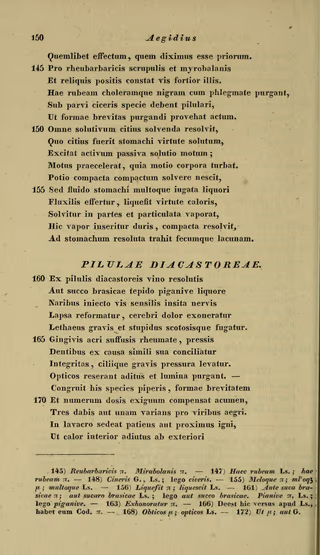
Ex pilulis diacastoreis vino resolutis
Aut succo brasicae tepido piganive liquore
Naribus iniecto vis sensilis insita nervis
Lapsa reformatur, cerebri dolor exoneratur
Lethaeus gravis et stupidus scotosisque fugatur.
Gingivis acri suffusis rheumate, pressis
Dentibus ex causa simili sua conciliatur
Integritas, ciliique gravis pressura levatur.
Opticos reserant aditus et lumina purgant. —
Congruit his species piperis, formae brevitatem
Et numerum dosis exiguum compensat acumen,
Tres dabis aut unam varians pro viribus aegri.
In lavacro sedeat patiens aut proximus igni,
Ut calor interior adiutus ab exteriori
Promtius humorem cerebri dissolvere possit.
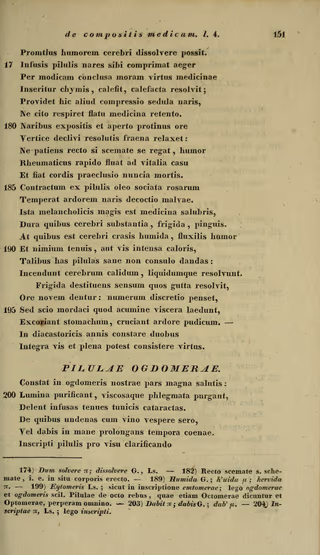
Infusis pilulis nares sibi comprimat aeger
Per modicam conclusa moram virtus medicinae
Inseritur chymis, calefit, calefacta resolvit;
Providet hic aliud compressio sedula naris,
Ne cito respiret flatu medicina retento.
Naribus expositis et aperto protinus ore
Vertice declivi resolutis fraena relaxet:
Ne patiens recto si scemate se regat, humor
Rheumaticus rapido fluat ad vitalia casu
Et fiat cordis praeclusio nuncia mortis.
Contractum ex pilulis oleo sociata rosarum
Temperat ardorem naris decoctio malvae.
Ista melancholicis magis est medicina salubris,
Dura quibus cerebri substantia, frigida, pinguis.
At quibus est cerebri crasis humida, fluxilis humor
Et nimium tenuis, aut vis intensa caloris,
Talibus has pilulas sane non consulo dandas:
Incendunt cerebrum calidum, liquidumque resolvunt.
Frigida destituens sensum quos gutta resolvit,
Ore novem dentur: numerum discretio penset,
Sed scio mordaci quod acumine viscera laedunt,
Excoriant stomachum, cruciant ardore pudicum. —
In diacastoricis annis constare duobus
Integra vis et plena potest consistere virtus.