Hover or tap a word to see its match.
By pills before a meal, all anathymia is dissolved,
The belly is loosened, the digestive force is aided,
If they are given at their proper hours according to the law of their custom;
Emphraxis of the liver and a swollen mass of the spleen,
A stain of rancor rooted out from the descending pores
Extirpated outwardly flees from the genial regions;
They purge the spleen, heart, liver, head, flanks, kidney,
The loins, the rectum, and the puerperal chamber.
In order that evils, which are feared to come, may be prevented,
let them be given before food, to one whose limbs are filled with bad
and harmful humors, for purging the lowest parts. —
He whom *tusis* afflicts, because, being full, he rejects what he has consumed,
thus badly disposed needs to be given pills before food,
so that the innate heat may be better able to be restored,
so that the stomach may be strengthened and a better concoction
of the humors may be prepared, the dregs of bad things having been purged.
For food thrust in, unless a suitable use of medicine
precedes it, will produce the kindling of ruin,
it will stand as a sluggish weight, nor will the bottom of the stomach attract it
to itself, it will not be of use, but will become a burden.
The peptic virtue will falter and the action
of nature will degenerate, presaging a future plague,
thence much pain, swelling, upset, belching,
nausea, hiccup, twisting of the belly, uproar.
For the hidden heat, buried by a doubled mass,
will not bear the assaults, unless it is supported by medicine. —
But he who will be healthy, whom no plethora strikes
nor suspected cacochymia burdens, if his belly
turns out to be constipated, requires pills after meals,
so that after nature has completed her actions,
and has digested the mass of food in a certain order,
separating the fiery from the earthy, the moist from the dry,
the light things of nature from the heavy, the subtle from the gross,
a soothing and friendly loosening of the belly may be able to follow.
With the ferment of feces later retained by constipation,
a deadly pain of the stomach is born from the scybala
and scotosis and an acute pain of the head arise,
to which heat rolling back into the brain adds strength.
A short form, lightness of virtue, soothing action
demands that the number be increased: you should administer five
Adding thirty, according to the strength of the recipient,
increasing or decreasing; experience makes one learned,
and the rule of reason weighs the number of the *crasis*.
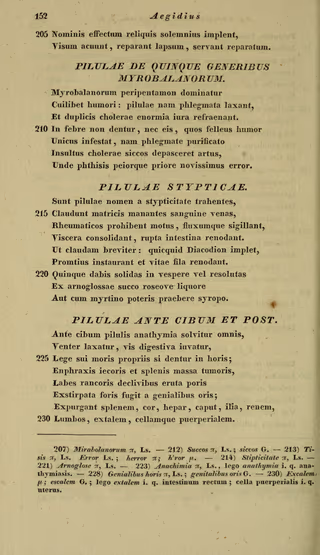
Ante cibum pilulis anathymia solvitur omnis,
Venter laxatur, vis digestiva iuvatur,
Lege sui moris propriis si dentur in horis;
Enphraxis iecoris et splenis massa tumoris,
Labes rancoris declivibus eruta poris
Exstirpata foris fugit a genialibus oris;
Expurgant splenem, cor, hepar, caput, ilia, renem,
Lumbos, extalem, cellamque puerperialem.
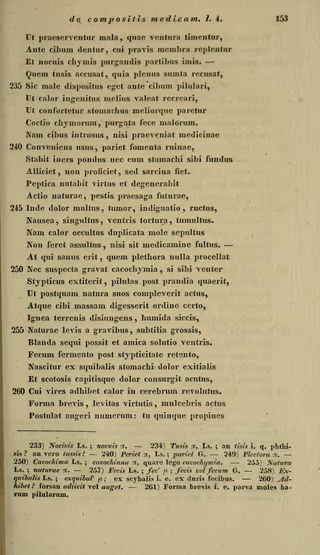
Ut praeserventur mala, quae ventura timentur,
Ante cibum dentur, cui pravis membra replentur
Et nocuis chymis purgandis partibus imis. —
Quem tusis accusat, quia plenus sumta recusat,
Sic male dispositus eget ante cibum pilulari,
Ut calor ingenitus melius valeat recreari,
Ut confortetur stomachus meliorque paretur
Coctio chymorum, purgata fece malorum.
Nam cibus intrusus, nisi praeveniat medicinae
Conveniens usus, pariet fomenta ruinae,
Stabit iners pondus nec eum stomachi sibi fundus
Alliciet, non proficiet, sed sarcina fiet.
Peptica nutabit virtus et degenerabit
Actio naturae, pestis praesaga futurae,
Inde dolor multus, tumor, indignatio, ructus,
Nausea, singultus, ventris tortura, tumultus.
Nam calor occultus duplicata mole sepultus
Non feret assultus, nisi sit medicamine fultus. —
At qui sanus erit, quem plethora nulla procellat
Nec suspecta gravat cacochymia, si sibi venter
Stypticus extiterit, pilulas post prandia quaerit,
Ut postquam natura suos compleverit actus,
Atque cibi massam digesserit ordine certo,
Ignea terrenis disiungens, humida siccis,
Naturae levis a gravibus, subtilia grossis,
Blanda sequi possit et amica solutio ventris.
Fecum fermento post stypticitate retento,
Nascitur ex squibalis stomachi dolor exitialis
Et scotosis capitisque dolor consurgit acutus,
Cui vires adhibet calor in cerebrum revolutus.
Forma brevis, levitas virtutis, mulcebris actus
Postulat augeri numerum: tu quinque propines
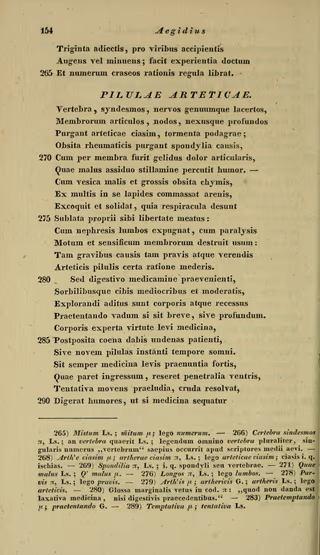
Triginta adiectis, pro viribus accipientis
Augens vel minuens; facit experientia doctum
Et numerum craseos rationis regula librat.