Hover or tap a word to see its match.
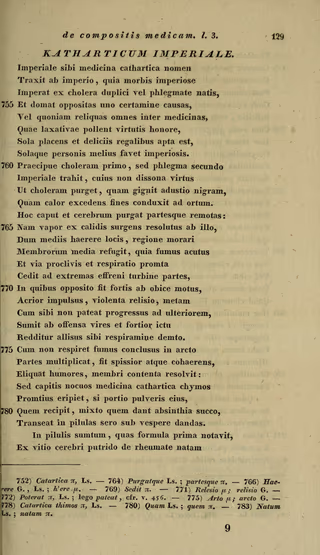
The cathartic medicine *Imperiale* drew its name
from empire, because it imperiously rules
over diseases born from double cholera or phlegm,
And subdues opposing causes in a single contest,
Or because among all the other medicines,
Which are strong with the honor of laxative virtue,
It alone is pleasing and suited to royal delights,
And it alone better favors imperious persons.
Above all, *Imperiale* draws out cholera first, but phlegm secondly,
Whose virtue is not discordant
So that it purges the black cholera, which burning engenders,
Which heat exceeding its limits has brought to birth.
This purges the head and the brain and the remote parts:
For the vapor rising from hot things, released by it,
While it avoids sticking in the middle places, lingering in the middle region
Of the limbs, because the sharp smoke
And the downward path and the ready exhalation
Proceeds to the outermost parts in an unbridled whirlwind,
In which a strong motion occurs from the opposed obstacle,
A sharper impulse, a violent rebounding,
Since progress to a further boundary does not lie open to it,
It takes strength from the collision and, striking against itself,
Is rendered stronger by the blow, with respiration removed.
When the smoke, enclosed in a narrow space, does not escape,
It multiplies its parts, becomes thicker and cohesive,
Melts the humors, and loosens the contents of the member:
But the cathartic medicine will more promptly snatch away
the harmful humors of the head, if a portion of its powder,
Which it receives, mixed with the juice which wormwood gives,
Should be made into pills to be given late in the evening.
Taken in pills, which the first formula noted,
Born from the putrid rheum from a defect of the brain
It purges the stain of foul odor from a corrupted mouth.
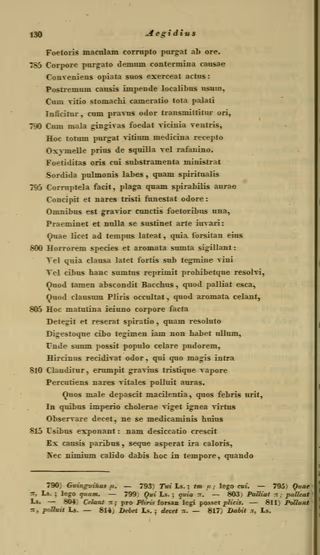
Once the body is purged, let a suitable opiate bordering on the cause
finally exercise its actions:
lastly, devote its use to local causes,
when the entire vault of the palate is infected by a defect of the stomach,
when a foul odor is transmitted to the mouth,
when the bad proximity of the belly pollutes the gums,
the medicine purges this entire defect, once an oxymel
of squill or radish has first been taken.
The foulness of the mouth, for which a sordid affliction of the lungs
supplies the foundation, which the corruption of the breath
causes, which the injury of the breathable air
contracts and defiles the nostrils with a foul odor:
this alone is heavier than all stenches,
it is prominent and cannot bear to be helped by any art:
Although it may lie hidden for a time, because perhaps
consumed spices and aromatics seal up its horror:
or because it lies hidden enclosed under the cover of strong wine,
or consumed food represses it and prevents it from being released,
yet what Bacchus hides, what food conceals,
what the enclosed *Pliris* hides, what aromatics conceal,
this a morning exhalation, made when the body is fasting,
uncovers and unlocks, which, once the food is dissolved
and digested, no longer has any covering,
by which it can conceal its shame from the people,
the goat-like odor returns, which the more it is enclosed
within, the more heavily it breaks out and with a sad vapor
striking the nostrils it pollutes the vital airs.
Those whom emaciation wickedly consumes, those whom fever burns,
in whom the fiery power thrives by the rule of choler,
must take care not to expose themselves to the uses
of this medicine: for desiccation increases
from equal causes, and the rage of the heat exacerbates itself,
nor will you give this in a time that is too warm, when
Hot air dissolves the humors of the body.
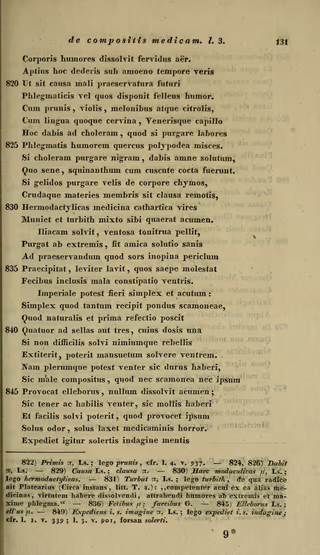
You will give this more aptly during the pleasant time of spring,
So that it may be a preventative cause against future illness
For the phlegmatic, or those whom bilious humor disposes.
With plums, violets, melons and citrons,
With hart's tongue also, and maidenhair
You will give this for choler, but if you strive to purge
The humor of phlegm, you mix in oak polypody.
If to purge black choler, you will give it dissolved in water
In which senna, squinanth with dodder have been boiled.
If you wish to purge cold humors from the body,
And the raw matter is enclosed in remote limbs,
The cathartic medicine will fortify the hermodactyl powers
And, with turbith mixed in, let it seek sharpness for itself.
It resolves the iliac passion, drives away windy thunders,
Purges from the extremities, the loosening becomes friendly to the healthy
For preserving against the peril that unexpected fate
Casts down, it lightly washes those whom bad constipation of the belly
Often troubles, with feces enclosed.
Imperiale can be made simple and acute:
Simple, which receives only such a weight of scammony,
As the natural and first restoration demands
For four or three stools, one dose of which,
If it has not been difficult to loosen and too rebellious,
Will be able to loosen a tame belly.
For often the belly can be held so hard,
So badly disposed, that neither scammony nor
Hellebore provokes it, and no sharpness dissolves it;
So tender and manageable can the belly be held, so soft
And easy to loosen, that the mere odor provokes it,
The mere horror of the medicine relaxes it.
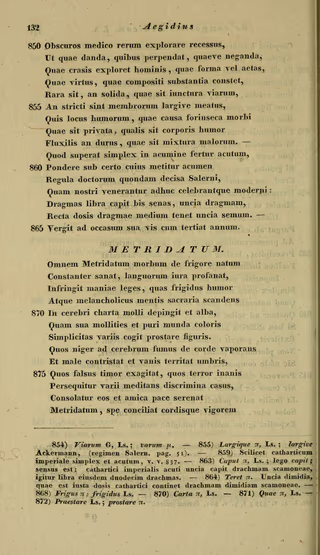
It will therefore be expedient, with the investigation of a skillful mind,
For a physician to explore the obscure recesses of things,
So that he may consider what things are to be given, to whom, or what things are to be denied,
So that he may explore what the crasis of the person is, what form or age,
What virtue, what the substance of the compound consists of,
Whether it is porous or solid, what the joining of the pathways is,
Whether the passages of the limbs are narrow or wide,
What the place of the humors is, what the extrinsic cause of the disease
What the private one is, of what sort the humor of the body is,
Whether flowing or hard, what the mixture of evils is.
That which surpasses the simple in sharpness is called acute,
Whose sharpness is measured under a certain weight
By the rule of the doctors formerly decided at Salerno,
Which our modern ones still venerate and celebrate:
A pound takes twice six drams, an ounce a dram,
A proper dose of a half-ounce holds half a dram.
Its power verges toward its decline when it reaches its third year.
Imperiale sibi medicina cathartica nomen
Traxit ab imperio, quia morbis imperiose
Imperat ex cholera duplici vel phlegmate natis,
Et domat oppositas uno certamine causas,
Vel quoniam reliquas omnes inter medicinas,
Quae laxativae pollent virtutis honore,
Sola placens et deliciis regalibus apta est,
Solaque personis melius favet imperiosis.
Praecipue choleram primo, sed phlegma secundo
Imperiale trahit, cuius non dissona virtus
Ut choleram purget, quam gignit adustio nigram,
Quam calor excedens fines conduxit ad ortum.
Hoc caput et cerebrum purgat partesque remotas:
Nam vapor ex calidis surgens resolutus ab illo,
Dum mediis haerere locis, regione morari
Membrorum media refugit, quia fumus acutus
Et via proclivis et respiratio promta
Cedit ad extremas effreni turbine partes,
In quibus opposito fit fortis ab obice motus,
Acrior impulsus, violenta relisio, metam
Cum sibi non pateat progressus ad ulteriorem,
Sumit ab offensa vires et fortior ictu
Redditur allisus sibi respiramine demto.
Cum non respiret fumus conclusus in arcto
Partes multiplicat, fit spissior atque cohaerens,
Eliquat humores, membri contenta resolvit:
Sed capitis nocuos medicina cathartica chymos
Promtius eripiet, si portio pulveris eius,
Quem recipit, mixto quem dant absinthia succo,
Transeat in pilulas sero sub vespere dandas.
In pilulis sumtum, quas formula prima notavit,
Ex vitio cerebri putrido de rheumate natam
Foetoris maculam corrupto purgat ab ore.
Corpore purgato demum contermina causae
Conveniens opiata suos exerceat actus:
Postremum causis impende localibus usum,
Cum vitio stomachi cameratio tota palati
Inficitur, cum pravus odor transmittitur ori,
Cum mala gingivas foedat vicinia ventris,
Hoc totum purgat vitium medicina recepto
Oxymelle prius de squilla vel rafanino.
Foetiditas oris cui substramenta ministrat
Sordida pulmonis labes, quam spiritualis
Corruptela facit, plaga quam spirabilis aurae
Concipit et nares tristi funestat odore:
Omnibus est gravior cunctis foetoribus una,
Praeminet et nulla se sustinet arte iuvari:
Quae licet ad tempus lateat, quia forsitan eius
Horrorem species et aromata sumta sigillant:
Vel quia clausa latet fortis sub tegmine vini
Vel cibus hanc sumtus reprimit prohibetque resolvi,
Quod tamen abscondit Bacchus, quod palliat esca,
Quod clausum Pliris occultat, quod aromata celant,
Hoc matutina ieiuno corpore facta
Detegit et reserat spiratio, quam resoluto
Digestoque cibo tegimen iam non habet ullum,
Unde suum possit populo celare pudorem,
Hircinus recidivat odor, qui quo magis intra
Clauditur, erumpit gravius tristique vapore
Percutiens nares vitales polluit auras.
Quos male depascit macilentia, quos febris urit,
In quibus imperio cholerae viget ignea virtus
Observare decet, ne se medicaminis huius
Usibus exponant: nam desiccatio crescit
Ex causis paribus, seque asperat ira caloris,
Nec nimium calido dabis hoc in tempore, quando
Corporis humores dissolvit fervidus aër.
Aptius hoc dederis sub amoeno tempore veris
Ut sit causa mali praeservatura futuri
Phlegmaticis vel quos disponit felleus humor.
Cum prunis, violis, melonibus atque citrolis,
Cum lingua quoque cervina, Venerisque capillo
Hoc dabis ad choleram, quod si purgare labores
Phlegmatis humorem quercus polypodea misces.
Si choleram purgare nigram, dabis amne solutum,
Quo sene, squinanthum cum cuscute cocta fuerunt.
Si gelidos purgare velis de corpore chymos,
Crudaque materies membris sit clausa remotis,
Hermodactylicas medicina cathartica vires
Muniet et turbith mixto sibi quaerat acumen.
Iliacam solvit, ventosa tonitrua pellit,
Purgat ab extremis, fit amica solutio sanis
Ad praeservandum quod sors inopina periclum
Praecipitat, leviter lavit, quos saepe molestat
Fecibus inclusis mala constipatio ventris.
Imperiale potest fieri simplex et acutum:
Simplex quod tantum recipit pondus scamoneae,
Quod naturalis et prima refectio poscit
Quatuor ad sellas aut tres, cuius dosis una
Si non difficilis solvi nimiumque rebellis
Extiterit, poterit mansuetum solvere ventrem.
Nam plerumque potest venter sic durus haberi,
Sic male compositus, quod nec scamonea nec ipsum
Provocat elleborus, nullum dissolvit acumen;
Sic tener ac habilis venter, sic mollis haberi
Et facilis solvi poterit, quod provocet ipsum
Solus odor, solus laxet medicaminis horror.
Expediet igitur solertis indagine mentis
Obscuros medico rerum explorare recessus,
Ut quae danda, quibus perpendat, quaeve neganda,
Quae crasis exploret hominis, quae forma vel aetas,
Quae virtus, quae compositi substantia constet,
Rara sit, an solida, quae sit iunctura viarum,
An stricti sint membrorum largive meatus,
Quis locus humorum, quae causa forinseca morbi
Quae sit privata, qualis sit corporis humor
Fluxilis an durus, quae sit mixtura malorum.
Quod superat simplex in acumine fertur acutum,
Pondere sub certo cuius metitur acumen
Regula doctorum quondam decisa Salerni,
Quam nostri venerantur adhuc celebrantque moderni:
Dragmas libra capit bis senas, uncia dragmam,
Recta dosis dragmae medium tenet uncia semum.
Vergit ad occasum sua vis cum tertiat annum.