Hover or tap a word to see its match.
From the lower as well as the upper region of the body
The *Patriarcha* draws phlegm first, and choler second. —
Those whom the heat of tertian fever torments, when bilious humor
Ready for exit, it floats at the uppermost mouth of the stomach;
Those whom burdensome cacochymia oppresses, whom nausea vexes,
Those whom the evil unifier of the faculty of the limbs,
The force of anorexia, forces to waste away gradually,
These the *Vomitus Patriarchae* helps and relieves and purges from both hinges,
Purifying the harmful things of the stomach.
Let it be given as a drink in the morning, when, as the breezes
Of the past night grow thin, the moisture of the air,
Unboiled by the solar rays, sweats out and is attenuated,
When the sun, previously blushing, strips off its boyish years,
Retaining no marks of a bashful countenance,
But brightens the face of the world with the splendor of a smile;
Then heat ascends, and as the stimulus of heat compels,
Then the hot humor, suitable to be purged, boils. —
Digestives given beforehand to the sick person resolve raw things,
They prepare the resolved things for vomiting, while they relax hard things;
Let the chest be fomented with mallows boiled in hydroleum,
And from *Dialthaea* which is mixed with butter,
Let an inunction be made, so that an easier vomit may follow.
Let bear's breech, fenugreek with flax, and mallow be boiled;
Let a vigorous pounding mix the fat of a pig into the decoctions,
So that the mixed parts may unite through every single thing:
This mixture, having suffered the light heat of a frying pan,
Expands the thorax, added in the manner of a poultice,
And makes it so that the vomit happens easily without labor. —
Let it be given with hot water: for a cold mixture, by weighing down,
Compresses and draws the motion of the vomit towards the lower parts.
The strained liquid is given to the delicate, the substance to the robust. —
Perhaps you might investigate, why does greater care
Prevail in vomits? Because such a purgation
Has more danger and labor attached to it.
In vomits there are two motions: downward and upward,
Widely opposed, contrary, and exceedingly rebellious.
For the humor is drawn downward by its own gravity,
[and] is snatched upward from the center by the force of the medicine:
With opposing motions struggling against each other, there threatens
a very great disturbance of nature, [which] for those not well cautioned
too often mixes in the hazards of a horrendous death.
Hence the faith of the art, the Hippocratic sanction, the eulogy
of life, the method of nature, the rule of truth
orders to keep consumptive patients away from vomiting medicines,
and those whom a melancholic and leaden humor afflicts,
those in whom the tight thorax, freely following the vertebrae
of the spine, confines the lung in narrow embraces,
those whom emaciation wastes away too greatly, whose limbs are softened by
*synthesis*, asthmatics, whom an importunate
affection of the lung urges with complaints and panting coughs;
A discreet system of healing abstains those thus disposed
from vomiting, lest the dissonant and repugnant motion,
beating the precordia with opposing blows,
should rupture the vital veins, with the diaphragm being injured.
But if a vigorous cause, ignorant of being held by law,
compels such bodies to be purged through vomiting,
which the order of previously learned moderation teaches:
a more cautious and far more vigilant zeal must be applied,
having more art, which may temper all the labor
and diminish and redeem it by its lightness. —
If the whole substance of the Vomit is given, a twelfth part
of a pound makes the dose; if you administer the strainings,
a sixth makes it. The Patriarch lasts for twin years.
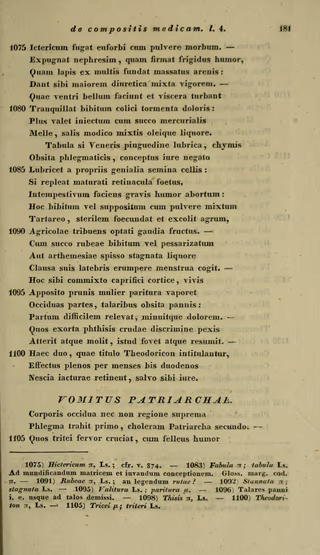
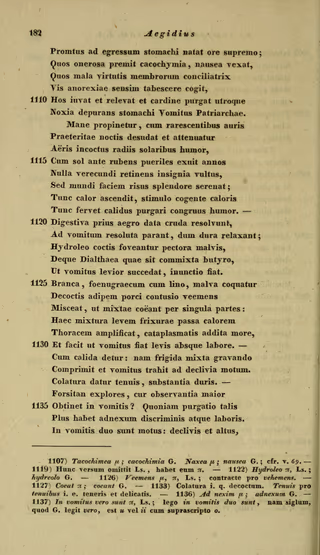
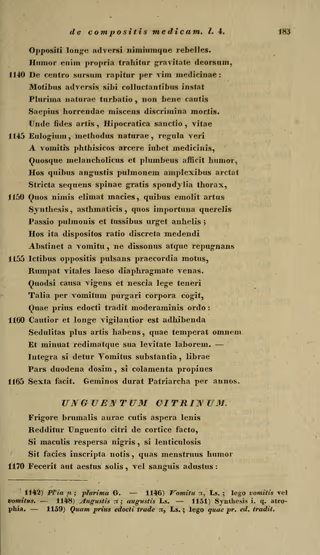
Corporis occidua nec non regione suprema
Phlegma trahit primo, choleram Patriarcha secundo. —
Quos tritei fervor cruciat, cum felleus humor
Promtus ad egressum stomachi natat ore supremo;
Quos onerosa premit cacochymia, nausea vexat,
Quos mala virtutis membrorum conciliatrix
Vis anorexiae sensim tabescere cogit,
Hos iuvat et relevat et cardine purgat utroque
Noxia depurans stomachi Vomitus Patriarchae.
Mane propinetur, cum rarescentibus auris
Praeteritae noctis desudat et attenuatur
Aëris incoctus radiis solaribus humor,
Cum sol ante rubens pueriles exuit annos
Nulla verecundi retinens insignia vultus,
Sed mundi faciem risus splendore serenat;
Tunc calor ascendit, stimulo cogente caloris
Tunc fervet calidus purgari congruus humor. —
Digestiva prius aegro data cruda resolvunt,
Ad vomitum resoluta parant, dum dura relaxant;
Hydroleo coctis foveantur pectora malvis,
Deque Dialthaea quae sit commixta butyro,
Ut vomitus levior succedat, inunctio fiat.
Branca, foenugraecum cum lino, malva coquatur
Decoctis adipem porci contusio veemens
Misceat, ut mixtae coëant per singula partes:
Haec mixtura levem frixurae passa calorem
Thoracem amplificat, cataplasmatis addita more,
Et facit ut vomitus fiat levis absque labore. —
Cum calida detur: nam frigida mixta gravando
Comprimit et vomitus trahit ad declivia motum.
Colatura datur tenuis, substantia duris. —
Forsitan explores, cur observantia maior
Obtinet in vomitis? Quoniam purgatio talis
Plus habet adnexum discriminis atque laboris.
In vomitis duo sunt motus: declivis et altus,
Oppositi longe adversi nimiumque rebelles.
Humor enim propria trahitur gravitate deorsum,
De centro sursum rapitur per vim medicinae:
Motibus adversis sibi colluctantibus instat
Plurima naturae turbatio, non bene cautis
Saepius horrendae miscens discrimina mortis.
Unde fides artis, Hipocratica sanctio, vitae
Eulogium, methodus naturae, regula veri
A vomitis phthisicos arcere iubet medicinis,
Quosque melancholicus et plumbeus afficit humor,
Hos quibus angustis pulmonem amplexibus arctat
Stricta sequens spinae gratis spondylia thorax,
Quos nimis elimat macies, quibus emolit artus
Synthesis, asthmaticis, quos importuna querelis
Passio pulmonis et tussibus urget anhelis;
Hos ita dispositos ratio discreta medendi
Abstinet a vomitu, ne dissonus atque repugnans
Ictibus oppositis pulsans praecordia motus,
Rumpat vitales laeso diaphragmate venas.
Quodsi causa vigens et nescia lege teneri
Talia per vomitum purgari corpora cogit,
Quae prius edocti tradit moderaminis ordo:
Cautior et longe vigilantior est adhibenda
Sedulitas plus artis habens, quae temperat omnem
Et minuat redimatque sua levitate laborem. —
Integra si detur Vomitus substantia, librae
Pars duodena dosim, si colamenta propines
Sexta facit. Geminos durat Patriarcha per annos.