
Hover or tap a word to see its match.
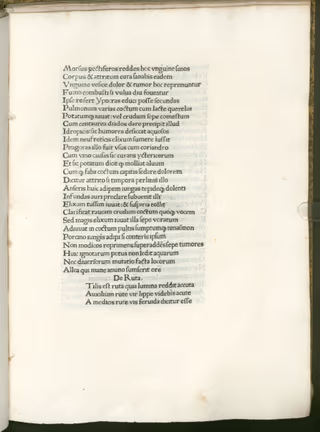
Rue is useful because it renders the eyes sharp.
Bleary-eyed man, you will see the help of rue acutely.
The power of rue is said by physicians to be hot.
And its degree of dryness among these is said to be the third.
It is very useful to the stomach if it is drunk often.
It expels the fetus by a drink, and restrains lust.
Drunk, it suppresses a cough and also purges the menses.
If you cook this in water to which you have added sour wine,
its decoction suppresses gripings of the belly.
It helps the lungs and the chest to be sound, and cures the disease
which the Attic tongue calls pleurisy.
It helps arthritics and sciatica, and cures fever,
drunk, or if you cook it green in oil
and foment with the warm oil before the patient's tremor.
This ointment benefits the womb and a tumor of the intestine,
or if it is poured inside by a clyster;
and drunk with wine it will be able to benefit both.
Decocted and drunk with oil, it repels worms.
Decocted for a long time with fig and the liquor of wine,
let the dried fig be joined to rue and cooked in wine;
it will benefit the dropsical if it is applied at night.
Eaten fresh and raw, it purges the eyes of darkness,
and better when mixed with juice of fennel and gall of a rooster,
and with honey, if its juice is joined in equal measure,
and the eyes of the patient are often anointed with it.
Mixing it with rose oil and also with vinegar,
its juice can cure the pain of the head,
however immoderate, you will be able to cure it by often anointing with this.
If its expressed juice is poured into the nostrils,
it stops flowing blood by drying it well.
If heated in the rind of a pomegranate
you pour it into the ears, you will drive away the pain from there.
Mixing it with ceruse and rose oil and vinegar,
You make its juice a wondrous ointment
To drive away what we call the sacred fire
And it destroys the scab to which the name *erpeta* is given
And with this ointment you purge what are called in Greek *acoras*
They are ulcers of the head flowing with sluggish humor
Inserted into the nostrils, it also cures *ozimas*: these are
Ulcers born in the nostrils that smell heavily
Drunk or eaten exceedingly, it resists poisons
Mithridates, king of Pontus, often proved this
Who, with twenty leaves of rue with a little salt
And large nuts joined and two Carican
Figs and two dried ones and a large doubled one
Was accustomed to rise in the morning fasting to eat
And armed with such food, he did not fear any ambushes
That anyone might lay for him with whatever poison
And it shows that weasels can resist poisons
Which wondrously eat that rue beforehand
When they are about to fight with fierce serpents
Boiled with butter and a little oil, it puts to flight
The swelling, placed warm under the matrix, and of the colon
And thus placed underneath, it benefits all internal diseases
With this you will also be able to cure swollen testicles
If you apply it thus, well crushed with bay leaves
From this an antidote useful for not a few causes
Is made: physicians call it *diapigamen*
*Pigamon* in the Greek language is what rue is called
The preparation of this antidote is held to be such:
Join in equal weight nitre, pepper, and cumin
Of these three put as much as of rue
And first macerate the cumin in sharp wine
And it is fitting afterwards to be roasted with heated iron,
all pounded well together, then you shall bind them with honey.
Pains of the chest and side, of the liver and kidneys,
are often cured by this antidote, when eaten.
It thins the bile, it softens the belly without colic,
it comforts the stomach, makes it digest food well.
v Tilis eſt ruta quia lumina reddit accuta
Auxilium rute vir lippe videbis acute
A medicis rute vis feruida dicitur eſſe
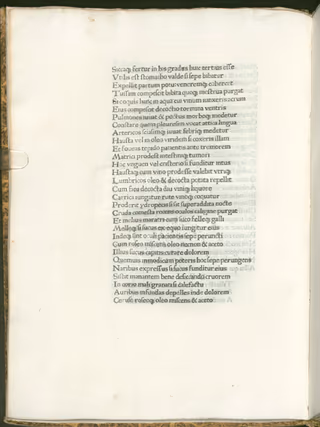
Siccaqꝫ fertur in his gradus huic tertius eſſe
Vtilis eſt ſtomacho valde ſi ſepe bibatur
Expellit partum potu: veneremqꝫ cohercet
Tuſſim compeſcit bibita quoqꝫ meſtrua purgat
Si coquis hanc in aqua cui vinum iunxeris acrum
Eius compeſcit decoctio tormina ventris
Pulmones iuuat & pectus morboqꝫ medetur
Conſtare quem pleureſim vocat actica lingua
Artericos ſciaſimqꝫ iuuat febriqꝫ medetur
Hauſta vel in oleo viridem ſi coxeris illam
Et foueas tepido patientis ante tremorem
Matrici prodeſt inteſtiniqꝫ tumori
Hoc vnguen vel criſterio ſi funditur intus
Hauſtaqꝫ cum vino prodeſſe valebit vtriqꝫ
Lumbricos oleo & decocta potata repellit
Cum ficu decocta diu viniqꝫ liquore
Carrica iungatur rute vinoqꝫ coquatur
Proderit ydropicis ſi ſit ſuperaddita nocte
Cruda comeſta recens oculos caligine purgat
Et melius maratri cum ſuco felleqꝫ galli
Melleqꝫ ſi ſucus ex equo iungitur eius
Indeqꝫ ſint oculi pacientis ſepe peruncti
Cum roſeo miſcens oleo necnon & aceto
Illius ſucus capitis curare dolorem
Quemuis inmodicum poteris hoc ſepe perungens
Naribus expreſſus ſi ſucus funditur eius
Siſtit manantem bene deſiccando cruorem
In corio mali granati ſi calefactū
Auribus infundas depelles inde dolorem
Ceruſe roſeoqꝫ oleo miſcens & aceto
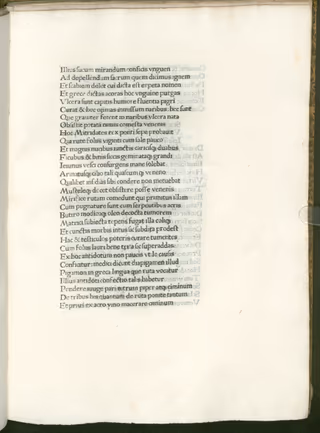
Illius ſucum mirandum conficis vnguen
Ad depellendum ſacrum quem dicimus ignem
Et ſcabiem delet cui dicta eſt erpeta nomen
Et grece dictas acoras hoc vnguine purgas
Vlcera ſunt capitis humore fluentia pigri
Curat & hoc ozimas immiſſum naribus: hec ſunt
Que grauiter fetent in naribus vlcera nata
Obſiſtit potata nimis comeſta venenis
Hoc Mitridates rex ponti ſepe probauit
Qui rute foliis viginti cum ſale pauco
Et magnis nucibus iunctis cariciſqꝫ duabus
Ficubus & binis ſiccis geminataqꝫ grandi
Ieiunus veſci conſurgens mane ſolebat
Armatuſqꝫ cibo tali quaſcunqꝫ veneno
Quilibet inſidias ſibi condere non metuebat
Muſteleqꝫ docet obſiſtere poſſe venenis
Mirifice rutam comedunt que primitus illam
Cum pugnature ſunt cum ſerpentibus acris
Butiro modicoqꝫ oleo decocta tumorem
Matrici ſubiecta tepens fugat illa coliqꝫ
Et cunctis morbis intus ſic ſubdita prodeſt
Hac & teſticulos poteris curare tumentes
Cum foliis lauri bene trita ſic ſuperaddas
Ex hoc antidotum non paucis vtile cauſis
Conficitur: medici dicunt diapigamen illud
Pigamon in greca lingua que ruta vocatur
Illius antidoti confectio talis habetur
Pondere iunge pari nitrum piper atqꝫ ciminum
De tribus his quantum de ruta ponite tantum
Et prius ex acro vino macerare ciminum
Conuenit & ferro poſt aſſari calefacto
Omnia trita ſimul bene deinde ex melle ligabis
Pectoris & lateris iecoris renumqꝫ dolores
Hoc ex antidoto curantur ſepe comeſto
Extenuat bilem mollit ſine tormine ventrem
Confortat ſtomachum facit vt bene digerat eſcam