Hover or tap a word to see its match.
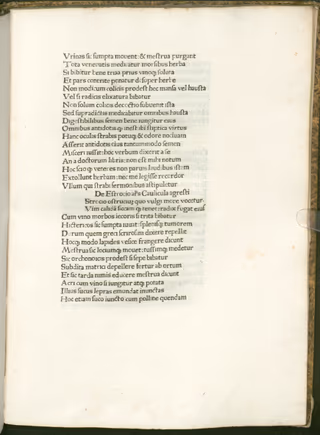
Strocium, which by the custom of the common people is called ostrucium.
It holds a hot and dry power: its root drives away
Diseases of the liver, if it is crushed and drunk with wine.
Taken thus, it helps the jaundiced: and a hard swelling of the spleen
Which the Greeks called *scirrhosis*, it repels.
And in this manner they say it breaks stones of the bladder.
Thus it promotes menses and urine: and cures a cough.
Thus it benefits asthmatics if it is often drunk.
Placed under the womb, it is said to expel an abortion
And thus they say it draws out menses that are too late.
If it is joined with sharp wine and drunk,
Its juice cleanses anointed leprous sores.
With this juice also, joined with fine flour, a certain...
A stye is cured: as they say, [and] any pustule whatever,
If you apply it in the manner of a plaster to the pain.
Its juice, combined by rubbing with honey,
Purges the humors of the head, if it is drawn up the nostril.
Its powder by itself provokes sneezing,
When put into the nostrils, no more sluggishly than white hellebore.
Its juice will wondrously heal the jaundiced,
If they draw it up the nostril mixed with breast milk.
Strocio oſtruciuꝫ quo vulgi more vocetur.
Vim calidā ſiccamqꝫ tenet: radix fugat eiuſ
Cum vino morbos iecoris ſi trita bibatur
Hictericos ſic ſumpta iuuat: ſpleniſqꝫ tumorem
Durum quem greci ſcriroſim dixere repellit
Hocqꝫ modo lapides veſice frangere dicunt
Meſtrua ſic lociumqꝫ mouet: tuſſimqꝫ medetur
Sic orthonoicis prodeſt ſi ſepe bibatur
Subdita matrici depellere fertur ab ortum
Et ſic tarda nimis educere meſtrua dicunt
Acri cum vino ſi iungitur atqꝫ potata
Illius ſucus lepras emundat inunctas
Hoc etiam ſuco iuncto cum polline quendam
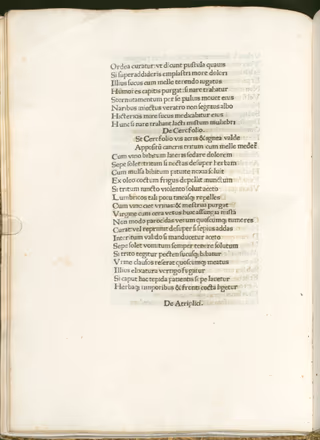
Ordea curatur:vt dicunt puſtula quauis
Si ſuperaddideris emplaſtri more dolori
Illius ſucus cum melle terendo iugatus
Humores capitis purgat:ſi nare trahatur
Sternutamentum per ſe puluis mouet eius
Naribus iniectus veratro non ſegnius albo
Hictericis mire ſucus medicabitur eius
Hunc ſi nare trahant lacti miſtum muliebri
