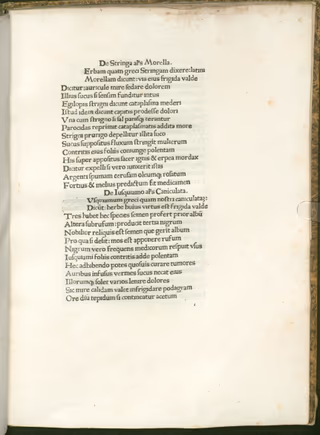
De Stringa al̓s Morella.

Poet
Macer
Form
Hexameter
Open the page in the book
The page this poem fills. Each opens in the De viribus herbarum reader.

Hover or tap a word to see its match.

The herb which the Greeks called *Stringa*, the Latins

call *Morella*: its force is said to be very cold.

It wonderfully soothes the pain of the ear

if its juice is poured in gradually.

They say a poultice of *strignus* cures *egilopis*.

They say that this same thing is beneficial for a headache.

If salt and bread are ground together with *strignus*,

it suppresses *parocidas* when applied in the manner of a poultice.

Itchiness is driven away when smeared with the juice of *strignus*.

The juice applied below binds the flux of women.

Join barley meal to its crushed leaves;

applied upon them, *sacer ignis* and biting *erpea*

are said to be driven out; but if one joins to these

litharge, ceruse, and rose oil,

the aforementioned medicine becomes stronger and better.

Erbam quam greci Stringam dixere:latini

Morellam dicunt:vis eius frigida valde

Dicitur:auricule mire ſedare dolorem

Illius ſucus ſi ſenſim funditur intus

Egilopis ſtrigni dicunt cataplaſma mederi

Iſtud idem dicunt capitis prodeſſe dolori

Vna cum ſtrigno ſi ſal paniſqꝫ terantur

Parocidas reprimit cataplaſmatis addita more

Strigni prurigo depellitur illita ſuco

Sucus ſuppoſitus fluxum ſtringit mulierum

Contritis eius foliis coniunge polentam

His ſuper appoſitus ſacer ignis & erpea mordax

Dicitur expelli ſi vero iunxerit iſtis

Argenti ſpumam ceruſam oleumqꝫ roſatum

Fortius & melius predictum fit medicamen
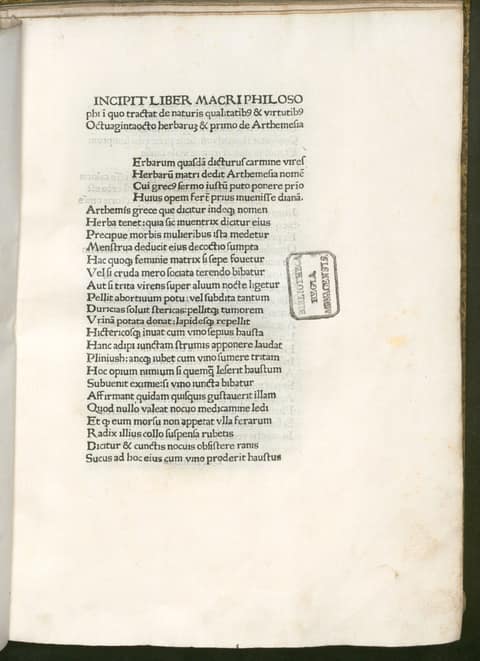
Title page of De viribus herbarum
Title page of De viribus herbarum , 1477

About this text

Provenance

This digital edition is derived from the Bayerische Staatsbibliothek digitization of an early printed edition of De viribus herbarum, the Latin herbal poem traditionally attributed to Macer Floridus or Odo of Meung.

Methodology

Each scan is treated as a page-level unit. The page image remains the authority for the edition. Local Kraken OCR was used as a reading aid, then Gemini generated scan-grounded Latin transcription and English translation from the images, the OCR aid, and the approved glossary. Word links connect the English translation to the Latin transcription and locations on the scans. 95 uncertain word-link decisions remain unlinked. Some links highlight only the text because the source word could not be located on the scan.

Rights

The BSB IIIF manifest declares the digital surrogate under the Public Domain Mark 1.0. Poet Doctor's presentation adds generated OCR, transcription, translation, navigation metadata, and editorial context.

Original scans: Bayerische Staatsbibliothek ( Public Domain Mark 1.0 ).

Historian’s note. This text records the medicine of its own time, and later evidence has replaced most of it. It is not medical advice. We read it as history, and we ask what, if anything, connects it to medicine today. More on how we read old medical books