Hover or tap a word to see its match.
*Sotira* the savioress, the conciliatrix of nature:
This, given with mead, with the root of the cause torn out,
Cures headache, which lasts for a long time.
It brings the auxiliary support of light to epileptics.
It curbs the force of mania disturbing the realms of wisdom.
Poured into the ears, dissolved in woman's milk,
It rouses the hearing worn away by a windy whirlwind.
It comes to the aid of the asthmatic, drives away the panting cough,
And buries the complaint of the stomach concerning coldness.
Against the hiccup of the stomach and the tumult of vomiting
This prevails much, nor does it let it go unpunished. —
Given with mead, it heals pleuritics in the end,
So that the corrupted blood may be well purged and cleansed. —
It thins out spasms of the liver, and cleanses the stain of the
Icteric color, when bilious humor overflows. —
Drunk with posca or with the liquor of plantain
It lightly tames bloody sputum without labor,
And curbs the flux of the belly, and chains vomiting.
The sleepless eyes which the cruel force of pain draws open,
*Sotira* soothes with the peace of tranquil sleep.
When arthritic pain rages hostilely in the limbs
When it rages through the limbs, when it burns the arms and legs,
*Sotira* buries the weakness and provides vigor
associated with the juices of burdock or *iva*.
The pestiferous poison, which a scorpion, viper, or *tirus*
introduces, it valiantly defeats and fights off death.
In a quartan fever, even if long and veteran,
it is medicinal, it is useful, it is specific.
Force to chronic diseases, which a longer age establishes,
it applies, and compels them to restrict their own bounds.
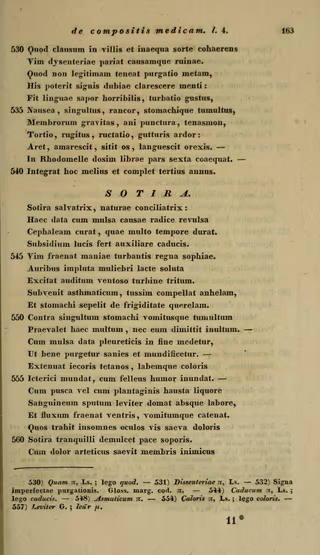
Sotira salvatrix, naturae conciliatrix:
Haec data cum mulsa causae radice revulsa
Cephaleam curat, quae multo tempore durat.
Subsidium lucis fert auxiliare caducis.
Vim fraenat maniae turbantis regna sophiae.
Auribus impluta muliebri lacte soluta
Excitat auditum ventoso turbine tritum.
Subvenit asthmaticum, tussim compellat anhelam,
Et stomachi sepelit de frigiditate querelam.
Contra singultum stomachi vomitusque tumultum
Praevalet haec multum, nec eum dimittit inultum. —
Cum mulsa data pleureticis in fine medetur,
Ut bene purgetur sanies et mundificetur. —
Extenuat iecoris tetanos, labemque coloris
Icterici mundat, cum felleus humor inundat. —
Cum pusca vel cum plantaginis hausta liquore
Sanguineum sputum leviter domat absque labore,
Et fluxum fraenat ventris, vomitumque catenat.
Quos trahit insomnes oculos vis saeva doloris
Sotira tranquilli demulcet pace soporis.
Cum dolor arteticus saevit membris inimicus
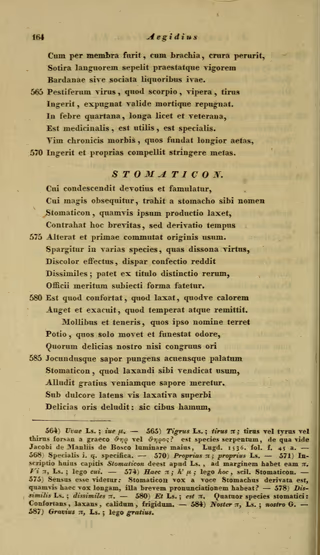
Cum per membra furit, cum brachia, crura perurit,
Sotira languorem sepelit praestatque vigorem
Bardanae sive sociata liquoribus ivae.
Pestiferum virus, quod scorpio, vipera, tirus
Ingerit, expugnat valide mortique repugnat.
In febre quartana, longa licet et veterana,
Est medicinalis, est utilis, est specialis.
Vim chronicis morbis, quos fundat longior aetas,
Ingerit et proprias compellit stringere metas.