Hover or tap a word to see its match.
The celebrated medicine which prides itself marked with the title of the Duke of Apulia
Comes to the aid of iliac pain,
Which a stone massed from many sands generates,
Drunk with warm unmixed wine, which adopts the strength
Of saxifrage, of milium solis, and also of lynx stones:
Also let the part which a greater pressure of pain torments
Arm itself against the disease with the shield of a poultice,
As the base of whose nature lay the Duke's medicine,
Mixing musceleum, juice of watercress, and olive oil.
If there is not such an abundance of musceleum liquid,
A liquid pressed from a small part of a plaster
Mixing balsams, by means of a thin syringe
Pour it through the fragile duct of the male organ. —
If the savage force of viscous choler, resolving, should bring on the evil
And burden the intestines with swollen storms,
The medicine of Dukes confers no benefit, but when taken it sharpens
the raging bile, and exacerbates the cause of the pain.
If the pain arises from scybala, or glassy phlegm
with a windy whirlwind beating against the closed passages,
this medicine, administered simply, will do too much harm.
For since its diuretic power is established as very strong,
while it promotes urine it tends to constrict the belly
and sluggishly slows down in expelling feces,
thus the pain is increased, while constipation grows.
The medicine will serve this ailment, and will be able
powerfully to subvert the whole excessive cause of the pain,
if, resolved through the smallest parts but entirely,
it is drunk with warm water, in which you have boiled
plums of Damascus and violet flowers with mercury weed:
which, if it mixes to itself honey, oil and *Benedicta*
dissolved in sea water, in which you have boiled mallow, mercury weed,
and the green branches of watercress,
it is beneficial when infused into the private parts as a clyster.
The previously mentioned pain of the stomach born from cold,
disturbing the side with a whirlwind of a windy blast,
however angry, however prepared for wars,
once breathed upon by this, calms the penalty of its torture:
it will be drunk on an empty stomach added to Bacchus,
in which a nutmeg has been boiled down and steeped.
It opens emphraxes: it grinds stones, and draws them out
dissolved, it dissolves the iliac passion, releases the menses:
which, if the euphorbic force or the power of scammony
sharpens, restrained by the command of mastic and gum,
and the use of a soft clyster has preceded it,
loosening the very hard bolts of opposing feces,
taken by mouth it resolves the crises of the colic disease.
This a rule of doctrine holds and defends as firm
by a general law, which no fantastic error,
No false, no empty fallacy of deceit obscures the fact:
That a cathartic medicine must never be given to a belly,
Whose constipative hardness obstructs the recesses
And locks the excretory organs of the first gate:
Especially when colic disease beats the inward parts
And the discord of the iliac plague rages. —
The same power, effecting a similar result, and a rival virtue
Belongs to *Nephrocathari*, *Philoanthropos* and *Lithotripti*,
Nor is the praise of Justinus suppressed by the virtue of the former. —
After the sun has twice traversed the zodiacal circle
The lifespan of this medicine reaches its limits.
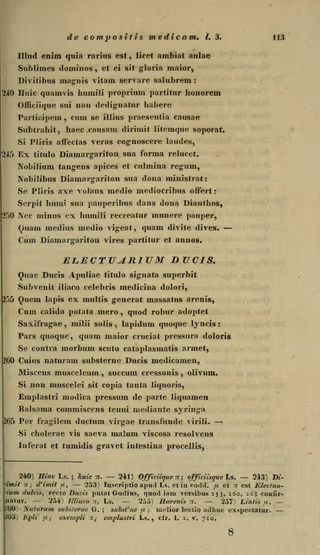
Quae Ducis Apuliae titulo signata superbit
Subvenit iliaco celebris medicina dolori,
Quem lapis ex multis generat massatus arenis,
Cum calido potata mero, quod robur adoptet
Saxifragae, milii solis, lapidum quoque lyncis:
Pars quoque, quam maior cruciat pressura doloris
Se contra morbum scuto cataplasmatis armet,
Cuius naturam substerne Ducis medicamen,
Miscens musceleum, succum cressonis, olivum.
Si non muscelei sit copia tanta liquoris,
Emplastri modica pressum de parte liquamen
Balsama commiscens tenui mediante syringa
Per fragilem ductum virgae transfunde virili. —
Si cholerae vis saeva malum viscosa resolvens
Inferat et tumidis gravet intestina procellis,
Non confert medicina Ducum, sed sumta furentem
Exacuit choleram, causamque doloris acerbat.
Si dolor ex squibalis, vitreo vel phlegmate fiat
Turbine ventoso clausos pulsante meatus,
Haec data simpliciter nimium medicina nocebit.
Nam sua cum valde constet diuretica virtus,
Dum movet urinam tendit constringere ventrem
Et pigra lentescit in fecibus eiiciendis,
Sic dolor augetur, dum constipatio crescit.
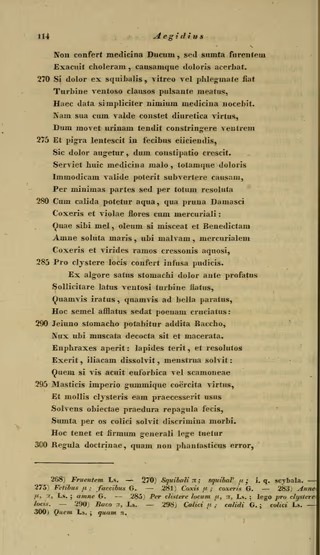
Serviet huic medicina malo, totamque doloris
Immodicam valide poterit subvertere causam,
Per minimas partes sed per totum resoluta
Cum calida potetur aqua, qua pruna Damasci
Coxeris et violae flores cum mercuriali:
Quae sibi mel, oleum si misceat et Benedictam
Amne soluta maris, ubi malvam, mercurialem
Coxeris et virides ramos cressonis aquosi,
Pro clystere locis confert infusa pudicis.
Ex algore satus stomachi dolor ante profatus
Sollicitare latus ventosi turbine flatus,
Quamvis iratus, quamvis ad bella paratus,
Hoc semel afflatus sedat poenam cruciatus:
Jeiuno stomacho potabitur addita Baccho,
Nux ubi muscata decocta sit et macerata.
Enphraxes aperit: lapides terit, et resolutos
Exerit, iliacam dissolvit, menstrua solvit:
Quem si vis acuit euforbica vel scamoneae
Masticis imperio gummique coërcita virtus,
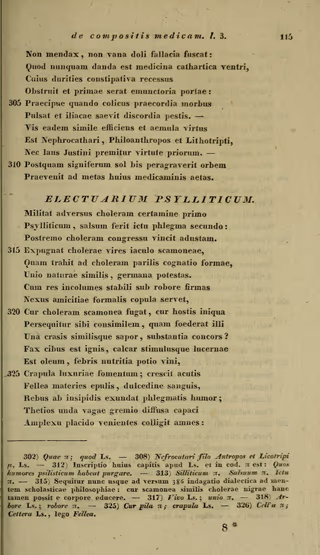
Et mollis clysteris eam praecesserit usus
Solvens obiectae praedura repagula fecis,
Sumta per os colici solvit discrimina morbi.
Hoc tenet et firmum generali lege tuetur
Regula doctrinae, quam non phantasticus error,
Non mendax, non vana doli fallacia fuscat:
Quod nunquam danda est medicina cathartica ventri,
Cuius durities constipativa recessus
Obstruit et primae serat emunctoria portae:
Praecipue quando colicus praecordia morbus
Pulsat et iliacae saevit discordia pestis. —
Vis eadem simile efficiens et aemula virtus
Est Nephrocathari, Philoanthropos et Lithotripti,
Nec laus Justini premitur virtute priorum. —
Postquam signiferum sol bis peragraverit orbem
Praevenit ad metas huius medicaminis aetas.