Hover or tap a word to see its match.
*Benedicta* draws humors from remote members,
Dissolves the stone, puts to flight articular disease,
Overcomes strangury, phrenesis, colic, and paralysis,
Cuts off emphraxes of the liver, and tumors of the spleen,
Resolves the iliac plague, and represses podagra.
With divisive roots, herbs,
Gums, and seeds, which possess diuretic virtue, having been given beforehand,
Under a certain order, a similar one of which the fruitful page of Salernus,
Distinguished by columns, describes,
With the body softened by the virtue of a warm bath,
In which cress, groundsel, mallow,
Bran and althaea, cissus, and the herb linochis have been cooked;
With the principal and best approved ones mixed into it,
Which the distinction of the aforesaid things sets forth,
It administers the utmost cure to nephritics and those suffering from stones. —
If hermodactyl is mixed into it in double the weight
That the rule of compounding demands,
It comes to the aid of arthritic attacks born from acrid rheum
And *Benedicta* is beneficial for cold podagra. —
Which, when mixed with the apozem of a clyster,
Instilled into the pudendal places, if it loosens the colicky belly,
Pledges that it will remove the harms of colicky pain,
If finally it is drunk mixed with *Diamargariton*.
But first the belly, and the pudendal parts,
The kidneys and loins thirst for the fomentations of a warm bath.
If the action of the clyster should be deaf and rebellious,
So that it cannot dissolve the hard feces of the belly,
The medicine taken by mouth is harmful, and the forces of the pain
It sharpens, renews the disease, and storms the belly. —
It overcomes a headache conceived by a defect of the stomach, which a cold cause
created, with cloves mixed into it
And nutmeg. But first let an anointing of the forehead
And sides of the head be performed with warm olive oil. —
Those whom dropsy ferments, for whom digestion, being undigested
in the second stage, distends the limbs with a wandering swelling:
Those whom an inundation weighs down, *Benedicta* with powerful vigor
Frees and redeems: given with wine of parsley,
Of mastic and fennel, of carrot, and of double cumin.
After the anger of pleuritic heat has cooled down,
And already its movements, with twice seven nights having passed
After the acme, seeking to break out from their own cells,
With the order having been set aside, lest perhaps the flowing
Matter wander about, lest it harm the limbs with a foolish return,
This medicine takes precautions, given with ptisan, tragacanth
Gum, penidions, melons, and citruls. —
The uninjured life of *Benedicta* remains for two years.
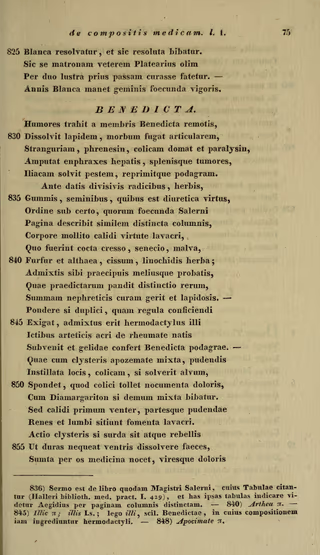
Humores trahit a membris Benedicta remotis,
Dissolvit lapidem, morbum fugat articularem,
Stranguriam, phrenesin, colicam domat et paralysin,
Amputat enphraxes hepatis, splenisque tumores,
Iliacam solvit pestem, reprimitque podagram.
Ante datis divisivis radicibus, herbis,
Gummis, seminibus, quibus est diuretica virtus,
Ordine sub certo, quorum foecunda Salerni
Pagina describit similem distincta columnis,
Corpore mollito calidi virtute lavacri,
Quo fuerint cocta cresso, senecio, malva,
Furfur et althaea, cissum, linochidis herba;
Admixtis sibi praecipuis meliusque probatis,
Quae praedictarum pandit distinctio rerum,
Summam nephreticis curam gerit et lapidosis. —
Pondere si duplici, quam regula conficiendi
Exigat, admixtus erit hermodactylus illi
Ictibus arteticis acri de rheumate natis
Subvenit et gelidae confert Benedicta podagrae. —
Quae cum clysteris apozemate mixta, pudendis
Instillata locis, colicam, si solverit alvum,
Spondet, quod colici tollet nocumenta doloris,
Cum *Diamargariton* si demum mixta bibatur.
Sed calidi primum venter, partesque pudendae
Renes et lumbi sitiunt fomenta lavacri.
Actio clysteris si surda sit atque rebellis
Ut duras nequeat ventris dissolvere faeces,
Sumta per os medicina nocet, viresque doloris
Exacuit, morbum renovat, ventremque procellat. —
Conceptam vitio stomachi, quam causa creavit
Frigida, cephaleam domat antophilis sibi mixtis
Et nuce muscata. Sed frontis inunctio primo
Et laterum capitis calido celebretur olivo. —
Quos fermentat hydrops, pexis quibus hora secundo
Incrudata, vago distendit membra tumore:
Quos gravat eluvies, Benedicta vigore potenti
Liberat et redimit: data cum vino petrosilli,
Masticis et marathri, dauci, duplicisque cimini.
Postquam pleuretici deferbuit ira caloris,
Jamque suos motus, bis septem noctibus actis
Post acmen propriis quaerens erumpere cellis,
Ordine postposito ne proflua forsan oberret
Materies, fatuo ne laedat membra recursu,
Haec medicina cavet data cum ptisana, dragaganto
Gummi, penidiis, melonibus atque citrolis. —
Permanet incolumis Benedictae vita biennis.