Hover or tap a word to see its match.
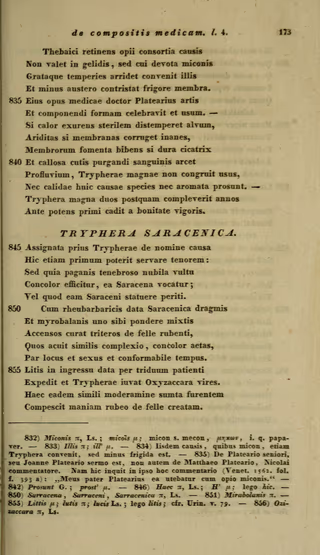
The cause previously assigned concerning the name of Tryphera
will also be able to preserve its first tenor here:
but because, cloudy with a dark face,
it is made the same color as the pagans, it is called Saracena;
or because skilled Saracens established it.
Saracenica, given with drachms of rhubarb
and myrobalans mixed with it in one weight,
cures kindled tertian fevers from red bile,
which a similar complexion, a like-colored age,
equal place and sex, and a conformable season sharpen.
Given to the patient for three days at the beginning of the strife,
it is expedient, and Oxyzaccara aids the powers of Tryphera.
This same medicine, taken with similar moderation,
restrains raging mania created from red bile.
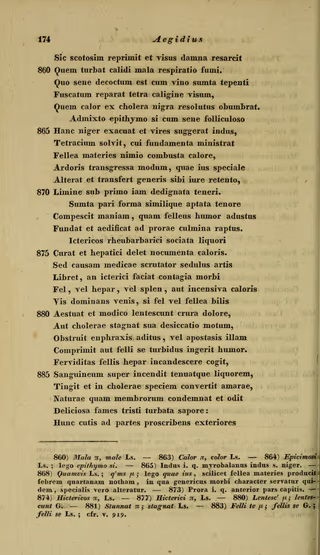
Thus it suppresses scotosis and repairs the damage to vision
Which a bad exhalation of hot smoke disturbs.
Taken with warm wine in which senna has been decocted,
It repairs vision darkened by foul gloom,
Which heat released from black bile overshadows.
If, with epithymum mixed in alongside full-podded senna,
The black Indian [myrobalan] should sharpen it and supply strength,
It resolves a quartan fever, to which bilious matter
Burned up by excessive heat supplies the foundations,
Having crossed the limit of burning, which alters and transfers
The specific law, with the law of the genus retained for itself,
Now disdaining to be held under the first threshold.
Taken in equal form and adapted with a similar tenor,
It restrains mania, which burnt bilious humor
Founds and builds, seized to the heights of the prow.
Allied to a liquor of rhubarb, it cures
Jaundiced patients and destroys the harms of hepatic heat.
But let a zealous investigator of the medical art
Weigh the cause, whether the gall bladder, or the liver, or the spleen,
Or the burning force of heat ruling the veins,
Causes the contagions of the jaundiced disease; if the gall bladder or bilious bile
Boils and the legs grow sluggish with moderate pain,
Or its own drying-out stagnates the motion of the bile,
An enphraxis obstructs the approaches, or an apostasis
Compresses it, or a turbid humor forces itself upon the gall bladder.
The fervidity of the gall bladder forces the liver to become hot,
It moreover burns and thins the blood liquor,
Dyes it and converts it into the form of bitter bile,
Which the fastidious hunger of the nature of the members
Disturbed by the foul taste, condemns and hates:
Proscribing this to the exterior parts of the skin
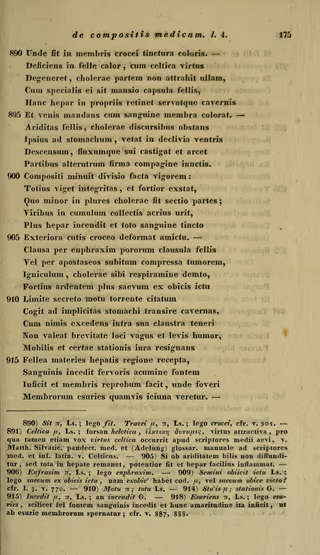
Whence a dyeing of a saffron color occurs in the limbs. —
Deficient heat in the gall, when the *celtica* power
degenerates, draws no part of the bile,
although its special dwelling is the capsule of the gall;
the liver retains and preserves it in its own caverns,
and, committing it to the veins, colors the limbs with the blood. —
The dryness of the gall, obstructing the courses of the bile
itself to the stomach, forbids its descent
into the lower parts of the belly, and restrains and wards off its flux,
the parts being joined to one another by a firm connection.
A division made lessens the vigor of a compound:
the integrity of the whole flourishes, and it remains stronger,
the less the division of the bile into several parts becomes;
with its forces gathered into a mass it burns more fiercely,
it inflames the liver more, and, the whole blood being dyed,
it disfigures the outer parts of the skin with a saffron garment. —
The enclosure of the pores of the gall closed by an emphraxis,
or compressed by the sudden swelling of an apostasis,
forces the little fire—burning more strongly once its ventilation is taken away,
more savage from the stroke against the barrier,
roused by a torrential motion on a secret path—
to pass into the tangled caverns of the stomach,
since, overflowing too much, the wandering and light humor cannot
be held within its own cloisters due to the shortness of the place;
mobile and resigning the rights of a fixed station,
the bilious matter received in the region of the liver,
advances upon the fountain of blood with the sharpness of its heat,
infects it and renders it reprobate to the limbs, from which
the hunger of the limbs, although fasting, shrinks from being nourished. —
If a viscous humor mixes itself with the gall
It thickens the choler, binds and glues it together,
And with the swiftness of its proper motion denied to it,
It forbids it from running down to the stomach with its accustomed motion.
Therefore, accumulated, it overflows into the recesses of the liver,
Whence it will have drawn the material cause of its generation
And the form of its *crasis* and its first origin.
The fiery part of the blood mass, since the house of the gall
Is not open, claims for itself the sole citadel of the liver. —
If the disease has drawn its origin from a defect of the liver,
*Enphraxis* obstructs, heat burns, cold congeals,
The pressure of a tumor stretches and enlarges the member,
Sclerosis hardens, the expulsive force weakens,
With the spleen burdened by the dregs of melancholic ferment
The celestial virtue degenerates, and the faculty of the spleen
Failing, does not cleanse the liver: the humor of the blood becomes
Thick and dark, not fit for nourishing the members.
Given with hart's tongue and maidenhair fern
Plums and violets, melons and citruls
It purges the liver, stomach, spleen, upper diaphragm,
And the places under the ribs blocked by boiling *chymis*,
It tempers the hepatic fires, and repairs the color. —
If it is compounded simple and free from sharpness,
The dose will be one ounce, but with sharpness mixed in
More sparing and smaller and adjusted to frequent use. —
The first year completes it and the second destroys it.
Assignata prius Trypherae de nomine causa
Hic etiam primum poterit servare tenorem:
Sed quia paganis tenebroso nubila vultu
Concolor efficitur, ea Saracena vocatur;
Vel quod eam Saraceni statuere periti.
Cum rheubarbaricis data Saracenica dragmis
Et myrobalanis uno sibi pondere mixtis
Accensos curat triteros de felle rubenti,
Quos acuit similis complexio, concolor aetas,
Par locus et sexus et conformabile tempus.
Litis in ingressu data per triduum patienti
Expedit et Trypherae iuvat Oxyzaccara vires.
Haec eadem simili moderamine sumta furentem
Compescit maniam rubeo de felle creatam.
Sic scotosim reprimit et visus damna resarcit
Quem turbat calidi mala respiratio fumi.
Quo sene decoctum est cum vino sumta tepenti
Fuscatum reparat tetra caligine visum,
Quem calor ex cholera nigra resolutus obumbrat.
Admixto epithymo si cum sene folliculoso
Hanc niger exacuat et vires suggerat indus,
Tetracium solvit, cui fundamenta ministrat
Fellea materies nimio combusta calore,
Ardoris transgressa modum, quae ius speciale
Alterat et transfert generis sibi iure retento,
Limine sub primo iam dedignata teneri.
Sumta pari forma similique aptata tenore
Compescit maniam, quam felleus humor adustus
Fundat et aedificat ad prorae culmina raptus.
Ictericos rheubarbarici sociata liquori
Curat et hepatici delet nocumenta caloris.
Sed causam medicae scrutator sedulus artis
Libret, an icterici faciat contagia morbi
Fel, vel hepar, vel splen, aut incensiva caloris
Vis dominans venis, si fel vel fellea bilis
Aestuat et modico lentescunt crura dolore,
Aut cholerae stagnat sua desiccatio motum,
Obstruit enphraxis aditus, vel apostasis illam
Comprimit aut felli se turbidus ingerit humor.
Ferviditas fellis hepar incandescere cogit,
Sanguineum super incendit tenuatque liquorem,
Tingit et in cholerae speciem convertit amarae,
Naturae quam membrorum condemnat et odit
Deliciosa fames tristi turbata sapore:
Hunc cutis ad partes proscribens exteriores
Unde fit in membris crocei tinctura coloris. —
Deficiens in felle calor, cum celtica virtus
Degeneret, cholerae partem non attrahit ullam,
Cum specialis ei sit mansio capsula fellis,
Hanc hepar in propriis retinet servatque cavernis
Et venis mandans cum sanguine membra colorat. —
Ariditas fellis, cholerae discursibus obstans
Ipsius ad stomachum, vetat in declivia ventris
Descensum, fluxumque sui castigat et arcet
Partibus alterutrum firma compagine iunctis.
Compositi minuit divisio facta vigorem:
Totius viget integritas, et fortior exstat,
Quo minor in plures cholerae fit sectio partes;
Viribus in cumulum collectis acrius urit,
Plus hepar incendit et toto sanguine tincto
Exteriora cutis croceo deformat amictu. —
Clausa per enphraxim pororum clausula fellis
Vel per apostaseos subitum compressa tumorem,
Igniculum, cholerae sibi respiramine demto,
Fortius ardentem plus saevum ex obicis ictu
Limite secreto motu torrente citatum
Cogit ad implicitas stomachi transire cavernas,
Cum nimis excedens intra sua claustra teneri
Non valeat brevitate loci vagus et levis humor,
Mobilis et certae stationis iura resignans
Fellea materies hepatis regione recepta,
Sanguinis incedit fervoris acumine fontem
Inficit et membris reprobum facit, unde foveri
Membrorum esuries quamvis ieiuna veretur. —
Si felli se viscosus commisceat humor
Ingrossat choleram, ligat et conglutinat ipsam,
Et proprii motus sibi cursilitate negata,
Consueto vetat ad stomachum discurrere motu.
Ad sinus igitur hepatis cumulata redundat,
Unde suae causam geniturae materialem
Et formam craseos et primum traxerit ortum.
Sanguineae massae pars ignea, cum casa fellis
Non pateat, solam iecoris sibi vendicat arcem. —
Ex hepatis vitio si passio traxerit ortum,
Obstruit enphraxis, calor urit, congelat algor,
Tendit et amplificat membrum pressura tumoris,
Sclirosis indurat, vis expulsiva fatiscit,
Fece melancholici fermenti splene gravato
Caelica degenerat virtus, splenisque facultas
Deficiens non mundat hepar: fit sanguinis humor
Spissus et obscurus membris non aptus alendis.
Cum lingua data cervina Venerisque capillo
Prunis ac violis, melonibus atque citrullis
Purgat hepar, stomachum, splenem, diaphragma supremum,
Et loca sub costis ferventibus obsita chymis,
Temperat hepaticos ignes, reparatque colorem. —
Si componatur simplex et acuminis expers,
Uncia una dosis fiet, sed acumine mixto
Parcior atque minor et commoderata frequenti. —
Annus complet eam primus deletque secundus.