Hover or tap a word to see its match.
Part 1
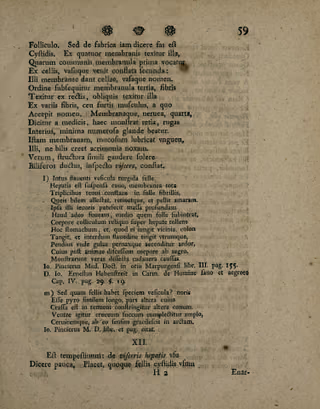
It is timely to say a few things about the use of the viscus
Of the liver. It pleases also the use of the cystic bladder of gall
Eſt tempeſtiuum: de viſceris hepatis vſu
Dicere pauca. Placet, quoque fellis cyſtidis vſum
Part 2
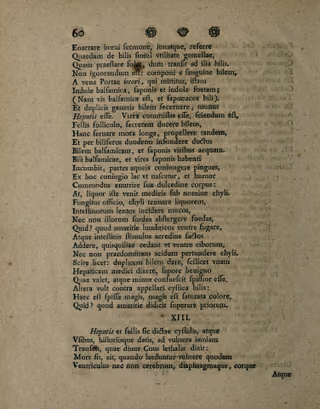
to relate in brief discourse, and it is pleasing to recount
some things as well concerning the utility of the twin bile,
which the bile is wont to provide as it passes to the bowels.
It must not be ignored that bile is composed from the blood
which is sent by the portal vein to the liver, and that it is
pregnant with a balsamic nature, and the nature of soap;
(for bile has a balsamic and saponaceous power).
And to secrete a twofold kind of bile is the function
of the liver. It must be known that the duties entrusted
to the follicle of gall are to draw the secreted bile,
to preserve this for a long delay, to propel it at last,
and through the bile-bearing ducts to pour into the duodenum
the balsamic bile, equal to the powers of soap.
Upon the balsamic bile, having the powers of soap,
it is incumbent to join the fatty parts to the watery ones,
so that from this union milk may be born, and a humor
suitable to nourish the body by its sweetness:
but that liquor comes to physicians under the name of chyle.
It performs the office of thinning the liquor of the chyle,
of cutting through the sluggish mucus of the intestines,
and also of wiping away their foul filth;
what more? by its bitterness of driving worms from the belly,
and to the intestines of adding stimuli made by its acridity,
so that the dregs of food may depart from the belly,
and also of blunting the predominant acid of the chyle.
One may know that a twofold bile is given: namely, the one
physicians have called hepatic, which prevails
with a mild taste, and is less accustomed to be thick.
The other, on the contrary, wishes to be called cystic bile:
this is thicker, and is more saturated in color;
what more? by its bitterness it has learned to surpass the former.
Enarrare breui ſermone, iuuatque, referre
Quaedam de bilis ſimul vtilitate gemellae,
Quam praeſtare ſolet, dum tranſit ad ilia bilis.
Non ignorandum eſt: componi e ſanguine bilem,
A vena Portae iecori, qui mittitur, iſtam
Indole balſamica, ſaponis et indole foetam;
(Nam vis balſamica eſt, et ſaponacea bili).
Et duplicis generis bilem ſecernere, munus
Hepatis eſſe. Vices commiſſas eſſe, ſciendum eſt,
Fellis folliculo, ſecretam ducere bilem,
Hanc ſeruare mora longa, propellere tandem,
Et per biliferos duodeno infundere ductus
Bilem balſamicam, et ſaponis viribus aequam.
Bili balſamicae, et vires ſaponis habenti
Incumbit, partes aqueis coniungere pingues,
Ex hoc coniugio lac vt naſcatur, et humor
Commodus enutrire ſua dulcedine corpus:
At, liquor iſte venit medicis ſub nomine chyli.
Fungitur officio, chyli tenuare liquorem,
Inteſtinorum lentos incidere mucos,
Nec non illorum ſordes abſtergere foedas,
Quid? quod amaritie lumbricos ventre fugare,
Atque inteſtinis ſtimulos acredine factos
Addere, quisquiliae cedant vt ventre ciborum,
Nec non praedominans acidum pertundere chyli.
Scire licet: duplicem bilem dare, ſcilicet vnam
Hepaticam medici dixere, ſapore benigno
Quae valet, atque minus conſueſcit ſpiſſior eſſe.
Altera vult contra appellari cyſtica bilis:
Haec eſt ſpiſſa magis, magis eſt ſaturata colore,
Quid? quod amaritie didicit ſuperare priorem.