Hover or tap a word to see its match.
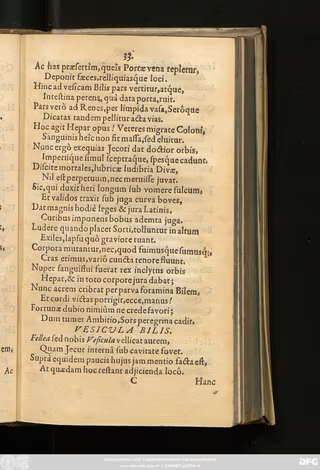
But the gallbladder plucks our ear,
Which the liver nurtures under its internal cavity.
Indeed, above, a mention of it has already been made in a few words,
But certain things remain to be added in this place.
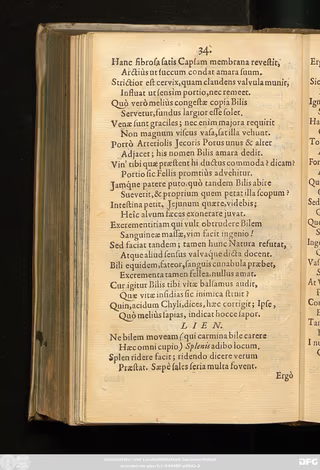
A sufficiently fibrous membrane clothes this receptacle,
So that the bitter sac may store its juice more securely.
The neck is narrower, which a closing valve protects;
So that a portion may flow in gradually, and not flow back.
But so that the collected abundance of Bile may be better
Preserved, the base is usually larger.
The veins are slender; for a not-large organ does not require
Larger vessels, those convey enough.
Furthermore, one or another Pore lies adjacent to the arterioles
Of the Liver; bitter Bile gave its name to these.
Do you want me to tell you what benefits these ducts provide? I shall say.
Thus a portion of the Gall is brought more promptly.
And now I think it is clear where the Bile is accustomed to go
At last, and what proper goal it seeks?
It seeks the intestines, seek the Jejunum, you will see;
Here it helps the belly to discharge the feces.
He who wishes to thrust excrementitious Bile
Upon the blood mass, does violence to his own intellect!
But let him do it anyway; nevertheless Nature refutes him,
And the senses and the aforementioned valve teach otherwise.
Indeed, I confess, the blood provides a cradle for the Bile,
Yet no one loves biliary excrements.
Why therefore is the Bile called by you the balsam of life,
Which, so hostile, lays ambushes for life?
Rather, you will say, it corrects the acidity of the Chyle; the taste
Itself indicates this, so that you may understand better.
Fellea ſed nobis Veſicula vellicat aurem,
Quam Jecur internâ ſub cavitate fovet.
Suprà equidem paucis hujus jam mentio facta eſt,
At quædam hoc reſtant adjicienda locô.
Hanc fibroſa ſatis Capſam membrana reveſtit,
Arctiùs ut ſuccum condat amara ſuum.
Strictior eſt cervix, quam claudens valvula munit;
Influat ut ſenſìm portio, nec remeet.
Quò verò meliùs congeſtæ copia Bilis
Servetur, fundus largior eſſe ſolet.
Venæ ſunt graciles; nec enìm majora requirit
Non magnum viſcus vaſa, ſat illa vehunt.
Porrò Arteriolis Jecoris Porus unus & alter
Adjacet; his nomen Bilis amara dedit.
Vin' tibi quæ præſtent hi ductus commoda? dicam?
Portio ſic Fellis promtiùs advehitur.
Jamq́ue patere puto, quò tandem Bilis abire
Sueverit, & proprium quem petat illa ſcopum?
Inteſtina petit, Jejunum quære, videbis;
Heîc alvum fæces exonerare juvat.
Excrementitiam qui vult obtrudere Bilem
Sanguineæ maſſæ, vim facit ingenio!
Sed faciat tandem; tamen hunc Natura refutat,
Atque aliud ſenſus valvaque dicta docent.
Bili equidem, fateor, ſanguis cunabula præbet,
Excrementa tamen fellea, nullus amat.
Cur igitur Bilis tibi vitæ balſamus audit,
Quæ vitæ inſidias ſic inimica ſtruit?
Quin, acidum Chyli, dices, hæc corrigit; Ipſe,
Quò meliùs ſapias, indicat hocce ſapor.