Hover or tap a word to see its match.
Part 1
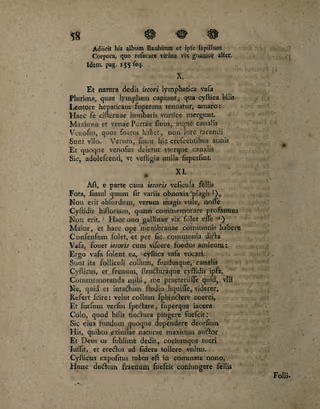
XI.
Moreover, since the gallbladder, cherished in the hollow part
Of the liver, is at the same time exposed to various wounds l),
It will not be absurd, but rather more useful, to know
The cystic history, which it will not be profane
To recount. This is scarcely wont to be m)
Larger than a hen's egg, and by the aid of a common membrane it is wont
To have sympathy, and through the vessels thus called
Common, it cherishes a friendly league with the viscus of the liver:
Therefore those vessels are wont to be called cystic vessels.
Thus the neck of the little sac, and the fundus, the cystic
Canal, and the frenum, and the cystic structure itself,
Must be recounted by me, lest I should seem to anyone
To have passed over anything, or to have purposely left anything untouched.
It matters to know: just as the neck is constrained by a sphincter,
And looks upward, and lies upon
The colon, which it is wont to stain with a tincture of bile:
So also its fundus hangs downward
In those to whom the greatest author of excellent nature
And God gave an uplifted face, and bade them behold
The sky, and raise their erect countenances to the stars.
The cystic tube has been set forth in the ninth section;
The frenum is wont to join this duct of the gall
Aſt, e parte caua iecoris veſicula fellis
Fota, ſimul quum ſit variis obnoxia plagis l),
Non erit abſurdum, verum magis vtile, noſſe
Cyſtidis hiſtoriam, quam commemorare profanum
Non erit. Haec ouo gallinae vix ſolet eſſe ᵐ)
Maior, et haec ope membranae communis habere
Conſenſum ſolet, et per ſic communia dicta
Vaſa, fouet iecoris cum viſcere foedus amicum:
Ergo vaſa ſolent ea, cyſtica vaſa vocari.
Sunt ita folliculi collum, fundusque, canalis
Cyſticus, et frenum, ſtructuraque cyſtidis ipſa,
Commemoranda mihi, me praeteriiſſe quid, vlli
Ne, quid et intactum ſtudio liquiſſe, viderer.
Refert ſcire: velut collum ſphinctere coerci,
Et ſurſum verſus ſpectare, ſuperque iacere
Colo, quod bilis tinctura pingere ſueſcit:
Sic eius fundum quoque dependere deorſum
His, quibus eximiae naturae maximus auctor
Et Deus os ſublime dedit, coelumque tueri
Iuſſit, et erectos ad ſidera tollere vultus.
Cyſticus expoſitus tubus eſt in commate nono,
Hunc ductum fraenum ſueſcit coniungere fellis
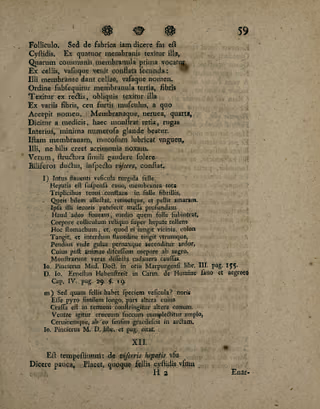
Part 2
follicle. But now it is right to speak of the structure
Of the cystic bladder. It is woven from four membranes,
Of which the first small membrane is called the common,
The second comes formed from cells and vessels:
Cells and vessels give a name to that membrane.
The third small membrane follows in order, from straight
Fibres it is woven, from oblique it is woven,
From various fibres, like a strong muscle, from which
It received its name. And the fourth membrane, the nervous,
Is so called by physicians; this displays networks and wrinkles
Internally, and is blessed with a numerous tiny gland.
A mucous ointment lubricates that membrane,
Lest the acrimony of the bile create harm to it.
Truly, that the bile-bearing ducts are wont to enjoy
A similar structure is evident when the viscus is inspected.
Folliculo. Sed de fabrica iam dicere fas eſt
Cyſtidis. Ex quatuor membranis texitur illa,
Quarum communis membranula prima vocatur
Ex cellis, vaſisque venit conflata ſecunda:
Illi membranae dant cellae, vaſaque nomen.
Ordine ſubſequitur membranula tertia, fibris
Texitur ex rectis, obliquis texitur illa
Ex variis fibris, ceu fortis muſculus, a quo
Accepit nomen. Membranaque, neruea, quarta,
Dicitur a medicis, haec monſtrat retia, rugas
Interius, minima numeroſa glande beatur.
Iſtam membranam, mucoſum lubricat vnguen,
Illi, ne bilis creet acrimonia noxam.
Verum, ſtructura ſimili gaudere ſolere
Biliferos ductus, inſpecto viſcere, conſtat.