Hover or tap a word to see its match.
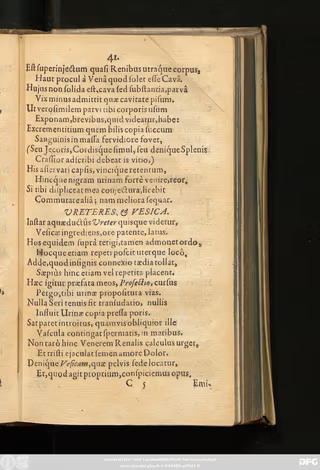
Each Ureter appears like an aqueduct,
entering the side of the bladder with an open mouth.
I have indeed touched upon these above, yet order advises,
and demands that each also be repeated in this place.
Add the fact that their remarkable connection removes weariness;
hence even repeated things quite often please.
Having thus prefaced these things, I, Dissection, continue my courses,
intending to set forth the pathways of the urine for you.
No thin transudation of the serum occurs, nor does
the pressed abundance of Urine flow in through any pores.
The entrance is sufficiently open, although it rather obliquely
touches the vessels of the sperm, in males.
Not rarely from this does a kidney stone urge on Venus,
and Pain ejaculates the seed in sad love.
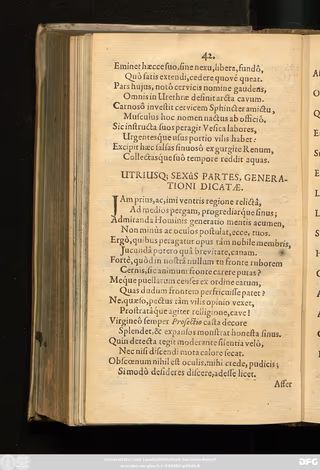
Finally we shall observe the Bladder, which is located in the seat of the pelvis,
and the proper work which it performs.
This stands out freely with its base, without attachment,
So that it may be able to extend sufficiently, or to yield.
A part of it, rejoicing in the familiar name of the neck,
Ends entirely, narrowed, in the hollow of the Urethra.
The Sphincter invests the neck with a fleshy cloak,
A muscle having obtained this name from its duty.
Thus equipped, the Bladder performs its labors,
And this humble portion possesses pressing uses:
It receives the salty waters from the winding whirlpool of the Kidneys,
And returns the collected waters at its proper time.
Inſtar aquæductûs Vreter quisque videtur,
Veſicæ ingrediens, ore patente, latus.
Hos equidem ſuprà tetigi, tamen admonet ordo,
Hocque etiam repeti poſcit uterque locô.
Adde, quod inſignis connexio tædia tollat,
Sæpiùs hinc etiam vel repetita placent.
Hæc igitur præfata meos, Proſectio, curſus
Pergo, tibi urinæ propoſitura vias.
Nulla Seri tenuis fit tranſudatio, nullis
Influit Urinæ copia preſſa poris.
Sat patet introitus, quamvis obliquior ille
Vaſcula contingat ſpermatis, in maribus.
Non rarò hinc Venerem Renalis calculus urget,
Et triſti ejaculat ſemen amore Dolor.
Deniq́ue Veſicam, quæ pelvis ſede locatur,
Et, quod agit proprium, conſpiciemus opus.
Eminet hæcce ſuo, ſine nexu, libera, fundô,
Quò ſatis extendi, cedere quové queat.
Pars hujus, notô cervicis nomine gaudens,
Omnis in Urethræ deſinit arcta cavum.
Carnosô inveſtit cervicem Sphincter amictu,
Muſculus hoc nomen nactus ab officiô.
Sic inſtructa ſuos peragit Veſica labores,
Urgentesq́ue uſus portio vilis habet:
Excipit hæc ſalſas ſinuosô ex gurgite Renum,
Collectasq́ue ſuô tempore reddit aquas.