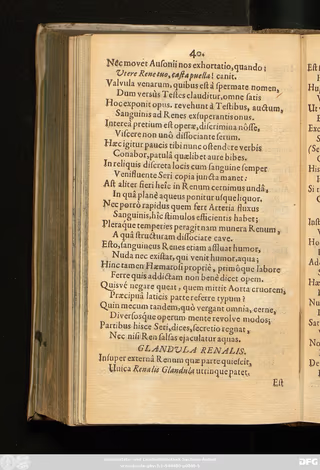
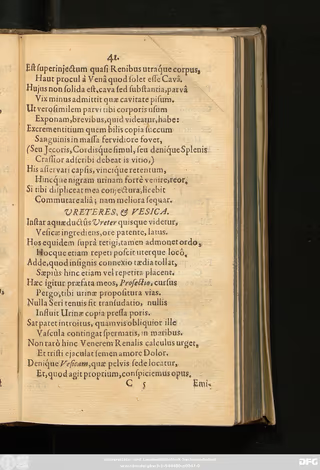
GLANDULA RENALIS.

Poet
Strauss
Form
Elegiac couplet
Open the page in the book
The pages this poem fills. Each opens in the Mikrokosmographia Metrica, sive Humani Corporis Historia reader.

Hover or tap a word to see its match.

Moreover, what rests on the external part of the Kidneys,

a single Renal Gland lies open on each side.

There is a body, as if thrown over the kidneys on each side,

which is usually not far from the Vena Cava.

Its substance is not solid, but hollow, which in its small

cavity admits scarcely less than a pea.

That I may explain to you the likely use of this small body,

receive in brief what it seems to be:

The excrementitious juice which the abundance of bile

fosters in the hotter mass of the blood

(whether it ought to be ascribed to a grosser defect

of the liver and the heart together, or finally of the spleen),

I suppose is preserved in these capsules, and kept confined,

and that from here perhaps the black urine comes.

If my conjecture displeases you, you will be allowed

to exchange it for another; for I will follow better ones.

Inſuper externâ Renum quæ parte quieſcit,

Unica Renalis Glandula utrinque patet.

Eſt ſuperinjectum quaſi Renibus utrâque corpus,

Haut procul à Venâ quod ſolet eſſe Cavâ.

Hujus non ſolida eſt, cava ſed ſubſtantia, parvâ

Vix minus admittit quæ cavitate piſum.

Ut veroſimilem parvi tibi corporis uſum

Exponam, brevibus, quid videatur, habe:

Excrementitium quem bilis copia ſuccum

Sanguinis in maſſa fervidiore fovet,

(Seu Jecoris, Cordisq́ue ſimul, ſeu deniq́ue Splenis

Craſſior adſcribi debeat is vitio,)

His aſſervari capſis, vinciq́ue retentum,

Hincq́ue nigram urinam fortè venire, reor.

Si tibi diſpliceat mea conjectura, licebit

Commutare aliâ; nam meliora ſequar.
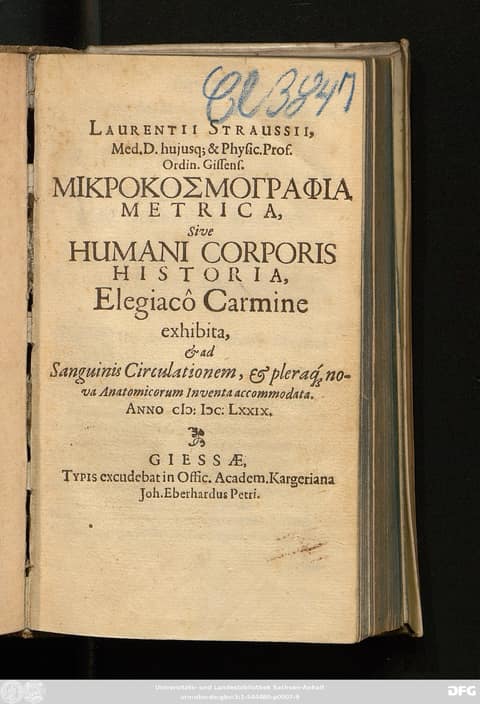
Title page of Mikrokosmographia Metrica, sive Humani Corporis Historia
Title page of Mikrokosmographia Metrica, sive Humani Corporis Historia , 1679

About this text

Provenance

This digital edition is derived from the Deutsche Digitale Bibliothek record for the Universitäts- und Landesbibliothek Sachsen-Anhalt digitization of Lorenz Strauss's 1679 _Mikrokosmographia Metrica, sive Humani Corporis Historia_.

Methodology

Each scan is treated as a page-level unit. The page image remains the authority for the edition. Local Kraken OCR used the Reichenau Latin early-print model as a reading aid, then Gemini generated scan-grounded Latin transcription and scholarly English translation from the images, the OCR aid, and the approved glossary. During review preparation, the title and dedication pages received a light editorial repair to translate Latin abbreviations that had been left in the English output. Word links connect the English translation to the Latin transcription and locations on the scans. Some links highlight only the text because the source word could not be located on the scan.

Rights

The source work is in the public domain by publication age, and the DDB/Halle metadata records the digital surrogate under the Creative Commons Public Domain Mark 1.0. Poet Doctor's presentation adds generated OCR, transcription, translation, navigation metadata, and editorial context.

Original scans: Deutsche Digitale Bibliothek / Universitäts- und Landesbibliothek Sachsen-Anhalt ( Public Domain Mark 1.0 ).

Historian’s note. This text records the medicine of its own time, and later evidence has replaced most of it. It is not medical advice. We read it as history, and we ask what, if anything, connects it to medicine today. More on how we read old medical books