Hover or tap a word to see its match.
The mass of the Pancreas is present, quite soft and slippery,
Having obtained its ancient name from flesh:
Yet this substance is not truly fleshy,
Rather it possesses the character of a glandular body.
The first Vertebra of the Loins, as you see, gives it its origin,
And it lies hidden beneath the posterior part of the stomach.
The branch which supplies veins to it is called the Splenicus,
And the pair between the ribs carries nervous threads.
And at the same time the Coeliac source itself again the left
Supplies, underneath this part lies many a gland.
Nor are lacteal vessels lacking here with inserted fibres,
And those which gush with clear flowing dew.
Indeed, that the Pancreas first gives origin to the chyliferous
Veins, you know that not a few men have established:
But our hastening care bids us avoid meanders,
Which it is clear can lead into various paths.
Meanwhile let us look at the Duct worthy of our song,
Which the studious hand of Virsungus showed.
In the accustomed order of Nature it is usually single,
Although the author has seen this work as double.
The substance of the said Duct is indeed membranous,
Yet it itself is everywhere entirely of its own kind.
Winding into the Duodenum, it opens with a wide mouth,
Where, mixed with yellow bile, it makes its way.
But it does not enter the Spleen, unless perhaps rarely,
Which path will then be more an error of Nature.
But as to what uses this discovery serves, there is not one
Mind among all; yet a use is not absent.
Thus far, I believe that a proper liquor is carried down from here,
By which that milky cream may be purified,
And at the same time a more intimate secretion of the chyle may take place,
And the foul dregs of stercoraceous mud may cease.
From here certain men wish to derive most diseases,
And fever is believed to have first arisen from this hearth:
For the threefold humor, fermenting in various parts,
Does not continually flow together in such a place in vain.
While the juice of the pancreas mixes its acidity with the bile,
And the lymph also brings its own liquids here;
Just as each rejoices and thrives in its own particles,
So too it moves bodies by its own power;
And from there the mixture boils with continuous tumult,
And sweeps all the viscera into sympathy.
Thus it is clear that certain men have taught: nor was favor lacking for their words;
Saliva is stirred by new theses.
I envy no one their laurel. Let the matter itself speak;
And then time will teach whether the work is true.
If I see anything in these matters, to me in those seats
Not every source and origin of evil lies hidden.
For many things call such a great dominion of the threefold liquor
Into doubt, with Sense offering no objection.
And deceptive Experience herself suspends her judgment,
And bids us to follow the ancients with reason.
" I am not a follower of the Ancients, nor, believe me, of the Moderns,
" Whether it is Ancient or Modern, I love the truth.
Those things belong to another place. We, by the begun path,
Will proceed; the whole way is not yet finished.
I will briefly teach you the primary advantages of the pancreas,
Lest I seem to want to weave excessive delays.
Namely, it provides the same use which a gland does,
Suspending individual vessels in a safe place.
Furthermore, like a pillow, it is laid under the stomach,
Lest contact with the spine be able to cause it harm.
The gland seems to support the branches of the vessels,
very often wasting of the body has arisen from this.
For thus they silently compel the nourishments to weave a delay,
while the gland, having suffered a scirrhus, presses upon the veins.
The ancients stated almost these uses of the glandular body;
but the light of today teaches more.
Indeed, to many this Gland seems unsuited
to be able to provide a soft cushion for the stomach;
For neither does the part touch the part with no separation,
nor does its position teach that this is very close to that.
But it pleases to reserve some things here for later cares;
meanwhile, you, see the teachings of Warthoni.
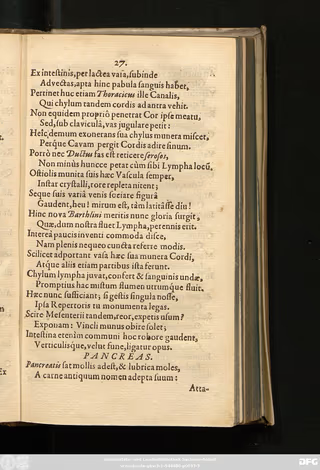
Pancreatis ſat mollis adeſt, & lubrica moles,
A carne antiquum nomen adepta ſuum :
Attamen hæc verè ſubſtantia carnea non eſt,
Glandoſi potiùs corporis omen habet.
Vertebra Lumborum, ceu cernis, prima dat ortum,
Partéque ſub ſtomachi poſteriore latet.
Ramus, qui tribuit venas huic, Splenicus audit,
Parq́; inter Coſtas Nervea fila vehit.
Cœliacusque ſimul rurſus fons ipſe ſiniſtrum
Suggerit, huic parti glandula multa ſubeſt.
Vaſa nec inſertis heîc deſunt lactea fibris,
Et quæ flumineo limpida rore ſcatent.
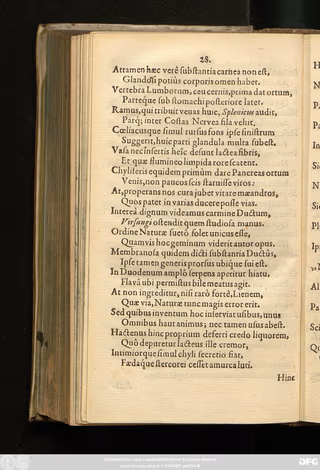
Chyliferis equidem primùm dare Pancreas ortum
Venis, non paucos ſcis ſtatuiſſe viros:
At, properans nos cura jubet vitare mæandros,
Quos patet in varias ducere poſſe vias.
Intereà dignum videamus carmine Ductum,
Virſungi oſtendit quem ſtudioſa manus.
Ordine Naturæ ſuetô ſolet unicus eſſe,
Quamvis hoc geminum viderit autor opus.
Membranoſa quidem dicti ſubſtantia Ductûs,
Ipſe tamen generis prorſus ubíque ſui eſt.
In Duodenum amplô ſerpens aperitur hiatu,
Flavâ ubi permiſtus bile meatus agit.
At non ingreditur, niſi rarò fortè, Lienem,
Quæ via, Naturæ tunc magis error erit.
Sed quibus inventum hoc inſerviat uſibus, unus
Omnibus haut animus; nec tamen uſus abeſt.
Hactenus hinc proprium deferri credo liquorem,
Quô depuretur lacteus ille cremor,
Intimiorque ſimul chyli ſecretio fiat,
Fædáque ſtercorei ceſſet amurca luti.
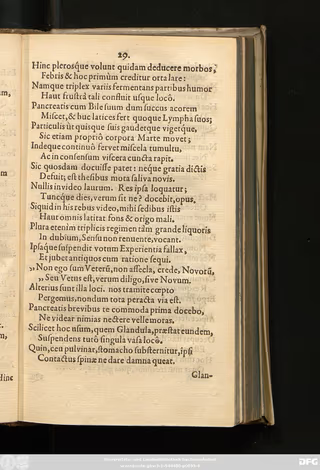
Hinc plerosq́ue volunt quidam deducere morbos,
Febris & hoc primùm creditur orta lare:
Namque triplex variis fermentans partibus humor
Haut fruſtrà tali confluit uſque locô.
Pancreatis cum Bile ſuum dum ſuccus acorem
Miſcet, & huc latices fert quoque Lympha ſuos;
Particulis ùt quisque ſuis gaudetque vigetq́ue,
Sic etiam propriô corpora Marte movet;
Indeque continuô fervet miſcela tumultu,
Ac in conſenſum viſcera cuncta rapit.
Sic quosdam docuiſſe patet: néque gratia dictis
Defuit; eſt theſibus mota ſaliva novis.
Nullis invideo laurum. Res ipſa loquatur;
Tuncq́ue dies, verum ſit ne? docebit, opus.
Siquid in his rebus video, mihi ſedibus iſtis
Haut omnis latitat fons & origo mali.
Plura etenìm triplicis regimen tàm grande liquoris
In dubium, Senſu non renuente, vocant.
Ipſaq́ue ſuſpendit votum Experientia fallax,
Et jubet antiquos cum ratione ſequi.
„ Non ego ſum Veterũ, non aſſecla, crede, Novorũ,
„ Seu Vetus eſt, verum diligo, ſive Novum.
Alterius ſunt illa loci. nos tramite cœpto
Pergemus, nondum tota peracta via eſt.
Pancreatis brevibus te commoda prima docebo,
Ne videar nimias nectere velle moras.
Scilicet hoc uſum, quem Glandula, præſtat eundem,
Suſpendens tutô ſingula vaſa locô.
Quin, ceu pulvinar, ſtomacho ſubſternitur, ipſi
Contactus ſpinæ ne dare damna queat.
Glandula vaſorum ramos fulcire videtur,
Sæpiùs hinc macies corporis orta fuit.
Namq́ue alimenta moram tacitè ſic nectere cogunt,
Dum venas ſcirrhum glandula paſſa premit.
Hos fermè antiqui glandoſi corporis uſus
Dixêre; at plures lux hodierna docet.
Quin etiam multis hæc Glandula inepta videtur,
Pulvinar ſtomacho quæ dare molle queat;
Nam neque pars partem nullô diſcrimine tangit,
Nec ſitus, hanc iſti proximè adeſſe, docet.
Sed placet heîc curis quædam ſervare ſecundis,
Warthoni intereà tu documenta vide.