Hover or tap a word to see its match.
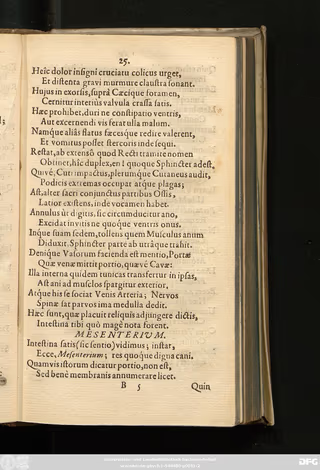
We have seen the intestines enough (so I feel); there presses on,
Behold, the mesentery; a thing also worthy to be sung.
Although it is said to be a portion of them, it is not,
But it is well permitted to number it among the membranes.
Moreover, whoever will consider it as a middle organ,
Will find many who approve of his words.
It is one in number, but division will make it twofold,
And then the Mesocolon will be a part of the Mesentery.
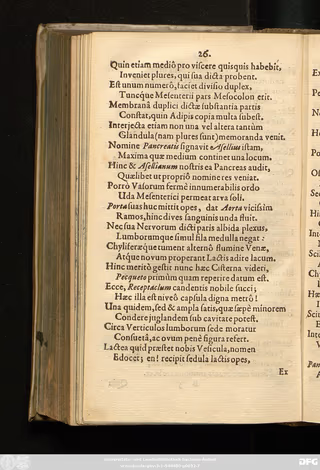
The substance of the said part consists of a double membrane,
Moreover, a great abundance of fat lies beneath.
Also, not merely one or two interspersed glands
(For there are many) must be mentioned.
Asellius designated by the name of Pancreas that
Largest single one which occupies the middle place.
Hence it is also called the Asellian Pancreas by our men,
So that each thing may be known by its proper name.
Furthermore, an almost innumerable array of vessels
Permeates the moist fields of the mesenteric soil.
The portal vein sends its riches here, the Aorta in turn gives
Branches, hence a rich wave of blood flows.
Nor does the plexus of nerves of the said pair,
And likewise the lumbar marrow, deny its white threads:
And the chyliferous veins swell with alternating flow,
And they hasten to approach the new lake of milk.
Hence this Cistern now deservedly desires to be seen,
Which it was first granted to Pecquet to discover.
Behold, the noble Receptacle of the shining juice;
This is that capsule worthy of snowy meter!
It is indeed single, but also ample enough, which can often
Conceal a smaller walnut within its cavity.
It dwells around the vertebrae of the loins in its customary
Seat, and its shape almost resembles an egg.
The name teaches what the Lacteal Vesicle does for us;
Behold! diligently it receives the riches of milk,
From the intestines, through the lacteal vessels, continually
Brought over, from here the blood has suitable nourishment.
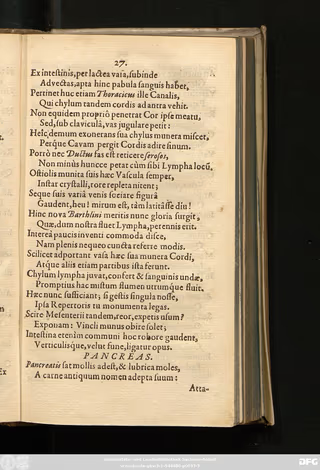
That Thoracic Canal also pertains to this,
Which finally carries the chyle to the chambers of the heart.
Indeed, it does not itself penetrate the Heart by its own passage,
But, beneath the collarbone, it seeks the jugular vessel:
Here finally discharging, the chyle mixes its gifts,
And proceeds through the Cava to approach the bosom of the Heart.
Furthermore, it is not right to keep silent about the serous Ducts,
Since the Lymph seeks this place for itself no less.
Fortified with their own little doors, these Vessels always
Shine, filled with dew like crystal;
And they rejoice to associate themselves with their veins in various shapes;
Alas! it is a marvel that they lay hidden for so long!
Hence new glory now arises for the merits of Barthlini,
Which, as long as our Lymph flows, will be everlasting.
Meanwhile, learn the advantages of the discovery in a few words,
For I cannot recount them all in full measure.
To be sure, these vessels bring their gifts to the Heart,
And they carry them to other parts as well.
The lymph aids the chyle, and contributes to the wave of blood;
Mixed by this, each stream flows more readily.
Let these things suffice for now; if you desire to know the details,
You should read the monuments of the Discoverer himself.
Finally, I suppose, you wish to know the use of the Mesentery?
I will explain: it is accustomed to perform the function of a bond;
For the intestines rejoice in this common strength,
And the work is tied to the vertebrae, as if by a rope.
Inteſtina ſatis (ſic ſentio) vidimus; inſtat,
Ecce, Meſenterium; res quoq́ue digna cani.
Quamvis iſtorum dicatur portio, non eſt,
Sed benè membranis annumerare licet.
Quin etiam mediô pro viſcere quisquis habebit,
Inveniet plures, qui ſua dicta probent.
Eſt unum numerô, faciet diviſio duplex,
Tuncq́ue Meſenterii pars Meſocolon erit.
Membranâ duplici dictæ ſubſtantia partis
Conſtat, quin Adipis copia multa ſubeſt.
Interjecta etiam non una vel altera tantùm
Glandula (nam plures ſunt) memoranda venit.
Nomine Pancreatis ſignavit Aſellius iſtam,
Maxima quæ medium continet una locum.
Hinc & Aſellianum noſtris ea Pancreas audit,
Quælibet ut propriô nomine res veniat.
Porrò Vaſorum fermè innumerabilis ordo
Uda Meſenterici permeat arva ſoli.
Porta ſuas huc mittit opes, dat Aorta viciſsìm
Ramos, hinc dives ſanguinis unda fluit.
Nec ſua Nervorum dicti paris albida plexus,
Lumborumque ſimul fila medulla negat:
Chyliferǽque tument alternô flumine Venæ,
Atq́ue novum properant Lactis adire lacum.
Hinc meritò geſtit nunc hæc Ciſterna videri,
Pecqueto primùm quam reperire datum eſt.
Ecce, Receptaclum candentis nobile ſucci;
Hæc illa eſt niveô capſula digna metrô!
Una quidem, ſed & ampla ſatis, quæ ſæpè minorem
Condere juglandem ſub cavitate poteſt.
Circa Verticulos lumborum ſede moratur
Conſuetâ, ac ovum penè figura refert.
Lactea quid præſtet nobis Veſicula, nomen
Edocet; en! recipit ſedula lactis opes,
Ex inteſtinis, per lactea vaſa, ſubinde
Advectas, apta hinc pabula ſanguis habet,
Pertinet huc etiam Thoracicus ille Canalis,
Qui chylum tandem cordis ad antra vehit.
Non equidem propriô penetrat Cor ipſe meatu,
Sed, ſub claviculâ, vas jugulare petit :
Heîc demum exonerans ſua chylus munera miſcet,
Perq́ue Cavam pergit Cordis adire ſinum.
Porrò nec Ductus fas eſt reticere ſeroſos,
Non minùs huncce petat cùm ſibi Lympha locũ.
Oſtiolis munita ſuis hæc Vaſcula ſemper,
Inſtar cryſtalli, rore repleta nitent;
Seque ſuis variâ venis ſociare figurâ
Gaudent, heu ! mirum eſt, tàm latitâſſe diu !
Hinc nova Barthlini meritis nunc gloria ſurgit,
Quæ, dum noſtra fluet Lympha, perennis erit.
Intereà paucis inventi commoda diſce,
Nam plenis nequeo cuncta referre modis.
Scilicet adportant vaſa hæc ſua munera Cordi,
Atq́ue aliis etiam partibus iſta ferunt.
Chylum lympha juvat, confert & ſanguinis undæ,
Promptiùs hac miſtum flumen utrumq́ue fluit.
Hæc nunc ſufficiant; ſi geſtis ſingula noſſe,
Ipſa Repertoris tu monumenta legas.
Scire Meſenterii tandem, reor, expetis uſum ?
Exponam : Vincli munus obire ſolet;
Inteſtina etenìm communi hoc robore gaudent,
Verticulisq́ue, velut fune, ligatur opus.