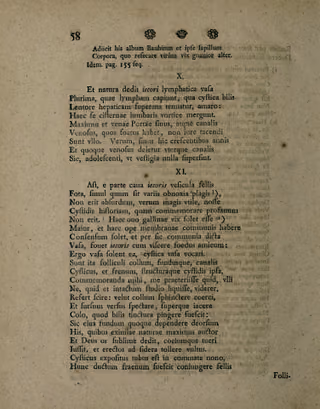
X.

Poet
Christian Tobias Ephraim Reinhard
Book
Medicus poeta , 1762
Form
Not identifiable from book
Open the page in the book
The page this poem fills. Each opens in the Medicus poeta reader.

X.

And nature has given to the liver very many lymphatic

Vessels, which take up the lymph by which the cystic bile,

Surpassing the hepatic in bitter viscosity, is thinned:

These plunge themselves into the whirlpool of the lumbar cistern.

Both the greatest sinus of the portal vein and the venous

Canal, which the fetus possesses, must by no right be passed over

In silence. Yet, with growing years, both this sinus

And the venous canal are each obliterated,

So that in the youth no traces remain.

Et natura dedit iecori lymphatica vasa

Plurima, quae lympham capiunt, qua cystica bilis

Lentore hepaticam superans tenuatur, amaro:

Haec se cisternae lumbaris vortice mergunt.

Maximus et venae Portae sinus, atque canalis

Venosus, quos foetus habet, non iure tacendi

Sunt vllo. Verum, sinus hic crescentibus annis

Et quoque venosus deletur vterque canalis

Sic, adolescenti, vt vestigia nulla supersint.
More by Christian Tobias Ephraim Reinhard

Similar poems

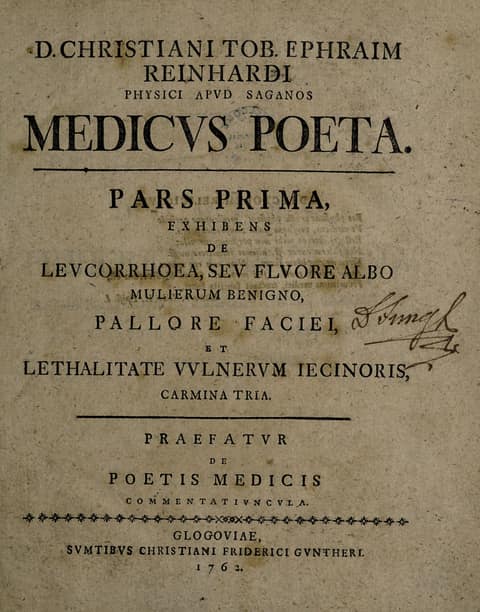
Title page of Medicus poeta
Title page of Medicus poeta , 1762

About this text

Provenance

This edition uses the Wellcome Collection copy, catalogued as _Medicus poeta. Pars prima, exhibens de leucorrhoea, pallore faciei, et lethalitate vulnerum jecinoris, carmina tria_ (b30503395). Scans 1 to 4 are the front cover and flyleaves with handwritten notes. Scan 5 is the title page. Scans 75 to 80 are blank leaves and the back cover.

Rights

The work is in the public domain by age. Wellcome Collection marks this copy with Public Domain Mark 1.0. Credit Wellcome Collection. Poet Doctor is a non-commercial site.

Original scans: Wellcome Collection ( Public Domain Mark 1.0 ).

Historian’s note. This text records the medicine of its own time, and later evidence has replaced most of it. It is not medical advice. We read it as history, and we ask what, if anything, connects it to medicine today. More on how we read old medical books