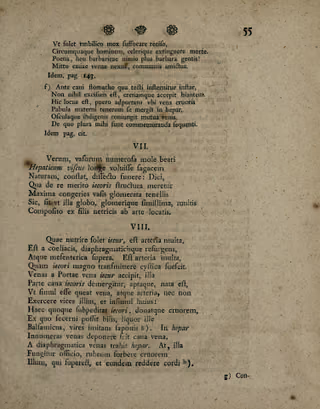
VII.

Poet
Christian Tobias Ephraim Reinhard
Book
Medicus poeta , 1762
Form
Not identifiable from book
Open the page in the book
The page this poem fills. Each opens in the Medicus poeta reader.

VII.

Indeed, that wise Nature wished by far

The hepatic viscus to be blessed with a numerous mass of vessels

Is evident when a corpse is dissected: Wherefore

The structure of the liver deservedly merits to be called

A very great congeries rolled together from delicate vessels

In such a way that it becomes most like a globe and a ball of yarn,

Composed of many threads arranged by the art of a spinner.

Verum, vasorum numerosa mole beari

Hepaticum viscus longe voluisse sagacem

Naturam, constat, dissecto funere: Dici,

Qua de re merito iecoris structura meretur

Maxima congeries vasis glomerata tenellis

Sic, fit vt illa globo, glomerique simillima, multis

Composito ex filis netricis ab arte locatis.
More by Christian Tobias Ephraim Reinhard

Similar poems

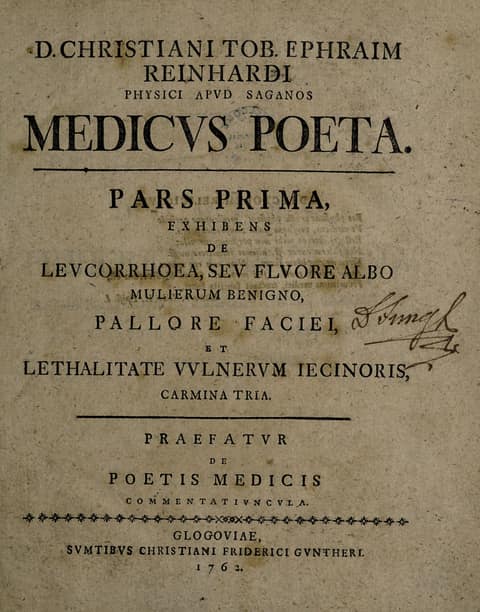
Title page of Medicus poeta
Title page of Medicus poeta , 1762

About this text

Provenance

This edition uses the Wellcome Collection copy, catalogued as _Medicus poeta. Pars prima, exhibens de leucorrhoea, pallore faciei, et lethalitate vulnerum jecinoris, carmina tria_ (b30503395). Scans 1 to 4 are the front cover and flyleaves with handwritten notes. Scan 5 is the title page. Scans 75 to 80 are blank leaves and the back cover.

Rights

The work is in the public domain by age. Wellcome Collection marks this copy with Public Domain Mark 1.0. Credit Wellcome Collection. Poet Doctor is a non-commercial site.

Original scans: Wellcome Collection ( Public Domain Mark 1.0 ).

Historian’s note. This text records the medicine of its own time, and later evidence has replaced most of it. It is not medical advice. We read it as history, and we ask what, if anything, connects it to medicine today. More on how we read old medical books