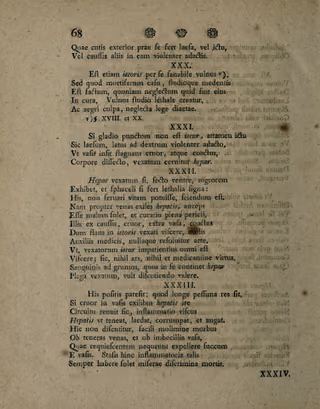
XXXIII.

Book
Medicus poeta , 1762
Form
Not identifiable from book
Open the page in the book
The page this poem fills. Each opens in the Medicus poeta reader.

Hover or tap a word to see its match.

XXXIII.

These things being posited, it becomes clear: that it is by far the worst thing,

if the blood in the slender vessels of the liver refuses

to go in its circuit in such a way, that inflammation holds,

injures, corrupts, and torments the viscus of the liver.

This disease is not dispersed by an easy effort,

on account of the tender veins, and on account of the weak vessels,

which cannot expel the stagnant humor

from the vessels. Hence such an inflammatory stasis

is always wont to bring the perils of a miserable death.

His positis patefit: quod longe pessima res sit,

Si cruor in vasis exilibus hepatis ire

Circuitu renuit sic, inflammatio viscus

Hepatis vt teneat, laedat, corrumpat, et angat.

Hic non discutitur, facili molimine morbus

Ob teneras venas, et ob imbecillia vasa,

Quae requiescentem nequeunt expellere succum

E vasis. Stasis hinc inflammatoria talis

Semper habere solet miserae discrimina mortis.
Title page of Medicus poeta
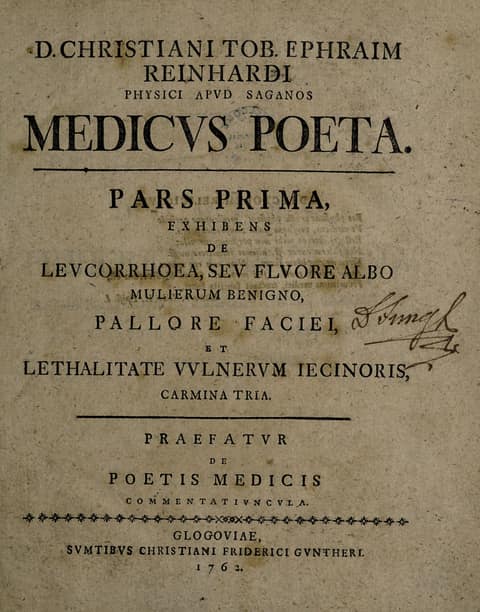
Title page of Medicus poeta , 1762

About this text

Provenance

This edition uses the Wellcome Collection copy, catalogued as _Medicus poeta. Pars prima, exhibens de leucorrhoea, pallore faciei, et lethalitate vulnerum jecinoris, carmina tria_ (b30503395). Scans 1 to 4 are the front cover and flyleaves with handwritten notes. Scan 5 is the title page. Scans 75 to 80 are blank leaves and the back cover.

Rights

The work is in the public domain by age. Wellcome Collection marks this copy with Public Domain Mark 1.0. Credit Wellcome Collection. Poet Doctor is a non-commercial site.

Original scans: Wellcome Collection ( Public Domain Mark 1.0 ).

Historian’s note. This text records the medicine of its own time, and later evidence has replaced most of it. It is not medical advice. We read it as history, and we ask what, if anything, connects it to medicine today. More on how we read old medical books