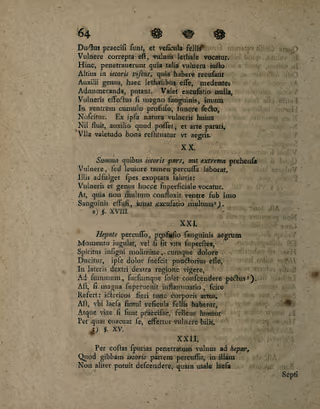
XXI.

Poet
Christian Tobias Ephraim Reinhard
Book
Medicus poeta , 1762
Form
Not identifiable from book
Open the page in the book
The page this poem fills. Each opens in the Medicus poeta reader.

Hover or tap a word to see its match.

XXI.

When the liver is struck, a profuse flow of blood slays

The patient in a moment, or if life survives,

Breath is drawn with great effort and with pain;

The pain itself is wont to be piercing,

To thrive in the right region of the right side,

And is accustomed to mount upward to the top of the chest t).

But, if a great inflammation supervenes, it is important

To know: that the limbs of the body then become jaundiced.

But, when the gall-bladder is held to be injured at the same time,

And if the passages are severed through which the bilious humor

Evacuates itself, bile is brought forth from the wound.

t) §. XV.

Hepate percusso, profusio sanguinis aegrum

Momento iugulat, vel si sit vita superstes,

Spiritus insigni molimine, cumque dolore

Ducitur, ipse dolor suescit punctorius esse,

In lateris dextri dextra regione vigere,

Ad summum, sursumque solet conscendere pectusᵗ).

Ast, si magna superuenit inflammatio, scire

Refert: ictericos fieri tunc corporis artus.

Ast, vbi laesa simul vesicula fellis habetur,

Atque viae si sunt praecisae, felleus humor

Per quas euacuat se, effertur vulnere bilis.

t) §. XV.
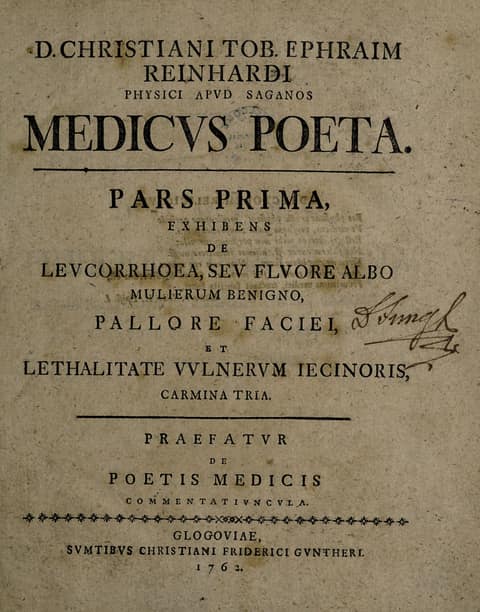
Title page of Medicus poeta
Title page of Medicus poeta , 1762

About this text

Provenance

This edition uses the Wellcome Collection copy, catalogued as _Medicus poeta. Pars prima, exhibens de leucorrhoea, pallore faciei, et lethalitate vulnerum jecinoris, carmina tria_ (b30503395). Scans 1 to 4 are the front cover and flyleaves with handwritten notes. Scan 5 is the title page. Scans 75 to 80 are blank leaves and the back cover.

Rights

The work is in the public domain by age. Wellcome Collection marks this copy with Public Domain Mark 1.0. Credit Wellcome Collection. Poet Doctor is a non-commercial site.

Original scans: Wellcome Collection ( Public Domain Mark 1.0 ).

Historian’s note. This text records the medicine of its own time, and later evidence has replaced most of it. It is not medical advice. We read it as history, and we ask what, if anything, connects it to medicine today. More on how we read old medical books