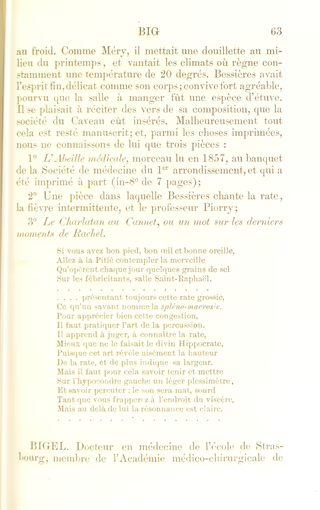
Si vous avez bon pied, bon œil et bonne oreille,

Poet
Edme-Barthélemy Bessières
Form
Alexandrin
Open the page in the book
The page this poem fills. Each opens in the Le Parnasse médical français reader.

Hover or tap a word to see its match.

If you have a good foot, a good eye, and a good ear,

Go to the Pitié to contemplate the marvel

That a few grains of salt work every day

On the fever patients, in the Saint-Raphaël ward.

always presenting this enlarged spleen,

Which a scholar calls *spleno-macrosia*.

To properly appreciate this congestion,

One must practice the art of percussion.

He teaches how to judge, to know the spleen,

Better than the divine Hippocrates did,

Since this art easily reveals the height

Of the spleen, and moreover indicates its width.

But for this one must know how to hold and place

On the left hypochondrium a light plessimeter,

And know how to percuss: the sound will be dull, muffled

As long as you strike over the organ,

But beyond it the resonance is clear.

Si vous avez bon pied, bon œil et bonne oreille,

Allez à la Pitié contempler la merveille

Qu'opèrent chaque jour quelques grains de sel

Sur les fébricitants, salle Saint-Raphaël.

présentant toujours cette rate grossie,

Ce qu'un savant nomme la spléno-macrosie.

Pour apprécier bien cette congestion,

Il faut pratiquer l'art de la percussion.

Il apprend à juger, à connaître la rate,

Mieux que ne le faisait le divin Hippocrate,

Puisque cet art révèle aisément la hauteur

De la rate, et de plus indique sa largeur.

Mais il faut pour cela savoir tenir et mettre

Sur l'hypocondre gauche un léger plessimètre,

Et savoir percuter : le son sera mat, sourd

Tant que vous frapperez à l'endroit du viscère,

Mais au delà de lui la résonnance est claire.
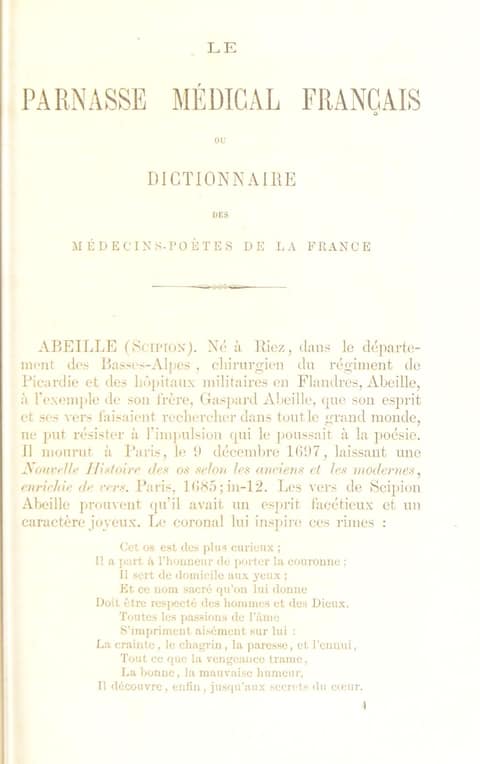
Title page of Le Parnasse médical français
Title page of Le Parnasse médical français , 1874

About this text

Provenance

This digital edition is derived from the Wellcome Collection copy of Achille Chéreau's 1874 dictionary of French physician-poets. The current reader uses the reacquired Wellcome IIIF JPEG corpus as the facsimile source of record.

Methodology

Each page is treated as a page-level unit. The page image remains the authority for the edition. Machine OCR is used as source OCR and reading aid, then corrected into French transcription, then translated into English. Word links connect the English translation to the French transcription and locations on the scans. Fifteen uncertain word-link decisions remain unlinked. Some links highlight only the text because the source word could not be located on the scan.

Rights

The source item is attributed to Wellcome Collection and marked with the Creative Commons Public Domain Mark. Poet Doctor's presentation adds generated transcription, translation, navigation metadata, and editorial context. No access control or anti-bulk-download measure should conflict with the public-domain status of the source material.

Original scans: Wellcome Collection ( Public Domain Mark 1.0 ).

Historian’s note. This text records the medicine of its own time, and later evidence has replaced most of it. It is not medical advice. We read it as history, and we ask what, if anything, connects it to medicine today. More on how we read old medical books