Hover or tap a word to see its match.
XXXII.
If a bruised liver, when the belly is cut open, exhibits
blackness, and if it bears the lethal signs of sphacelus:
from these, one must know that life could not have been saved.
For on account of the slender veins of the liver, the evil
is wont to be perilous, and the cure full of danger,
from those causes, while the blood, outside the vessels, clotted
and standing in the substance of the bruised liver, is resolved
by no medical aids, and by no art.
Just as the liver is more intolerant of injuries than any
viscus; so neither art, nor any virtue in a medicine,
can avail in dispersing the clots of blood, which the liver,
bruised by a blow, contains within itself.
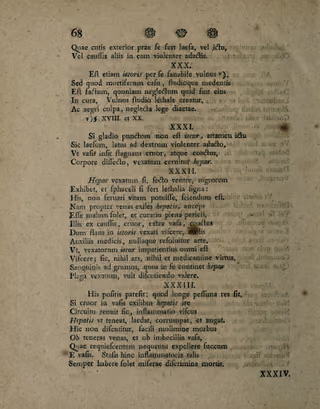
Hepar vexatum si, secto ventre, nigrorem
Exhibet, et sphaceli si fert lethalia signa:
His, non seruari vitam potuisse, sciendum est.
Nam propter venas exiles hepatis, anceps
Esse malum solet, et curatio plena pericli,
Illis ex caussis, cruor, extra vasa, coactus
Dum stans in iecoris vexati viscere, nullis
Auxiliis medicis, nullaque resoluitur arte.
Vt, vexatorum iecur impatientius omni est
Viscere; sic, nihil ars, nihil et medicamine virtus,
Sanguinis ad grumos, quos in se continet hepar
Plaga vexatum, vult discutiendo valere.