XVI.

Poet
Christian Tobias Ephraim Reinhard
Book
Medicus poeta , 1762
Form
Not identifiable from book
Open the page in the book
The page this poem fills. Each opens in the Medicus poeta reader.

Hover or tap a word to see its match.

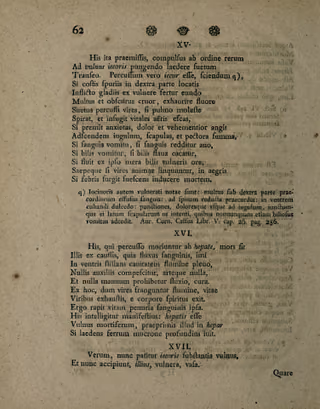
XVI.

For those who die from a stricken liver, death occurs

From these causes: because the flow of blood, trickling

In a full stream into the cavity of the lower belly,

Is checked by no remedies, and by no art,

And the discharge is prevented by no care of the hands.

From this stream, while the strength is broken, with the powers

Of life exhausted, the spirit departs from the body.

Therefore the very lack of blood snatches away life.

By these things it is understood more manifestly: that a wound

Of the liver is mortal, especially if that wounding iron

Has gone more deeply with its point into the liver.

His, qui percusso moriuntur ab hepate, mors fit

Illis ex caussis, quia fluxus sanguinis, imi

In ventris stillans cauitatem flumine pleno,

Nullis auxiliis compescitur, arteque nulla,

Et nulla manuum prohibetur fluxio, cura.

Ex hoc, dum vires franguntur flumine, vitae

Viribus exhaustis, e corpore spiritus exit.

Ergo rapit vitam penuria sanguinis ipsa.

His intelligitur manifestius: hepatis esse

Vulnus mortiferum, praeprimis illud in hepar

Si laedens ferrum mucrone profundius iuit.
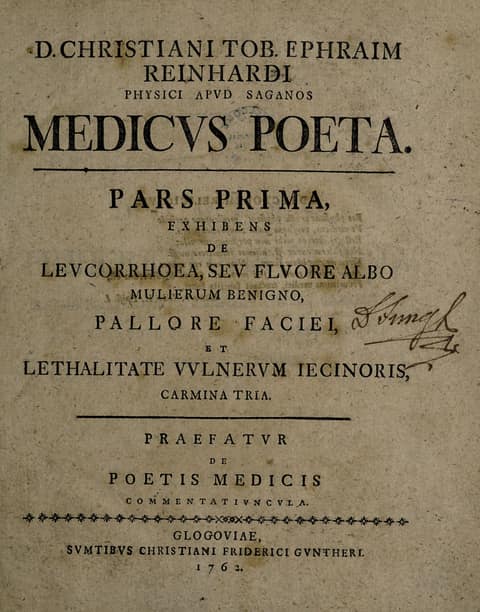
Title page of Medicus poeta
Title page of Medicus poeta , 1762

About this text

Provenance

This edition uses the Wellcome Collection copy, catalogued as _Medicus poeta. Pars prima, exhibens de leucorrhoea, pallore faciei, et lethalitate vulnerum jecinoris, carmina tria_ (b30503395). Scans 1 to 4 are the front cover and flyleaves with handwritten notes. Scan 5 is the title page. Scans 75 to 80 are blank leaves and the back cover.

Rights

The work is in the public domain by age. Wellcome Collection marks this copy with Public Domain Mark 1.0. Credit Wellcome Collection. Poet Doctor is a non-commercial site.

Original scans: Wellcome Collection ( Public Domain Mark 1.0 ).

Historian’s note. This text records the medicine of its own time, and later evidence has replaced most of it. It is not medical advice. We read it as history, and we ask what, if anything, connects it to medicine today. More on how we read old medical books