Hover or tap a word to see its match.
Part 1
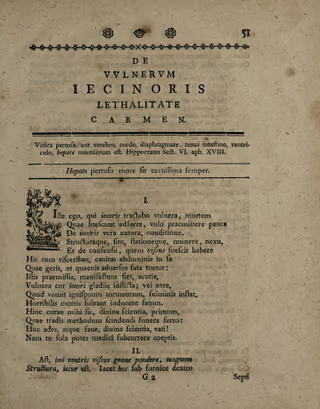
I.
I, who am about to treat of the wounds of the liver,
Which are wont to bring death, wish to premise a few things
Concerning the true nature and condition of the liver,
And its structure, site, and station, its office, connection,
And concerning the sympathy which the organ is wont to have
With those viscera which the cavity of the abdomen
Carries within itself, and protects against any fates whatsoever:
Once these things have been premised, it will become manifest
Why wounds inflicted upon the liver by sharp swords, or by the brass
Which a fire-spewing cannon vomits forth like a thunderbolt,
Are wont to bring on the fate of a horrible death.
Hence, may you be my care first of all, O divine science,
Who hand down the method of cutting open dead bodies with the steel:
Come hither, and favor the poet, O divine science!
For you alone are able to aid the undertakings of a physician.
II.
Now, the liver is an organ of the lower belly, heavy in weight, great
In structure. It lies under the right arch
I.
Ille ego, qui iecoris tractabo vulnera, mortem
Quae ſueſcunt adferre, volo praemittere pauca
De iecoris vera natura, conditione.
Structuraque, ſitu, ſtationeque, munere, nexu,
Et de conſenſu, quem viſcus ſueſcit habere
His cum viſceribus, cauitas abdominis in ſe
Quae gerit, et quaeuis aduerſus fata tuetur:
Iſtis praemiſſis, manifeſtum fiet, acutis,
Vulnera cur iecori gladiis inflicta; vel aere,
Quod vomit igniſpuum tormentum, fulminis inſtar,
Horribilis mortis ſoleant inducere fatum.
Hinc curae mihi ſis, diuina ſcientia, primum,
Quae tradis methodum ſcindendi funera ferro:
Huc ades, atque faue, diuina ſcientia, vati!
Nam tu ſola potes medici ſubcurrere coeptis.
II.
Aſt, imi ventris viſcus graue pondere, magnum
Structura, iecur eſt. Iacet hos ſub fornice dextro
Part 2
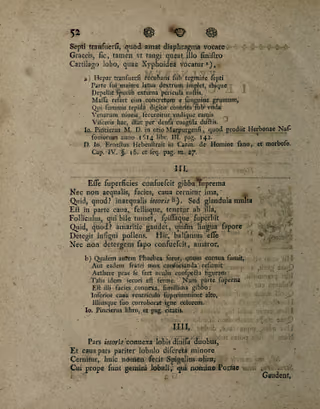
of the transverse septum, which it is fond of calling the diaphragm
among the Greeks, in such a way, however, that the cartilage which is called
xiphoid can be touched by that left lobe a).
Septi tranſuerſi, quod amat diaphragma vocare
Graecis, ſic, tamen vt tangi queat illo ſiniſtro
Cartilago lobo, quae Xyphoidea vocatur a).