Hover or tap a word to see its match.
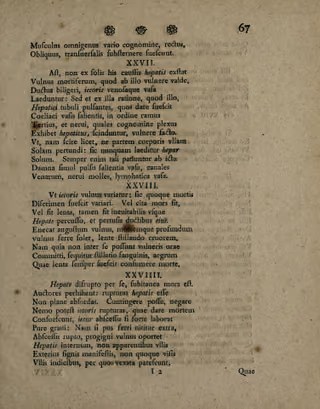
XXVII.
Yet it is not from these causes alone that a wound of the liver
is deadly, because by that wound the bile-bearing
ducts and venous vessels of the liver are severely
injured: but also for the reason that by that wound,
when inflicted, the pulsating hepatic tubules, which the third
branch in order of the throbbing coeliac vessel is accustomed
to supply, and the nerves, such as the plexus
called hepatic presents, are severed.
For, just as one may know that no part of the body is ever
pierced alone: so the liver is never injured
alone. For from such a blow, the vessels throbbing with a pulse,
the canals of the veins, the soft nerves, and the lymphatic vessels
always suffer damage at the same time.
Ast, non ex solis his caussis hepatis exstat
Vulnus mortiferum, quod ab illo vulnere valde,
Ductus biligeri, iecoris venosaque vasa
Laeduntur: Sed et ex illa ratione, quod illo,
Hepatici tubuli pulsantes, quos dare suescit
Coeliaci vasis salientis, in ordine ramus
Tertius, et nerui, quales cognomine plexus
Exhibet hepaticus, scinduntur, vulnere facto.
Vt, nam scire licet, ne partem corporis vllam
Solam pertundi: sic nunquam laeditur hepar
Solum. Semper enim tali patiuntur ab ictu
Damna simul pulsu salientia vasa, canales
Venarum, nerui molles, lymphatica vasa.