Hover or tap a word to see its match.
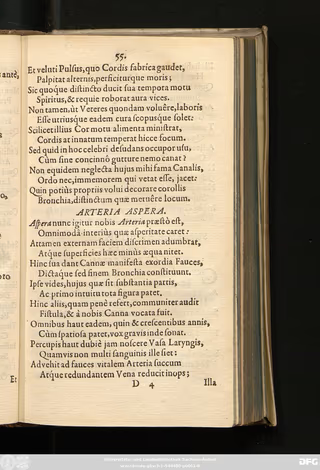
Now therefore the Arteria Aspera is before us,
Which lacks all manner of roughness on the inside:
Yet a difference shades its external face,
And this less even surface shines.
From here the throat gives the manifest beginnings of the Canna,
But the aforementioned bronchi constitute its end.
You yourself see what the substance of this part is,
And at first glance its whole figure is apparent.
Hence by others it is commonly called the Fistula, which it almost resembles,
And by us it has been called the Canna.
It is not the same for everyone, but rather with growing years,
When it opens up broadly, a deep voice sounds from it.
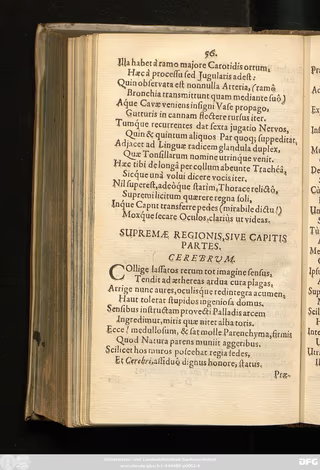
You doubtless very much desire now to know the vessels of the Larynx,
Although it is not of much blood:
An artery carries the vital juice to the throat
And a poor vein brings back the redundant juice;
The former has its origin from the greater branch of the Carotis,
But the latter is present from a process of the Jugular:
Moreover, some Artery has been observed, (which
The Bronchia transmit by means of their own branch)
And a shoot coming from the remarkable vessel of the Cava,
To bend its path back into the pipe of the Throat.
And then the sixth pairing provides the recurrent Nerves,
And indeed the fifth Pair also supplies some.
A double gland lies adjacent to the root of the Tongue,
Which comes by the name of the Tonsils on both sides.
These things I wished to tell you concerning the long Trachêa passing through the neck,
And thus together the path of the voice.
Nothing remains, and so immediately, with the Thorax left behind,
It is permitted to seek the kingdoms of the highest ground,
And to transfer our feet into the Head (marvelous to say!)
And soon to cut the Eyes, so that you may see more clearly.
Aſpera nunc igitur nobis Arteria præſtò eſt,
Omnimodâ interiùs quæ aſperitate caret :
Attamen externam faciem diſcrimen adumbrat,
Atq́ue ſuperficies hæc minùs æqua nitet.
Hinc ſua dant Cannæ manifeſta exordia Fauces,
Dictaq́ue ſed finem Bronchia conſtituunt.
Ipſe vides, hujus quæ ſit ſubſtantia partis,
Ac primo intuitu tota figura patet.
Hinc aliis, quam penè refert, communiter audit
Fiſtula, & à nobis Canna vocata fuit.
Omnibus haut eadem, quin & creſcentibus annis,
Cùm ſpatioſa patet, vox gravis inde ſonat.
Percupis haut dubiè jam noſcere Vaſa Laryngis,
Quamvis non multi ſanguinis ille ſiet:
Advehit ad fauces vitalem Arteria ſuccum
Atq́ue redundantem Vena reducit inops ;
Illa habet à ramo majore Carotidis ortum,
Hæc à proceſſu ſed Jugularis adeſt:
Quin obſervata eſt nonnulla Arteria, (ramô
Bronchia transmittunt quam mediante ſuô)
Áque Cavæ veniens inſigni Vaſe propago,
Gutturis in cannam flectere rurſus iter.
Túmque recurrentes dat ſexta jugatio Nervos,
Quin & quintum aliquos Par quoq; ſuppeditat.
Adjacet ad Linguæ radicem glandula duplex,
Quæ Tonſillarum nomine utrinque venit.
Hæc tibi de longâ per collum abeunte Trachêâ,
Sicque unà volui dicere vocis iter.
Nil ſupereſt, adeòque ſtatìm, Thorace relictô,
Supremi licitum quærere regna ſoli,
Ínque Caput transferre pedes (mirabile dictu!)
Móxque ſecare Oculos, clariùs ut videas.