Hover or tap a word to see its match.
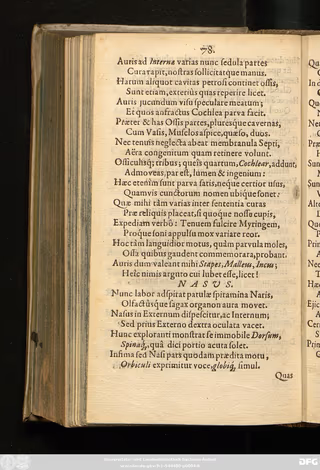
Now our labor breathes toward the vents of the open Nostril,
And the air moves the keen organ of smell.
The Nose is divided into the External and the Internal;
But first let the seeing right hand devote itself to the External.
To one exploring this, the immobile Dorsum presents itself,
And the Spine, as the sharp portion is usually called.
But the lowest part of the Nose, endowed with a certain motion,
Is expressed by the word Orbiculus, and also globus.
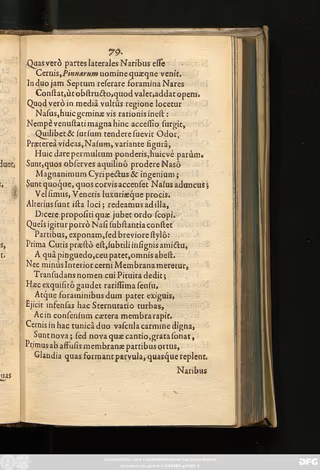
But whatever lateral parts you perceive the nostrils to have,
Each goes by the name of Pinnae.
Now it is established that the septum divides the nostrils into two openings,
So that if one is obstructed, the one that is functioning may provide assistance.
But as for the nose being placed in the middle region of the face,
There is the force of a twofold reason for this:
Namely, a great addition to beauty arises from this,
And every odor is accustomed to tend upwards.
Furthermore, you may see that the nose, by its varying shape,
Gives a great deal of weight to one person, or little to another.
There are those whom you may observe to reveal by an aquiline nose
The magnanimous heart and intellect of Cyrus;
There are also those whom a hooked nose classes with crows;
Or a snub nose, with the suitors of Venus and luxury.
Those matters belong to another place; let us return to those things
Which the order of our intended goal commands us to relate.
Therefore, I will explain further of what parts the substance
Of the nose consists, but in a briefer style:
First is the skin, notable for its thin covering,
From which, as is evident, all fat is absent.
No less does the interior membrane deserve to be examined,
To which the transuding Pituita gave its name;
This very delicate membrane enjoys an exquisite sense,
And while it is open with tiny pores,
Sneezing ejects hostile crowds through it,
And draws the other limbs into sympathy.
You perceive in this tunic two small vessels worthy of song,
They are new; but a song that is new sounds pleasing,
Their first origin is from the suffused parts of the membrane,
Which small glands form, and which they fill.
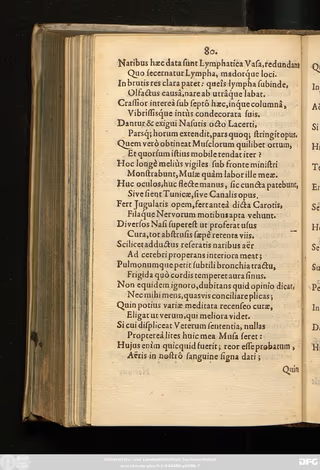
These lymphatic vessels are given to the nostrils, by which
The redundant lymph is secreted, and the moisture of the place.
In brutes the matter lies clear: in which the lymph frequently,
For the sake of smell, drips from both nostrils.
Meanwhile this is thicker beneath the septum, and in the column,
And adorned within by its own vibrissae.
Eight small muscles are also given to those with noses,
And a part of these extends, and a part also constricts the structure.
But what origin each of the muscles possesses,
And whither its mobile path tends?
This the watchful ministers beneath the brow will show
Far better than that labour of my Muse.
Turn your eyes here, turn your hands here, thus all things will be clear,
Whether they be tunics, or the work of a canal.
The jugular brings aid, the previously mentioned carotis brings aid,
And the threads of the nerves convey things suited for movements.
It remains that care should bring forth the diverse uses of the nose,
Care often held back by so many hidden paths.
To wit, air drawn in through the opened nostrils
Passes hastening to the interior of the brain;
And it seeks the bronchi of the lungs by a subtle course,
So that its cold breath might temper the cavities of the heart.
I am not indeed ignorant of what doubting opinion may say,
Nor is it my intention to reconcile every complexity;
But rather I review the meditations of varied inquiry,
So that he who sees better things may choose the truth.
If the opinion of the Ancients displeases anyone,
My Muse will sow no quarrels with him on that account:
For whatever of this there may be; I think it to be proven,
That signs of air are given in our blood;
Moreover, I think that air is always present in the remaining juices
Throughout the whole body, and in the viscera.
Although the manner of its entry remains undecided,
Nor is it yet agreed everywhere upon certain pathways;
Nevertheless, experience demonstrates the effect of the air,
And surely teaches it in the restored blood.
If the coldness of the air seems less suitable to you,
And you fear condensing frost in the boiling river:
And hence you would prefer to subscribe to the tenets of the moderns,
Rise, come, I freely give you my consent;
The light air tempers the dense blood by thinning it,
Thus it thrives, and the mass flows more florid.
Behold! Do I please? Let the somewhat cold air also please;
This, I think, will not accord badly with the Heart.
But I proceed to briefly set forth the remaining fruits,
Which Nature produces for man, when the Nostril is healthy.
By this path, as I have said, every odor is conveyed,
Hence, when the nostril is cut off, the power just mentioned perishes.
In which parts of the Nose does the sense of smelling reside?
Hitherto the matter has been debated in ambiguous ways.
There are the mammillary processes of the Cerebrum, girded by a tunic,
Which you see animate the nerve.
And the Nose gradually drives away excrements through its canals,
Arising from the abundant fountain of the blood.
Moreover, what the action of the Nostril contributes to the voice,
Coryza, often afflicting this, teaches.
Finally, who would deny that Nostrils mutilated by an inauspicious wound
Soon disgrace the entire face?
And hence they say that girls, often about to defend their chastity,
Provided for themselves with this defense;
And wise Egypt once punished the pacts of a stolen bed
by cutting off noses.
Nunc labor adſpirat patulæ ſpiramina Naris,
Olfactûsque ſagax organon aura movet.
Naſus in Externum diſpeſcitur, ac Internum;
Sed prius Externo dextra oculata vacet.
Hunc exploranti monſtrat ſe immobile Dorſum,
Spinaq́ꝫ, quâ dici portio acuta ſolet.
Infima ſed Naſi pars quodam prædita motu,
Orbiculi exprimitur voce, globíqꝫ ſimul.
Quas verò partes laterales Naribus eſſe
Cernis, Pinnarum nomine quæque venit.
In duo jam Septum reſerare foramina Nares
Conſtat, ùt obſtructo, quod valet, addat opem.
Quod verò in mediâ vultûs regione locetur
Naſus, huic geminæ vis rationis ineſt:
Nempè venuſtati magna hinc acceſſio ſurgit,
Quilibet & ſurſum tendere ſuevit Odor.
Prætereà videas, Naſum, variante figurâ,
Huic dare permultum ponderis, huicvé parùm.
Sunt, quos obſerves aquilinô prodere Naſô
Magnanimum Cyri pectus & ingenium;
Sunt quoq́ue, quos corvis accenſet Naſus aduncus;
Vel ſimus, Veneris luxuriǽque procis.
Alterius ſunt iſta loci; redeamus ad illa,
Dicere propoſiti quæ jubet ordo ſcopi.
Queîs igitur porrò Naſi ſubſtantia conſtet
Partibus, exponam, ſed breviore ſtylô:
Prima Cutis præſtò eſt, ſubtili inſignis amictu,
A quâ pinguedo, ceu patet, omnis abeſt.
Nec minùs Interior cerni Membrana meretur,
Tranſudans nomen cui Pituita dedit;
Hæc exquiſitô gaudet rariſſima ſenſu,
Atq́ue foraminibus dum patet exiguis,
Ejicit infenſas hac Sternutatio turbas,
Ac in conſenſum cætera membra rapit.
Cernis in hac tunicâ duo vaſcula carmine digna,
Sunt nova; ſed nova quæ cantio, grata ſonat,
Primus ab affuſis membranæ partibus ortus,
Glandia quas formant parvula, quasq́ue replent.
Naribus hæc data ſunt Lymphatica Vaſa, redundans
Quo ſecernatur Lympha, madorq́ue loci.
In brutis res clara patet: queîs lympha ſubindè,
Olfactus causâ, nare ab utrâque labat.
Craſſior intereà ſub ſeptô hæc, inq́ue columnâ,
Vibriſſisq́ue intùs condecorata ſuis.
Dantur & exigui Naſutis octo Lacerti,
Parsq́; horum extendit, pars quoq; ſtringit opus.
Quem verò obtineat Muſclorum quilibet ortum,
Et quorſum iſtius mobile tendat iter ?
Hoc longè meliùs vigiles ſub fronte miniſtri
Monſtrabunt, Muſæ quàm labor ille meæ.
Huc oculos, huc flecte manus, ſic cuncta patebunt,
Sive ſient Tunicæ, ſive Canalis opus.
Fert Jugularis opem, fert anteà dicta Carotis,
Filaq́ue Nervorum motibus apta vehunt.
Diverſos Naſi ſupereſt ut proferat uſus
Cura, tot abſtruſis ſæpè retenta viis.
Scilicet adductus reſeratis naribus aër
Ad cerebri properans interiora meat;
Pulmonumque petit ſubtili bronchia tractu,
Frigida quò cordis temperet aura ſinus.
Non equidem ignoro, dubitans quid opinio dicat,
Nec mihi mens, quasvis conciliare plicas;
Quin potius variæ meditata recenſeo curæ,
Eligat ut verum, qui meliora videt.
Si cui diſpliceat Veterum ſententia, nullas
Proptereà lites huic mea Muſa ſeret:
Hujus enìm quicquid fuerit; reor eſſe probatum,
Aëris in noſtrô ſanguine ſigna dari;
Quin etiam reliquis in toto corpore ſuccis
Viſceribusque auram ſemper adeſſe puto.
Ingreſsûs ratio quamvis ſub judice pendet,
Nec dum de certis conſtat ubique viis;
Aëris effectum tamen experientia monſtrat,
Inque reſtauratô ſanguine certa docet.
Si tibi frigiditas auræ minùs apta videtur,
Condenſansque times fervidô in amne gelu:
Hincq́ue modernorum placitis ſubſcribere malles,
Surge, age, conſenſum do tibi ſponte meum;
Temperat attenuans denſum levis aura cruorem,
Sic viget, atque magis florida maſſa fluit.
En! placeo? placeat quoq; frigidiuſculus aër;
Huic cum Corde, reor, non malè conveniet.
Sed pergo reliquos breviter proponere fructus,
Quos Natura homini, Nare valente, parit.
Hoc odor, ùt dixi, defertur tramite quivis,
Hinc nare abſciſsâ vis modò dicta perit.
Senſus odorandi queîs Naſi partibus inſit?
Hactenus ambiguis res agitata viis.
Sunt mammillares Cerebri, tunicâque recincti
Proceſſus, nervum quos animare vides.
Perque ſuos Naſus ſensìm excrementa canales,
Sanguinis ex largô fonte oriunda fugat.
Inſuper & voci quid conferat actio Naris,
Sæpiùs affligens hancce Coryza docet.
Denique quis truncas infauſtô vulnere Nares
Totam mox faciem dedecorare neget?
Hincq́ue pudicitiam aſſerturas ſæpè puellas
Hoc ſibi præſidiô conſuluiſſe ferunt;
Ægyptusq́ue ſagax furtivi fœdera lecti
Abſciſſis quondam naribus ulta fuit.