Hover or tap a word to see its match.
Now therefore turn your eyes with me from the Brain,
And subject these Eyes, friend, to your eyes.
A small orbit indeed encloses the said part,
Which at the same time you see has no great weight:
But a very great weight lies beneath! The sweetness of life,
Who, I ask, would deny that one deprived of Sight lacks?
The eyes are little Suns; to us most pleasing
Pledges, which he who alone lacks, lacks the world.
Nature surrounds this site with prudent strength,
So that Man, the observer, may be safe on all sides.
Because these ministering guards keep watch under the forehead,
Foreseen weapons can now do less harm.
The very perfection of sight seemed two Eyes
To require, so that a friend might bring aid to an injured one.
Meanwhile, each discerns not a double, but a single
Object; one and the same virtue unites them.
The external shape almost resembles round bulbs,
Where it rejoices in its canthi on either side.
Hence come those tears, that serous fluid,
Which the agitated Lympha carries from its own spring:
Affliction speaks its sorrows in this language,
Often complaining Love also feigns wounds;
And weeping is not the least pleasure of girls,
Which every woman rules by her own will.
Behold now, among the coverings given to the two Eyes,
In what a worthy place the spread Eyelid stands out.
The Eyelid, which owes its cloak to the fleshy tunic,
To which Muscle and Skin contribute.
And there is the other, lower one, which some maintain
Moves of its own accord, yet that movement is barely evident;
But the other blinks, highly mobile with a swift stroke,
And makes many words with its eyelashes.
Standing on the forehead, the eyebrow, distinguished by its hairy forest,
Very often associates its own gestures with these;
Although I would think it is with the primary purpose to remove dangers
Which could have threatened the eyes.
Here we rightly note the new vessels of the eyelids,
Hitherto unrevealed by ancient men;
Until Meibomius drew them from their hidden origin,
And the care of the man explained them in a learned diagram.
Do you ask what the caruncle in the larger canthus intends?
Lest the eyes be too wet, it closes the path.
And now the Muscle follows with a sixfold use,
Without which what grace of the face would there be? It would be a mask.
On this stage you may see the actors of the mind reveal themselves;
Here it expresses whatever the Spirit does within.
Now the mover raises, and the Proud man opens his
Eyes, now the humble Wretched man presses them down:
The third draws them inward, and is known by use to drinkers,
When you, O Iacchus, drain the crowned cups.
But the fourth, the Indignant, stands by with grim
Gestures; by this Phalaris was often terrifying:
The fifth in its orbit casts around with placid art
Its weight, and is carried to the lowest parts by oblique ways:
By a rather long tendon is rotated that very thin
Last one; hence the well-known trochlea has given it its name:
And these two woo favor for you with a smiling brow,
When you, O Love, lay an ambush for the good and gentle!
Let no one deny, once the poem is read, that such motors,
Beyond all others, Naso, were proper to you.
Unhappy teacher, how a wicked error carried you away!
Behold! Your eyes repelled you from your native soil!
There is a measure in things, and let the Use of the Muscle
Obey the mind, and thus all things will turn out well for the author.
And man alone, bidden to lift his upturned face to the stars,
Rejoices in so many motors of the eye:
But you see that the beasts, which look down prone to the earth,
Have needed a muscle suspending the eyes.
We proceed, the ship driven forward, to the various Canals,
Through which life and force come to the Eyes.
That clear one is owed to the Carotid streams,
But the Jugular vessel bears abundant feasts.
What I could say of the Nerves, I have mostly said;
When I gave you every bond of the Nerves.
I approach the Membranes; not those called coverings, but those,
By whose embrace the globe stands and falls.
The white adnata lies open, which is called the Conjunctiva,
And aptly sustains the role of a ligament.
Quite often in this the inflammation of the eye appears
With red spots, with Pain weeping its own tears.
The Sclirotica, offspring of the dura mater, follows this,
Which recalls its mother in character and thickness.
Yet in its anterior part it is transparent, like polished
Horn, by whose name it is sufficiently known:
Another succeeds, and is nearest to the aforesaid dura,
Known by learned men by the word Chorion:
But its anterior part is customarily called the uvea,
For it shines beautiful with a colour like a grape.
This obtains a slender origin from the pia mater,
And is seen to be blackish in its inner place.
The Uvea, rather thick, and distinguished by a double cloak,
Moves itself variously, driven by a ray of light.
In the middle, the anterior portion of the just-mentioned Tunic
Has a hole worthy of observation, behold.
This is usually called by the customary name Pupilla,
And is present so that so many images may enter;
For this door of vision lies open to countless
Objects, which alone it captures in a wondrous manner.
A varicolored bow passes beneath the border of the Tunic,
Which also has a name equal to the heavenly one.
The ciliary interstice is distinguished by its use
As a ligament, and its margin stands girt with its own fibers;
By the intervention of these, the Crystalline Humor itself
Is bound to the neighboring parts with excellent aid:
Furthermore, whenever the mobile Uvea blinks from here,
It is at hand, and that one moves itself in an equal manner.
Now the third Membrane of the eye longs to be seen,
To which indeed the Net gave various names:
But while its substance suggests an expanded nerve,
It proves itself to be an offspring of the brain, not without a witness.
It is obscurely white, surrounded by a slender thread,
And, half-drawn back, it resembles a kind of mitre:
And while the tenacious Retina halts the visual image,
Any thing painted there to the life shines forth.
Nor does the membrane just brought forth lack its own vessels,
By which the alimentary liquor stands and flows back.
When this, creeping forth, surrounds the drawn-out cloaks,
It now comes beautiful with the name of Crystalloides;
And the subtle Aranea is transparent with its own juice,
And thus shining it has the name and significance of a mirror.
Finally, the Membrane that clothes the vitreous liquor,
And hence is also rightly wont to be called the Vitreous;
Rejoicing everywhere in a sufficiently thin warp of threads,
Is moist with constant smoothness on both sides.
Here indeed you might be able to discern several, but small, Veins;
But more weighty matters call us elsewhere.
For who would wish to continuously dwell upon the smallest vessels?
Truly, that labor would be excessively difficult!
Rather, therefore, it is better to observe the Eyes' celebrated
Humors, of which it is granted to find three.
Are they excrementitious? The matter itself will speak,
When the Use of each is at hand to be recounted.
Like water, the first remains fluid with pleasant dew,
Nor does it lack remarkable utility.
The neighboring parts in the eyes are moistened by this sprinkling,
Lest heat crack them open like a dry field.
Moreover, it seems to magnify the images of the object,
Which the smaller Pupil gathers within its circle:
Furthermore, as a medium, the daylight rushing in with excessive brilliance
It refracts through its moderate lucidity;
And thus the same Humor, in the tunic which is called the Cornea,
Continues the work of the projecting ray.
Now succeeds a little wave similar to melted Glass,
Or which is thence called the vitreous Liquor:
This is less fluid than the former, but greater in weight,
And, being concave in its middle circle, forms a hollow;
Flatter anteriorly, rounded in the posterior part
It is observed, capable of mild light on both sides;
And the Crystalline Humour rests in the said cavity,
To which the Vitreous is present like a cushion.
The position of both fluids has become sufficiently known, you will say,
Now indicate to me, I ask, the purpose of the Vitreous.
This is the task, this is the toil; for who with such great discernment
Will touch a completely hidden matter for you with a needle?
There are those to whom the crude opinion of Galen is pleasing,
To whom the fluid of the Crystalloides is, as it were, a glutton;
And, hungering, it always desires new food,
Which the Vitreous Lympha might bring from its own provision;
But Plempius rightly refutes the ancient dogma,
Thinking a more worthy duty is present for this fluid:
For if the previously mentioned Retina should touch the humour
Similar to crystal in such close proximity,
Everything would stand in a confused light of rays,
And there would scarcely be a poor image in the convergence:
Hence the Vitreous will rather rejoice in another use,
And will soon allow the species to penetrate further,
So that the due refraction of the ray may occur in so many media,
And each may mark individual things in distinct ways.
Finally, the Crystalline humour must be examined by us,
Having the omen of its name from its own splendour;
For this shines and rejoices in a clear colour,
And all dye is also absent from this light:
Namely, so that this colour might receive all colours,
Another colour always had to be absent from it.
The concretion of this juice is not so hard;
Which gave it the name of Glacial in the art:
Moreover, it seems depressed in its anterior part,
The posterior portion remains almost round.
Thus the remarkable Humor, which we have seen thus far, has
These positions, this radiance Nature gave to it:
Nor does it gleam any less with the beautiful splendor of its duty,
Although it falls from its former condition;
For that Liquor is not the primary portion of Vision,
Nor does any fixed species shine in this place:
But rather the foremost glory of the media rises
In this Crystalline, and continues its dignity.
And whatever of the admitted light of the rays ever
From the first of the Humors (and whose name is of water)
Falls away, this the Ice collects in its deep borders,
And it projects the transmitted radiance further;
Until an image is painted on the tiny tablet,
And the Retina notes to the life both things and their modes.
To be sure, these things are thought to happen in no other way,
Than as we see established in a dark Chamber:
Hence whoever labor to teach the fabric of the eye,
Are accustomed to use this structure and aid.
And now I think the hidden things of the Eye lie open, and also
The manner of seeing, not sufficiently explained to the ancients before.
Indeed the rich abundance of things dictates more to me,
Yet here the Muse orders me to halt my course:
Wherefore leaving these things to others to be treated according to art,
Now I proceed to subject the Ears to your Eyes.
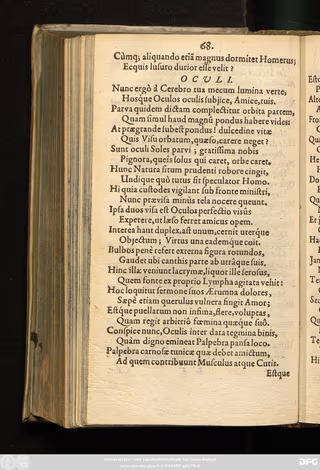
Nunc ergò à Cerebro tua mecum lumina verte,
Hosq́ue Oculos oculis ſubjice, Amice, tuis.
Parva quidem dictam complectitur orbita partem,
Quam ſimul haud magnũ pondus habere vides:
At prægrande ſubeſt pondus ! dulcedine vitæ
Quis Viſu orbatum, quæſo, carere neget ?
Sunt oculi Soles parvi ; gratiſſima nobis
Pignora, queîs ſolus qui caret, orbe caret.
Hunc Natura ſitum prudenti robore cingit,
Undique quò tutus ſit ſpeculator Homo.
Hi quia cuſtodes vigilant ſub fronte miniſtri,
Nunc præviſa minùs tela nocere queunt.
Ipſa duos viſa eſt Oculos perfectio visûs
Expetere, ut læſo ferret amicus opem.
Interea haut duplex, aſt unum, cernit uterq́ue
Objectum ; Virtus una eademq́ue coït.
Bulbos penè refert externa figura rotundos,
Gaudet ubi canthis parte ab utrâque ſuis.
Hinc illæ veniunt lacrymæ, liquor ille ſeroſus,
Quem fonte ex proprio Lympha agitata vehit:
Hoc loquitur ſermone ſuos Ærumna dolores,
Sæpè etiam querulus vulnera fingit Amor;
Eſtq́ue puellarum non infima, flere, voluptas,
Quam regit arbitriô fœmina quǽque ſuô.
Conſpice nunc, Oculis inter data tegmina binis,
Quàm digno emineat Palpebra panſa loco.
Palpebra carnoſæ tunicæ quæ debet amictum,
Ad quem contribuunt Muſculus atque Cutis.
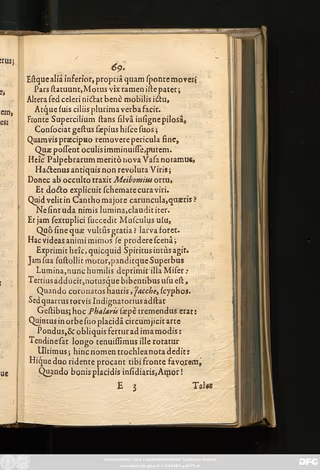
Eſtque aliä inferior, propriâ quam ſponte moveri
Pars ſtatuunt, Motus vix tamen iſte patet;
Altera ſed celeri nictat benè mobilis ictu,
Atque ſuis ciliis plurima verba facit.
Fronte Supercilium ſtans ſilvâ inſigne pilosâ,
Conſociat geſtus ſæpius hiſce ſuos;
Quamvis præcipuo removere pericula fine,
Quæ poſſent oculis imminuiſſe, putem.
Heîc Palpebrarum meritò nova Vaſa notamus,
Hactenus antiquis non revoluta Viris;
Donec ab occulto traxit Meibomius ortu,
Et docto explicuit ſchemate cura viri.
Quid velit in Cantho majore caruncula, quæris?
Ne ſint uda nimis lumina, claudit iter.
Et jam ſextuplici ſuccedit Muſculus uſu,
Quô ſine quæ vultûs gratia? larva foret.
Hac videas animi mimos ſe prodere ſcenâ;
Exprimit heîc, quicquid Spiritus intùs agit.
Jam ſua ſuſtollit motor, panditque Superbus
Lumina, nunc humilis deprimit illa Miſer:
Tertius adducit, notusque bibentibus uſu eſt,
Quando coronatos hauris, Jacche, ſcyphos.
Sed quartus torvis Indignatorius adſtat
Geſtibus; hoc Phalaris ſæpè tremendus erat:
Quintus in orbe ſuo placidâ circumjicit arte
Pondus, & obliquis fertur ad ima modis:
Tendine ſat longo tenuiſſimus ille rotatur
Ultimus; hinc nomen trochlea nota dedit:
Híque duo ridente procant tibi fronte favorem,
Quando bonis placidis inſidiaris, Amor!
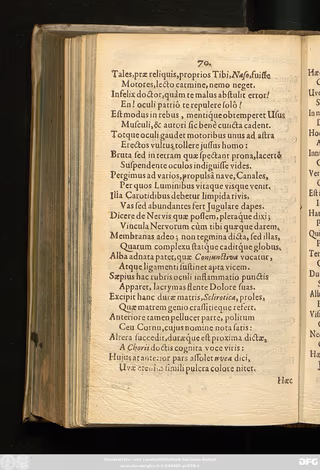
Tales, præ reliquis, proprios Tibi, Naſo, fuiſſe
Motores, lecto carmine, nemo neget.
Infelix doctor, quàm te malus abſtulit error!
En! oculi patriô te repulere ſolô!
Eſt modus in rebus, mentíque obtemperet Uſus
Muſculi, & autori ſic benè cuncta cadent.
Totque oculi gaudet motoribus unus ad aſtra
Erectos vultus tollere juſſus homo:
Bruta ſed in terram quæ ſpectant prona, lacertô
Suſpendente oculos indiguiſſe vides.
Pergimus ad varios, propulsâ nave, Canales,
Per quos Luminibus vitaque visque venit.
Illa Carotidibus debetur limpida rivis,
Vas ſed abundantes fert Jugulare dapes.
Dicere de Nervis quæ poſſem, pleraq́ue dixi;
Vincula Nervorum cùm tibi quæque darem.
Membranas adeo; non tegmina dicta, ſed illas,
Quarum complexu ſtatq́ue caditq́ue globus.
Alba adnata patet, quæ Conjunctiva vocatur,
Atque ligamenti ſuſtinet apta vicem.
Sæpius hac rubris oculi inflammatio punctis
Apparet, lacrymas flente Dolore ſuas.
Excipit hanc duræ matris, Sclirotica, proles,
Quæ matrem genio craſſitieque refert.
Anteriore tamen pellucet parte, politum
Ceu Cornu, cujus nomine nota ſatis:
Altera ſuccedit, durǽque eſt proxima dictæ,
A Chorii doctis cognita voce viris:
Hujus at anterior pars aſſolet uvea dici,
Uvæ etenim ſimili pulcra colore nitet.
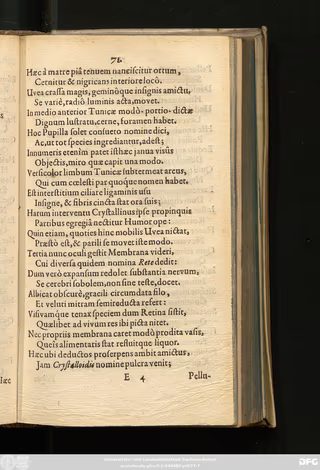
Hæc à matre piâ tenuem nanciſcitur ortum,
Cernitur & nigricans interiore locô.
Uvea craſſa magis, geminôque inſignis amictu,
Se variè, radiô luminis acta, movet.
In medio anterior Tunicæ modò-portio-dictæ
Dignum luſtratu, cerne, foramen habet.
Hoc Pupilla ſolet conſueto nomine dici,
Ac, ut tot ſpecies ingrediantur, adeſt;
Innumeris etenìm patet iſthæc janua visûs
Objectis, miro quæ capit una modo.
Verſicolor limbum Tunicæ ſubtermeat arcus,
Qui cum cœleſti par quoq́ue nomen habet.
Eſt interſtitium ciliare ligaminis uſu
Inſigne, & fibris cincta ſtat ora ſuis;
Harum interventu Cryſtallinus ipſe propinquis
Partibus egregiâ nectitur Humor ope:
Quin etiam, quoties hinc mobilis Uvea nictat,
Præſtò eſt, & parili ſe movet iſte modo.
Tertia nunc oculi geſtit Membrana videri,
Cui diverſa quidem nomina Rete dedit:
Dum verò expanſum redolet ſubſtantia nervum,
Se cerebri ſobolem, non ſine teſte, docet.
Albicat obſcurè, gracili circumdata filo,
Et veluti mitram ſemireducta refert:
Viſivamq́ue tenax ſpeciem dum Retina ſiſtit,
Quælibet ad vivum res ibi picta nitet.
Nec propriis membrana caret modò prodita vaſis,
Queîs alimentaris ſtat refluitque liquor.
Hæc ubi deductos proſerpens ambit amictus,
Jam Cryſtalloidis nomine pulcra venit;
Pellucetq́ue ſuo ſubtilis Aranea ſucco,
Sicq́ue nitens ſpeculi nomen & omen habet.
Deníque quæ vitreum veſtit Membrana liquorem,
Hincq́ue etiam dici Vitrea ritè ſolet;
Undíque ſat tenui filorum ſtamine gaudens,
Lævore aſſiduo parte ab utrâque madet.
Hîc equidem plures, ſed parvas, cernere Venas
Poſſis; aſt aliò nos graviora vocant.
Ecquis enìm minimis velit uſque inſiſtere vaſis;
Difficilis nimiùm næ! foret iſte labor.
Quin igitur celebres Oculorum cernere præſtat
Humores, quorum tres reperire datur.
Excrementitii num ſint? res ipſa loquetur,
Dum cujusq́ue Uſus commemorandus adeſt.
Inſtar aquæ primus jucundô fluxilis hæret
Rore, nec egregiâ commoditate caret.
Hacce madent oculis vicinæ aſpergine partes,
Ne veluti ſiccum fervor hiulcet agrum.
Quin etiam objecti ſpecies augere videtur,
Quas Pupilla ſuô cogit in orbe minor:
Inſuper, ùt medium, nimio ſplendore ruentem
Infringit modicâ luciditate diem;
Sicq́ue idem in tunicâ, quæ Cornea dicitur, Humor
Continuat radii proſilientis opus.
Succedit fuſo ſimilis nunc undula Vitro,
Quivè appellatur vitreus inde Liquor:
Hic illô minùs eſt fluidus, ſed pondere major,
Format & in medio concavus orbe ſinum;
Planior anteriùs, poſticâ parte rotundus
Conſpicitur, blandæ lucis utrínque capax;
Inqúe ſinu dictô Cryſtallinus Humor inhæret,
Cui pulvinaris Vitreus inſtar adeſt.
Sat ſitus innotuit, dices, utriusq́ue liquoris,
Significes Vitrei nunc mihi, quæſo, ſcopum.
Hoc opus, hic labor eſt; quis enìm diſcrimine tantô
Obtectam prorſus rem tibi tanget acu?
Sunt, quibus arridet ſententia craſſa Galeni,
Cui Cryſtalloidis ſit quaſi lurco liquor;
Eſuriensq́ue novam ſemper deſiderat eſcam,
Quam ferat ex propriô Vitrea Lympha penu;
Plempius antiquum meritò ſed dogma refellit,
Dignius huic liquido munus adeſſe putans:
Cryſtallo ſimilem nam ſi tàm parte propinquâ
Tangeret humorem Retina dicta prius,
Omnia confuſo radiorum lumine ſtarent,
Vixque in concurſu vilis imago foret:
Hinc aliô potiùs gaudebit Vitreus uſu,
Et ſpecies ultrà mox penetrare ſinet,
Debita tot mediis radii ut Refractio fiat,
Diſtinctisq́ue notet ſingula quisq́ue modis.
Luſtrandus tandem nobis Cryſtallinus humor,
A ſplendore ſuô nominis omen habens;
Hic etenìm clarô lucet, gaudetq́ue colore,
Omnis ab hoc etiam lumine fucus abeſt:
Scilicet ut caperet cunctos color iſte colores,
Debuit huic alius ſemper abeſſe color.
Non adeò dura eſt hujus concretio ſucci;
Quæ Glacialis ei nomen in arte dedit:
Inſuper anticâ depreſſus parte videtur,
Portio poſterior penè rotunda manet.
Sic habet inſignis, quem vidimus hactenus, Humor,
Hos Natura ſitus, hoc dedit illa jubar :
Nec minùs officii pulcro ſplendore coruſcat,
Quamvis antiquâ conditione cadit;
Non etenìm Liquor is primaria portio Visûs,
Fixaque nec ſpecies hoc nitet ulla locô :
Quin potiùs princeps mediorum gloria ſurgit
Hoc in Cryſtallô, continuatque decus,
Quicquid & admiſſi radiorum luminis unquam
A primô Humorum, (cuique vocamen aquæ eſt)
Excidit, hoc Glacies profundis colligit oris,
Transmiſſúmque magis projicit illa jubar;
Donec in exiguâ pingatur imago tabellâ,
Retinaque ad vivum resque modósque notet.
Scilicet haut aliâ fieri hæc ratione putantur,
Ac ſiſti obſcurâ cernimus in Camerâ :
Hinc oculi fabricam quicunque docere laborant,
Hac ſtructurâ uti, ſubſidióque ſolent.
Jamque patere Oculi reor abdita, tùmque videndi
Explicitum antiquis non ſatis antè modum.
Plura quidem dives dictat mihi copia rerum,
Attamen heîc curſum ſiſtere Muſa jubet :
Quare ex arte aliis hæc pertractanda relinquens,
Nunc Oculis Aures ſubdere pergo tuis.