Hover or tap a word to see its match.
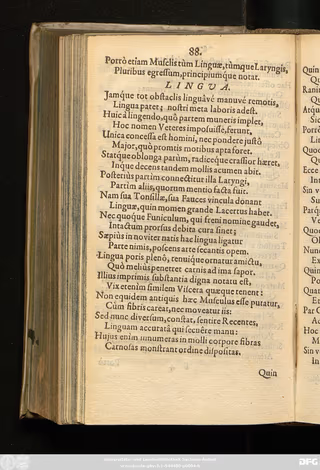
And now, with so many obstacles removed either by the tongue or by the hand,
The tongue lies exposed; the goal of our labor is at hand.
From licking, by which it fulfills part of its duty,
They say the ancients imposed this name upon it.
Only one is granted to man, nor is it greater than its proper
Weight, so that it might be suited for prompt movements.
And it stands somewhat oblong, and is attached more thickly at its root,
And finally, being soft, it tapers into a graceful point.
Posteriorly, it is partly connected to the larynx,
Partly to others, of which mention has been made.
For the tonsils give their bonds, the throat gives its own
To the tongue, and indeed the muscle has great power.
Nor will due care permit the cord, which rejoices in the name
Of the frenum, to be left entirely untouched;
Quite often in newborn children the tongue is bound
Too much by this part, demanding the aid of the cutter's art.
The tongue is adorned with a thin covering full of pores,
So that flavor may better penetrate to the depths of the flesh.
Its substance in particular is worthy of note,
For scarcely any of the viscera possess a similar one:
Indeed, it is not thought by the ancients to be a muscle,
Since it lacks fibers and is not moved by them:
But now it is clear that recent scholars feel differently,
Who have dissected the tongue with a careful hand:
For they show that innumerable fibers in its soft body,
Fleshy ones, are arranged in order.
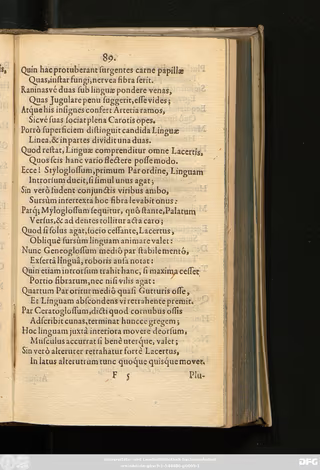
Moreover, rising papillae protuberate from this flesh,
Which a nervous fibre sows, like a fungus.
Or you see that there are two ranine veins under the weight of the tongue,
Which the Jugular store supplies;
And the Artery contributes notable branches to these,
Or thus the full Carotis allies its wealth.
Furthermore, a white Line distinguishes the surface of the Tongue,
And alone divides it into two parts.
As for what remains, the whole of the Tongue is comprised of muscles,
Which you know can bend it in various ways.
Behold! The Stylogloſſum, the first Pair in order, draws the Tongue
Inwards at once, if one acts;
But if both play with joined forces,
The interwoven fibre will lift this burden upwards:
And the Pair Mylogloſſum follows, with which standing, towards the Palate
And to the teeth the driven flesh is lifted;
But if the muscle acts alone, with its partner resting,
It is able to animate the tongue obliquely upwards:
Now the Geneogloſſum, a stable pair in the middle of the chin,
With the tongue thrust out, a handle of strength marks:
Moreover, it draws it inwards, if the greatest portion ceases
Of the fibres, and only a trifling one acts:
The fourth Pair arises as if in the middle bone of the throat,
And concealing the Tongue, presses it with a retracting force.
The Pair Ceratogloſſum, which to the horns of the said bone
Assigns its cradle, terminates this group;
This is able to move the tongue downwards near the interior,
If each muscle correctly comes to aid;
But if by chance either muscle is drawn back,
Then each also moves it to either side.
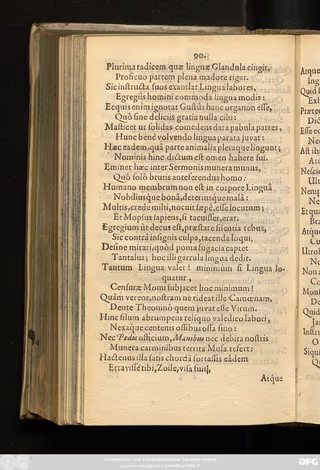
Many a gland which surrounds the root of the tongue,
Full of beneficial moisture, irrigates the part.
Thus equipped, the Tongue performs its labors,
A tongue advantageous to man in excellent ways:
For who does not know that this is the organ of Taste,
Without which there is no pleasure in the delights of food:
In order that he who eats the provided foods may chew the solid parts,
The prepared tongue assists him by rolling it well:
This is the same part with which most animals lick;
Hence it is said to hold the omen of its name.
This stands out as a gift among the gifts of Speech,
By which alone man is to be preferred to the brutes:
In the human body there is no member nobler
Than a good Tongue, and none worse than a bad one:
To many, believe me, it has often been harmful to have spoken;
And Mopsus would have been wise, if he had kept silent.
As it is an extraordinary honor to keep silence in affairs,
So on the contrary it is a notable fault to speak what should be kept silent.
Cease to wonder that Tantalus grasps at fleeing apples;
A garrulous tongue gave this to him.
So much power does the Tongue have! If the Tongue speaks
the very least,
This very least is subject to the censure of Momus!
How I fear lest he deride our Muse,
The man whom it pleases to be a Man with a Theonian tooth.
Hence, breaking off the thread, I bid farewell to the remaining labor,
And I leave the bones connected to hundreds of bones:
And the terrified Muse does not relate in verses the duty of the Foot,
Nor the duties assigned to our Hands:
Thus far she has perhaps seemed to you, O Zoilus,
To have wandered enough on that same string.
And a nausea has been created for your intellect by repeated words,
An intellect which flatters itself with its own resources:
What would happen, if the Muse were to describe in verse
The stiff and exhausted Limbs, and the Bones?
Would she sing of nothing besides Arms bared for more than half their part,
And the spoken Names of Vessels?
Indeed, it is clear that there is a great Use for all the Limbs,
And that they hold no less weight than the rest of the dwelling,
But since the Muscle reigns there with special skill,
And directs every point with its own hand,
I know not what my verses fear, with this one as Consul,
That they refuse to carry their foot further for me;
For truly it has disturbed our ventures too much thus far,
And not rarely has it entirely refused to fit the metre.
And although our effort lifts its arms with great force,
In order to dissect those arms of the body,
And skillful Care joins both hands to the Hands,
About to explain the reserved places:
On both sides, however, the delaying Muscle stands in the way,
Slowing our verses with its names.
Otherwise, Hand, suited for the body's countless uses,
You would not depart from me so torn from the body:
And I would show what strength your Thumb supplies,
Nay, I would grant a thousand due benefits to the Fingers:
I would sing of what the Shoulders avail, what they refuse to carry,
And already mention would have been made of the Elbow.
The wise man who wishes you to be the organ of instruments,
O Hand, has expressed the matter rightly for me.
For if Use extends anything to be taken up by both,
Who, unless the ready Hand comes forth, will be fit?
Nay, the dutiful Right Hand often averts heavy blows,
To which the welcome Left joins an allied hand:
Finally, who could sing the various arts which we establish with our hands,
Who could sing the games of the hands, or who their serious tasks?
Naked man, with his hands, overcomes the strength of beasts,
While he prepares weapons for himself, by which each of them perishes.
Finally, what should I report? They duly minister to Reason,
Along with Speech, the Hands; man alone has these.
Nor however, meanwhile, do the Feet lack their own weights,
Weights dutiful in diverse places.
Would anyone think the Legs a less useful weight for the Fabric,
Which are the greatest pillars of the whole house?
The rest of the viscera of the Human Body would collapse by their own mass,
If they were not kept safe by such a mass.
He walks wise, with face erect toward the stars,
And by his gait Man bears great glory.
How our Muse hastens to hasten on her own foot,
About to expound upon each Foot, nimble in its knee!
Behold the whole Foot, you will see nothing unpraiseworthy,
Its form commends all its steps by its usefulness.
The rounded Calf itself indicates a figure to be sung,
The Ankles show this, and the youthful Thigh.
And the Knee, as if bending itself of its own accord, behold,
Asks the Muse by what art she may sing this kind of duty.
But again the Muscle opposes itself with adverse daring,
And the Bones, incapable of being bent by my verses.
To confess the truth, I am unable, with so poor a vein,
To tell your so many faces, O wondrous Muscle;
Like Vertumnus you offer to me indeed a thousand figures,
And skillfully escape my feet.
Then too the songs proceed with a wearied leg,
Songs hardly to be burdened with so many broken sounds.
That fame awaits crowned Poets,
Whom the inclined Muse is more wont to favour.
My Tongue longs to be silent at the sight of the Tongue,
And thus to please even in this part of its duty;
Let the Tongue be the boundary for my wearied right hand,
Since now even the sharpness of the scalpel grows dull.
If by chance the author of the Poem has pricked with sprinkled salt,
He thinks he has done everything in a harmless manner.
A pure mind always recoils from biting bile,
Nor is a savage viper fostered by scattered jests.
I have nothing to do with satire: but nor would any flavour be present,
Unless there were a grain of salt in so great a body:
Hence, Reader, you will favour our Muse and Tongue,
And the Tongue will grant the pardon for my words, which I seek.
Many things, I confess, have eluded my labour,
Nor have individual details been recited in our meters;
He who plays has his reason. Nor did I wish to teach you everything
With my poem, but to refresh you.
If nevertheless it was permitted to be useful, the subject itself has moved
The reader; for it alone favours my Elegies!
Whatever learned Moderns have discovered in these matters,
I think I have recounted a great part;
Nor, however, have we despised the ancient masters in the art,
Whom an observing hand equally elevated:
„ Foolish Novelty displeases, crazy Antiquity
„ Does not please; believe me, nothing is prior to the Truth.
Dissection, you finish this undertaken journey on the path,
While the rotting corpse bids the work to finish.
We are dust and shadow! It is enough! Cease your labors,
And you, illustrious Guide and Companion of the way, Farewell:
Your honor and praises, Dissection, will always grow;
You alone destroy the whole Man for our good!
Jamq́ue tot obſtaclis linguâvé manuvé remotis,
Lingua patet; noſtri meta laboris adeſt.
Huic à lingendo, quô partem muneris implet,
Hoc nomen Veteres impoſuiſſe, ferunt,
Unica conceſſa eſt homini, nec pondere juſtô
Major, quò promtis motibus apta foret.
Statq́ue oblonga parùm, radiceq́ue craſſior hæret,
Inq́ue decens tandem mollis acumen abit.
Poſteriùs partìm connectitur illa Laryngi,
Partìm aliis, quorum mentio facta fuit.
Nam ſua Tonſillæ, ſua Fauces vincula donant
Linguæ, quin momen grande Lacertus habet.
Nec quoq́ue Funiculum, qui freni nomine gaudet,
Intactum prorſus debita cura ſinet;
Sæpiùs in noviter natis hac lingua ligatur
Parte nimis, poſcens arte ſecantis opem.
Lingua poris plenô, tenuíque ornatur amictu,
Quò meliùs penetret carnis ad ima ſapor.
Illius imprimis ſubſtantia digna notatu eſt,
Vix etenìm ſimilem Viſcera quæque tenent:
Non equidem antiquis hæc Muſculus eſſe putatur,
Cùm fibris careat, nec moveatur iis:
Sed nunc diverſum, conſtat, ſentire Recentes,
Linguam accuratâ qui ſecuêre manu:
Hujus enìm innumeras in molli corpore fibras
Carnoſas monſtrant ordine diſpoſitas.
Quin hac protuberant ſurgentes carne papillæ
Quas, inſtar fungi, nervea fibra ſerit.
Raninasvé duas ſub linguæ pondere venas,
Quas Jugulare penu ſuggerit, eſſe vides;
Atq́ue his inſignes confert Arteria ramos,
Sicvé ſuas ſociat plena Carotis opes.
Porrò ſuperficiem diſtinguit candida Linguæ
Linea, & in partes dividit una duas.
Quod reſtat, Linguæ comprenditur omne Lacertis,
Quos ſcis hanc vario flectere poſſe modo.
Ecce! Stylogloſſum, primum Par ordine, Linguam
Introrſum ducit, ſi ſimul unus agat;
Sin verò ludent conjunctis viribus ambo,
Sursùm intertexta hoc fibra levabit onus:
Parq́; Mylogloſſum ſequitur, quô ſtante, Palatum
Verſus, & ad dentes tollitur acta caro;
Quod ſi ſolus agat, ſocio ceſſante, Lacertus,
Obliquè ſursùm linguam animare valet:
Nunc Geneogloſſum mediô par ſtabile mentô,
Exſertâ linguâ, roboris anſa notat:
Quin etiam introrſum trahit hanc, ſi maxima ceſſet
Portio fibrarum, nec niſi vilis agat:
Quartum Par oritur mediô quaſi Gutturis oſſe,
Et Linguam abſcondens vi retrahente premit.
Par Ceratogloſſum, dicti quod cornubus oſſis
Adſcribit cunas, terminat huncce gregem;
Hoc linguam juxtà interiora movere deorſum,
Muſculus accurrat ſi benè uterq́ue, valet;
Sin verò alteruter retrahatur fortè Lacertus,
In latus alterutrum tunc quoq́ue quisq́ue movet.
Plurima radicem quæ linguæ Glandula cingit,
Proficuo partem plena madore rigat.
Sic inſtructa ſuos exantlat Lingua labores,
Egregiis homini commoda lingua modis:
Ecquis enim ignorat Guſtûs hanc organon eſſe,
Quô ſine deliciis gratia nulla cibi:
Maſticet ut ſolidas comedens data pabula partes,
Hunc benè volvendo lingua parata juvat:
Hæc eadem, quâ parte animalia pleraque lingunt;
Nominis hinc dictum eſt omen habere ſui.
Eminet hæc inter Sermonis munera munus,
Quô ſolô brutis anteferendus homo:
Humano membrum non eſt in corpore Linguâ
Nobiliusq́ue bonâ, deteriusq́ue malâ:
Multis, crede mihi, nocuit ſæpè, eſſe locutum;
Et Mopſus ſapiens, ſi tacuiſſet, erat.
Egregium ùt decus eſt, præſtare ſilentia rebus,
Sic contrà inſignis culpa, tacenda loqui.
Deſine mirari, quòd poma fugacia captet
Tantalus; hoc illi garrula lingua dedit.
Tantum Lingua valet! minimùm ſi Lingua lo-
quatur,
Cenſuræ Momi ſubjacet hoc minimum!
Quàm vereor, noſtram ne rideat ille Camœnam,
Dente Theoninô quem juvat eſſe Virum.
Hinc filum abrumpens reliquo valedico labori,
Nexaque centenis oſſibus oſſa ſino:
Nec Pedis officium, Manibus nec debita noſtris
Munera carminibus territa Muſa refert:
Hactenus illa ſatis chordâ fortaſſis eâdem
Erraviſſe tibi, Zoile, viſa fuit.
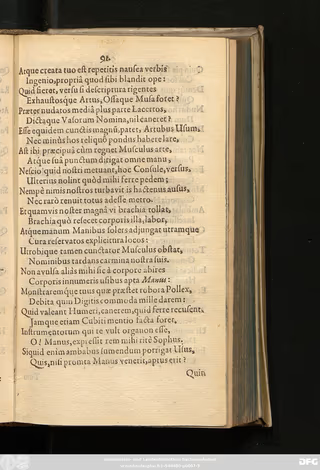
Atque creata tuo eſt repetitis nauſea verbis
Ingenio,propriâ quod ſibi blandit ope:
Quid fieret, verſu ſi deſcriptura rigentes
Exhauſtosq́ue Artus, Oſſaque Muſa foret?
Præter nudatos mediâ plus parte Lacertos,
Dictaque Vaſorum Nomina, nil caneret?
Eſſe equidem cunctis magnū,patet, Artubus Uſum,
Nec minùs hos reliquô pondus habere lare,
Aſt ibi præcipuâ cùm regnet Muſculus arte,
Atq́ue ſuâ punctum dirigat omne manu,
Neſcio quid noſtri metuant, hoc Conſule, verſus,
Ulterius nolint quòd mihi ferre pedem;
Nempè nimis noſtros turbavit is hactenus auſus,
Nec rarò renuit totus adeſſe metro.
Et quamvis noſter magnâ vi brachia tollat,
Brachia quò reſecet corporis illa, labor,
Atq́ue manum Manibus ſolers adjungat utramque
Cura reſervatos explicitura locos:
Utrobique tamen cunctator Muſculus obſtat,
Nominibus tardans carmina noſtra ſuis.
Non avulſa aliàs mihi ſic à corpore abires
Corporis innumeris uſibus apta Manus:
Monſtraremq́ue tuus quæ præſtet robora Pollex,
Debita quin Digitis commoda mille darem:
Quid valeant Humeri, canerem, quid ferre recuſent,
Jamque etiam Cubiti mentio facta foret.
Inſtrumentorum qui te vult organon eſſe,
O! Manus, expreſſit rem mihi ritè Sophus.
Siquid enim ambabus ſumendum porrigat Uſus,
Quis, niſi promta Manus venerit, aptus erit?
Quin pia ſæpè graves avertit Dextera motus,
Cui ſociam jungit grata Siniſtra manum:
Deniq́; quis varias, manibus quas condimus, artes,
Quis manuum luſus, ſeria quisvé canat?
Nudus homo manibus brutorum robora vincit,
Dum ſibi, queîs pereant ſingula, tela parat.
Denique quid referam? Rationi ritè miniſtrant,
Cum Sermone, Manus; has homo ſolus habet.
Nec tamen intereà Pedibus ſua pondera deſunt,
Pondera diverſis officioſa locis.
Ecquis Crura putet Fabricæ minus utile pondus,
Quæ ſunt totius maxima fulcra domûs?
Mole ſuâ ruerent, niſi tali cætera mole
Corporis Humani viſcera tuta forent.
Ambulat erecto ſapiens ad ſidera vultu,
Inceſſuque ſuo fert Homo grande decus.
Quàm properat properare ſuo pede noſtra Camœna,
Expoſitura agilem poplite quemque Pedem!
Totum cerne Pedem, nil non laudabile cernes,
Omnes forma gradus utilitate probat.
Indicat ipſa teres cantandam Sura figuram,
Hanc Tali monſtrant, & juvenile Femur.
Et quaſi ſponte Genu ſe flectens, ecce, Camœnam,
Officii genus hoc quò canat arte, rogat.
Aſt iterum adverſo ſe opponit Muſculus auſu,
Neſciaq́ue inflecti Verſibus Oſſa meis,
Ut verum fatear, nequeo, tàm paupere venâ,
Dicere tot facies, mire Lacerte, tuas;
Inſtar Vertumni mihi tu vel mille figuras
Offers, atque meos effugis arte pedes.
Tum quoque laſſato procedunt carmina crure,
Carmina tot fractis vix oneranda ſonis.
Iſta coronatos expectat Fama Poëtas,
Queîs propenſa magis Muſa favere ſolet.
Geſtit ad adſpectum Linguæ mea Lingua ſilere,
Hacque etiam officii parte placere ſui;
Lingua fatigatæ mihi dextræ terminus eſto,
Quando cultelli nunc & acumen hebet.
Si fortè aſperſo pupugit ſale Carminis autor,
Feciſſe innocuo ſe putat omne modo.
Candida Mens ſemper mordaci à bile refugit
Fota nec eſt ſparſis vipera ſæva jocis.
Nil mihi cum ſatyrâ: ſed nec ſapor ullus adeſſet,
Nî foret in tantô corpore mica ſalis:
Hinc noſtræ, Lector, Muſæ Linguæque favebis,
Et veniam dictis, quam peto, Lingua dabit.
Multa meo, fateor, ſe ſubduxêre labori,
Singula nec noſtris ſunt recitata metris ;
Eſt ſua ludenti ratio. neque cuncta docere
Carmine te volui, ſed recreare, meo.
Si prodeſſe tamen licuit, res ipſa legentem
Movit; namq́ue Elegis hæc favet una meis!
Quidquid in his rebus docti invenêre Moderni,
Me magnam partem commemorâſſe puto ;
Nec tamen antiquos contempſimus arte magiſtros,
Evexit pariter quos oculata manus:
„ Diſplicet inſipiens Novitas, delira Vetuſtas
„ Non placet; eſt Verô nil mihi, crede prius.
Hoc iter aggreſſum, Proſectio, tramite finis,
Dum finire jubet putre cadaver opus.
Pulvis & umbra ſumus! ſatis eſt! ceſſate labores,
Tuque viæ illuſtris Duxq́ue Comesq́ue Vale:
Semper honos, laudesq́ue tuæ, Proſectio, creſcent;
Totum Hominem noſtro deſtruis una bono!