Hover or tap a word to see its match.
Now the muscle is observed, notable for its varied use,
A part, which shines beautiful not in one part alone.
First, I believe, contraction gave it its Greek name,
For this is properly what every muscle does.
Here the head so mimics the tail with an equal tendon,
That you could call the end the beginning:
But in the middle is the belly, sufficiently filled with flesh,
Hence it also holds the name and omen of a body.
If by chance you ask, which portion among these little parts
Enjoys the honor of the principal part?
Different things please different people; the dispute is before the judge:
One takes the side of the tendon here, but another of the flesh.
I should think this is better said of the fibrous flesh,
Inasmuch as every muscle always loves it;
Since, however, one or another of these lacks a tendon,
So that flesh thus rightfully occupies the first place.
But indeed we see the remaining parts here contribute their shares,
And each join allied hands.
Hence the nerve brings aid, without which if the muscle were,
Motion would cease, and the work would soon perish.
But indeed, so that so noble an action may be better performed,
Many a fibre stretches out a hand in assistance.
There are also present fountains leaping with sweet blood,
Whereby the constant labour of the part may thrive everywhere.
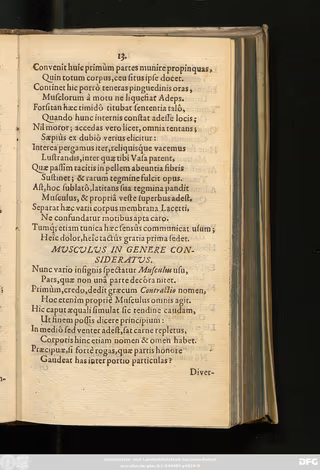
Nunc vario inſignis ſpectatur Muſculus uſu,
Pars, quæ non unâ parte decóra nitet.
Primùm, credo, dedit græcum Contractio nomen,
Hoc etenìm propriè Muſculus omnis agit.
Hîc caput æquali ſimulat ſic tendine caudam,
Ut finem poſſis dicere principium :
In mediô ſed venter adeſt, ſat carne repletus,
Corporis hinc etiam nomen & omen habet.
Præcipuæ, ſi fortè rogas, quæ partis honore
Gaudeat has inter portio particulas ?
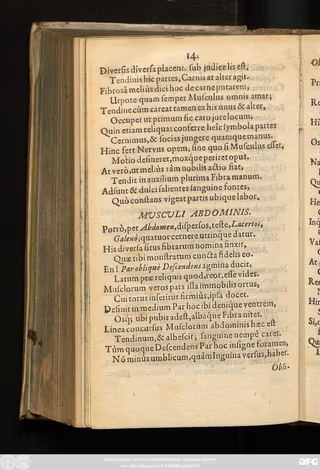
Diverſis diverſa placent. ſub judice lis eſt:
Tendinis hîc partes, Carnis at alter agit.
Fibrosâ meliùs dici hoc de carne putarem,
Utpote quàm ſemper Muſculus omnis amat;
Tendine cùm careat tamen ex his unus & alter,
Occupet ut primum ſic caro jure locum.
Quin etiam reliquas conferre heîc ſymbola partes
Cernimus, & ſocias jungere quamque manus.
Hinc fert Nervus opem, ſine quo ſi Muſculus eſſet,
Motio deſineret, moxq́ue periret opus.
At verò, ut meliùs tàm nobilis actio fiat,
Tendit in auxilium plurima Fibra manum.
Adſunt & dulci ſalientes ſanguine fontes,
Quò conſtans vigeat partis ubique labor.