Mikrokosmographia Metrica, sive Humani Corporis Historia: A Latin verse anatomy of the human body
By Lorenz Strauss · Published 1679 · Latin with English translation · Deutsche Digitale Bibliothek / Universitäts- und Landesbibliothek Sachsen-Anhalt
Historian’s note. This text records the medicine of its own time, and later evidence has replaced most of it. It is not medical advice. We read it as history, and we ask what, if anything, connects it to medicine today.
Historian’s note. This text records the medicine of its own time, and later evidence has replaced most of it. It is not medical advice. We read it as history, and we ask what, if anything, connects it to medicine today. More on how we read old medical books
We have not yet reviewed the translation of this book.
Mikrokosmographia Metrica, sive Humani Corporis Historia
A Latin verse anatomy of the human body
By Lorenz Strauss, 1679. The edition has the page scans, the Latin text, and an English translation.
Lorenz Strauss (1633–1687) was professor of medicine and physics at the University of Giessen and personal physician to the landgraves of Hesse-Darmstadt. Mikrokosmographia Metrica (Giessen, 1679) is his anatomy of the human body in Latin elegiac couplets. It moves through the belly, the chest and then the head, organ by organ, and ends with a prayer. The title page says that the poem follows “the circulation of the blood and most of the new discoveries of the anatomists.”
Strauss names these discoverers in his verse. He credits William Harvey with the circulation and follows Francis Glisson against Galen on the lobes of the liver. He sides with Jean Pecquet against Thomas Bartholin on where the chyle goes. He credits Marcello Malpighi with the papillae of the skin. On a dispute about fever he writes, “Whether it be Ancient or Modern, I love the truth.” His opening defends verse in medicine, since “Apollo the Physician played the first song.”
Lorenz Strauss is listed with the physician-poets in this library.
| Date | Place | Work | Notes |
|---|---|---|---|
| 1628 | Frankfurt | Exercitatio anatomica de motu cordis et sanguinis in animalibus By William Harvey | Harvey’s account of the circulation of the blood. Strauss crowns Harvey by name in his chapter on the heart and calls the blood’s course the circulus. |
| 1654 | London | Anatomia hepatis By Francis Glisson | Glisson’s study of the liver rejected the lobes that Galen had described. Strauss follows him and writes that Galen’s followers “thrust upon nature lobes which she herself denies.” |
| 1664 | London | Cerebri anatome By Thomas Willis | Willis’s anatomy of the brain placed voluntary motion in the cerebrum and involuntary functions in the cerebellum. Strauss sets out this view in verse, credits “the subtle Englishman,” and reserves his own judgment. |
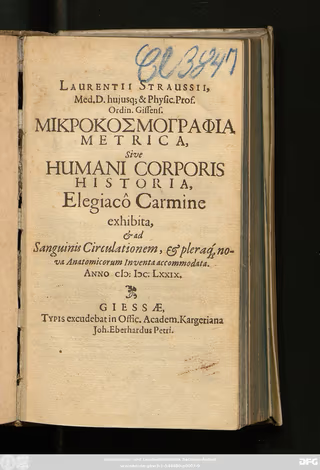
| 1679 | Giessen | Mikrokosmographia Metrica, sive Humani Corporis Historia By Lorenz Strauss | Printed by Johann Eberhard Petri at the Kargerian academic press, in 96 quarto pages. Strauss, born at Ulm, held the chair of medicine and physics at Giessen from 1661. He dedicated the poem to Georg and Johann Otto Horst, court physicians of the Horst family and his kinsmen by marriage. |
Illustrations
4 illustrations. Each opens its page in the reader, zoomed to the picture.
-

-
-
FINIS. -

Poems
35 poems, grouped by theme.