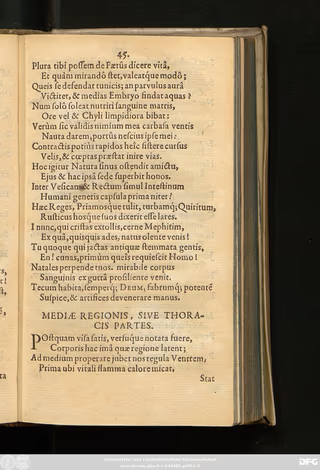
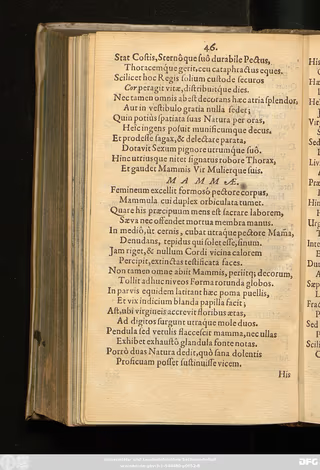
MEDIÆ REGIONIS, SIVE THORA- CIS PARTES.

Poet
Strauss
Form
Elegiac couplet
Open the page in the book
The pages this poem fills. Each opens in the Mikrokosmographia Metrica, sive Humani Corporis Historia reader.

Hover or tap a word to see its match.

AFter those things have been sufficiently seen, and noted in verse,

Which lie hidden in this lowest region of the body;

The rule bids us hasten to the middle belly,

Where the primary flame flickers with vital heat,

The durable chest stands with its ribs and sternum,

And wears a thorax, like a mail-clad knight.

Indeed, with this as its guard, the Heart, the King's throne,

Passes and distributes the secure days of life.

Yet not all splendor decorating these halls is absent,

Nor does grace fail to sit in the vestibule;

But rather Nature, having walked about her borders,

Has placed here immense and munificent beauty.

Sagacious to be of use, and prepared to delight,

She endowed each sex with its own pledge.

Hence the thorax of each shines, marked with strength,

And man and woman rejoice in their own breasts.

POſtquam viſa ſatis, verſuq́ue notata fuere,

Corporis hac imâ quæ regione latent;

Ad medium properare jubet nos regula Ventrem,

Prima ubi vitali flamma calore micat,

Stat Coſtis, Sternôque ſuô durabile Pectus,

Thoracemq́ue gerit, ceu cataphractus eques.

Scilicet hoc Regis ſolium cuſtode ſecuros

Cor peragit vitæ, diſtribuitq́ue dies.

Nec tamen omnis abeſt decorans hæc atria ſplendor,

Aut in veſtibulo gratia nulla ſedet;

Quin potiùs ſpatiata ſuas Natura per oras,

Heîc ingens poſuit munificumque decus.

Et prodeſſe ſagax, & delectare parata,

Dotavit Sexum pignore utrumq́ue ſuô.

Hinc utriusque nitet ſignatus robore Thorax,

Et gaudet Mammis Vir Mulierque ſuis.
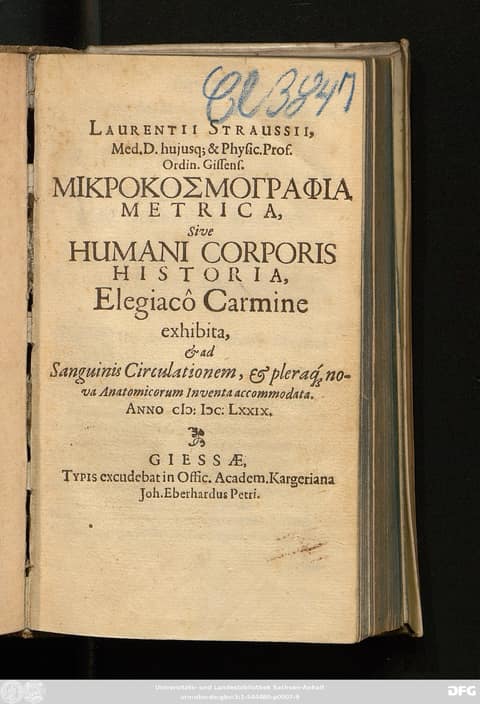
Title page of Mikrokosmographia Metrica, sive Humani Corporis Historia
Title page of Mikrokosmographia Metrica, sive Humani Corporis Historia , 1679

About this text

Provenance

This digital edition is derived from the Deutsche Digitale Bibliothek record for the Universitäts- und Landesbibliothek Sachsen-Anhalt digitization of Lorenz Strauss's 1679 _Mikrokosmographia Metrica, sive Humani Corporis Historia_.

Methodology

Each scan is treated as a page-level unit. The page image remains the authority for the edition. Local Kraken OCR used the Reichenau Latin early-print model as a reading aid, then Gemini generated scan-grounded Latin transcription and scholarly English translation from the images, the OCR aid, and the approved glossary. During review preparation, the title and dedication pages received a light editorial repair to translate Latin abbreviations that had been left in the English output. Word links connect the English translation to the Latin transcription and locations on the scans. Some links highlight only the text because the source word could not be located on the scan.

Rights

The source work is in the public domain by publication age, and the DDB/Halle metadata records the digital surrogate under the Creative Commons Public Domain Mark 1.0. Poet Doctor's presentation adds generated OCR, transcription, translation, navigation metadata, and editorial context.

Original scans: Deutsche Digitale Bibliothek / Universitäts- und Landesbibliothek Sachsen-Anhalt ( Public Domain Mark 1.0 ).

Historian’s note. This text records the medicine of its own time, and later evidence has replaced most of it. It is not medical advice. We read it as history, and we ask what, if anything, connects it to medicine today. More on how we read old medical books