Hover or tap a word to see its match.
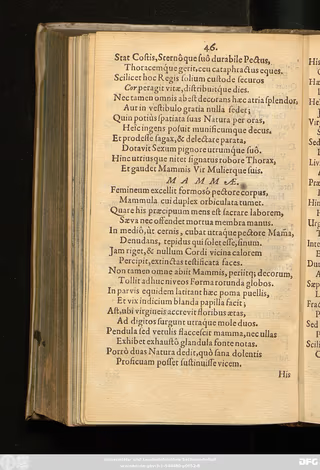
The female body excels with a beautiful chest,
On which a double rounded little breast swells.
Therefore it is my intention to dedicate my chief labor to these,
Nor will a cruel hand offend the dead limbs.
In the middle of the chest, as you see, a breast lies on either side,
Baring the bosom, which is accustomed to be warm.
Now it is stiff, and neighboring the Heart it perceives no heat,
Bearing witness that the torches are extinguished.
Yet not all beauty has departed and perished from the breasts,
The round form still lifts snowy globes.
In little girls, to be sure, these apples lie hidden,
And the charming nipple scarcely gives a sign;
But, when age has grown with maidenly flowers,
They rise in each mass to two fingers.
But in old women the pendulous breast grows flabby, and the gland
Exhibits no signs, its fountain being exhausted.
Furthermore, Nature gave two, so that a healthy one
Might be able to sustain the useful role of an aching one.
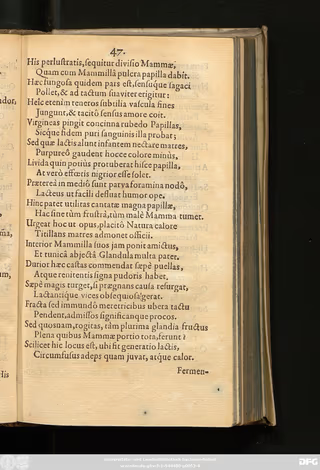
These having been surveyed, there follows the division of the Breast,
Which the beautiful nipple together with the Mammilla will provide.
This is indeed a spongy part, and is endowed with keen feeling,
And at a touch is pleasantly erected:
For here subtle little vessels join their tender ends,
And feeling unites in silent love.
An elegant redness paints maidenly Nipples,
And thus it proves the faithfulness of pure blood;
But mothers who nourish an infant with the nectar of milk,
Enjoy less of this purple hue,
Rather, in them a livid nipple protrudes,
But indeed in those past childbearing it is usually blacker.
Moreover, there are small holes in the middle of the node,
So that the milky fluid may flow down with easy aid.
Hence the great usefulness of the celebrated nipple is evident,
Without it the Breast swells both in vain and to ill effect.
To urge on this work, Nature, tickling with a pleasing heat,
Reminds mothers of their duty.
The inner Mammilla now lays aside its coverings,
And the tunic having been cast off, many a Gland is revealed.
Quite firm, this often commends chaste girls,
And holds the signs of resisting modesty.
Often it swells more, if a pregnant cause arises,
And compliantly performs the duties of nursing.
But in harlots, breasts broken by foul touch
Hang down, and signify the suitors they have admitted.
But what fruits, you ask, do so many glands bear,
Of which the whole portion of the Breast is full?
To be sure, this is the place where the generation of milk occurs,
Which the surrounding fat and heat assist.
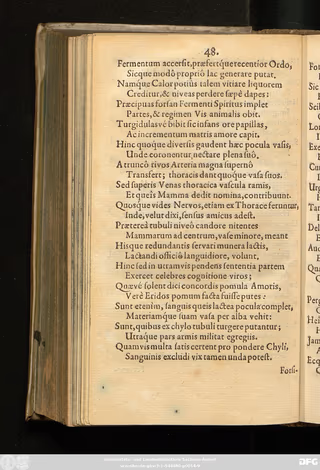
The more recent Order summons and prefers a ferment,
And thus thinks it generates milk in its own manner.
For Heat is rather believed to spoil such a fluid,
And often to destroy the snowy feasts:
Perhaps the Spirit of the Ferment fulfills the principal
Roles, and the animal Force undertakes the governance.
Or thus the infant drinks the swollen nipples with its mouth,
And takes its growth by the mother's love.
Hence also these cups rejoice in diverse vessels,
Whence they are crowned full with their own nectar.
The great Artery transfers streams from the upper trunk;
The vessels of the thorax also give theirs.
But the thoracic vessels, and those to which the Breast
Has given names, contribute Veins to the upper branches.
And the Nerves which you see, are also brought from the Thorax,
Thence, as I have said, a friendly sense is present.
Besides, little tubes shining with snowy whiteness
Travel to the center of the breasts, with a smaller vessel,
And by these they wish the gifts of overflowing milk to be preserved,
When the duty of suckling is more languid.
But hence an opinion wavering to either side
Exercises men celebrated for their knowledge;
Or those which are usually called the little apples of harmonious Love,
You might think have truly become the apple of Eris:
For there are those for whom blood fills the milky cups,
And carries its matter through the white vessels:
There are those by whom the little tubes are thought to swell from chyle;
Each side fights with excellent weapons.
Although many things contend sufficiently for the weight of Chyle,
Yet the wave of blood can scarcely be excluded.
Perhaps the coming day will further unearth the hidden passages,
And settle this dispute.
Thus, therefore, we have surveyed the breasts and the nipples,
And it is clear with what great utility they swell.
To be sure, the sake of adornment, insidious in its allurements,
Does not occupy all parts;
The greatest Mother of breasts shows something far different,
She who alone nurtures countless offspring in her bosom;
Excellent Nature teaches mothers by her own example,
And is the first to command them to give their own milk to their children.
Why therefore do you entrust your pledges to the care of another,
And cheat them of your own breast, you cruel stepmother?
Those duties of your lactating breast are pressing,
Hence they swell distended for you, and with pain.
Will the suckling of your children hold such great weariness,
That you would wish to be a mother inferior to the brutes?
And will Pleasure be able to sway you with its delights,
So that Love, which is feigned, strips away feeling?
Listen, the helpless little infant cries, and presses on with tears;
Behold, it is he who still blushes from your womb!
She who has given birth, I confess, is worthy of the name of procreator;
She who nourishes, is more worthy of the name of mother!
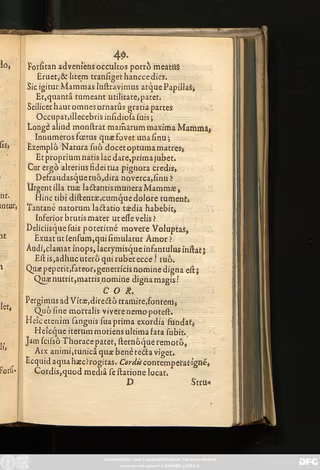
Femineum excellit formosô pectore corpus,
Mammula cui duplex orbiculata tumet.
Quare his præcipuum mens eſt ſacrare laborem,
Sæva nec offendet mortua membra manus.
In mediô, ùt cernis, cubat utrâque pectore Mam̄a,
Denudans, tepidus qui ſolet eſſe, ſinum.
Jam riget, & nullum Cordi vicina calorem
Percipit, extinctas teſtificata faces.
Non tamen omne abiit Mammis, periitq; decorum,
Tollit adhuc niveos Forma rotunda globos.
In parvis equidem latitant hæc poma puellis,
Et vix indicium blanda papilla facit;
Aſt, ubi virgineis accrevit floribus ætas,
Ad digitos ſurgunt utrâque mole duos.
Pendula ſed vetulis flacceſcit mamma, nec ullas
Exhibet exhauſtô glandula fonte notas.
Porrò duas Natura dedit, quò ſana dolentis
Proficuam poſſet ſuſtinuiſſe vicem.
His perluſtratis, ſequitur diviſio Mammæ,
Quam cum Mammillâ pulcra papilla dabit.
Hæc fungoſa quidem pars eſt, ſenſúque ſagaci
Pollet, & ad tactum ſuaviter erigitur:
Heîc etenìm teneros ſubtilia vaſcula fines
Jungunt, & tacitô ſenſus amore coit.
Virgineas pingit concinna rubedo Papillas,
Sicq́ue fidem puri ſanguinis illa probat;
Sed quæ lactis alunt infantem nectare matres,
Purpureô gaudent hocce colore minùs,
Livida quin potiùs protuberat hiſce papilla,
At verò effœtis nigrior eſſe ſolet.
Prætereà in mediô ſunt parva foramina nodô,
Lacteus ut facili defluat humor ope.
Hinc patet utilitas cantatæ magna papillæ,
Hac ſine tùm fruſtrà, tùm malè Mamma tumet.
Urgeat hoc ut opus, placitô Natura calore
Titillans matres admonet officii.
Interior Mammilla ſuos jam ponit amictus,
Et tunicâ abjectâ Glandula multa patet.
Durior hæc caſtas commendat ſæpè puellas,
Atque renitentis ſigna pudoris habet.
Sæpè magis turget, ſi prægnans cauſa reſurgat,
Lactantíque vices obſequioſa gerat.
Fracta ſed immundô meretricibus ubera tactu
Pendent, admiſſos ſignificanque procos.
Sed quosnam, rogitas, tàm plurima glandia fructus
Plena quibus Mammæ portio tota, ferunt?
Scilicet hic locus eſt, ubi fit generatio lactis,
Circumfuſus adeps quam juvat, atq́ue calor.
Fermentum accerſit, præfertq́ue recentior Ordo,
Sicque modô propriô lac generare putat.
Namq́ue Calor potiùs talem vitiare liquorem
Creditur, & niveas perdere ſæpè dapes:
Præcipuas forſan Fermenti Spiritus implet
Partes, & regimen Vis animalis obit.
Turgidulasvé bibit ſic infans ore papillas,
Ac incrementum matris amore capit.
Hinc quoque diverſis gaudent hæc pocula vaſis,
Unde coronentur nectare plena ſuô.
A truncô rivos Arteria magna ſupernô
Transfert; thoracis dant quoque vaſa ſuos.
Sed ſuperis Venas thoracica vaſcula ramis,
Et queîs Mamma dedit nomina, contribuunt.
Quosq́ue vides Nervos, etiam ex Thorace feruntur,
Inde, velut dixi, ſenſus amicus adeſt.
Prætereà tubuli niveô candore nitentes
Mammarum ad centrum, vaſe minore, meant
Hisque redundantis ſervari munera lactis,
Lactandi officiô languidiore, volunt.
Hinc ſed in utramvis pendens ſententia partem
Exercet celebres cognitione viros;
Quævé ſolent dici concordis pomula Amoris,
Verè Eridos pomum facta fuiſſe putes:
Sunt etenìm, ſanguis queis lactea pocula complet,
Materiamq́ue ſuam vaſa per alba vehit:
Sunt, quibus ex chylo tubuli turgere putantur;
Utráque pars armis militat egregiis.
Quamvis multa ſatis certent pro pondere Chyli,
Sanguinis excludi vix tamen unda poteſt.
Forſitan adveniens occultos porrò meatus
Eruet, & litem tranſiget hancce dies.
Sic igitur Mammas luſtravimus atq́ue Papillas,
Et, quantâ tumeant utilitate, patet.
Scilicet haut omnes ornatûs gratia partes
Occupat, illecebris inſidioſa ſuis;
Longè aliud monſtrat mam̃arum maxima Mamma,
Innumeros fœtus quæ fovet una ſinu;
Exemplô Natura ſuô docet optuma matres,
Et proprium natis lac dare, prima jubet.
Cur ergò alterius fidei tua pignora credis,
Defraudasq́ue tuô, dira noverca, ſinu ?
Urgent illa tuæ lactantis munera Mammæ,
Hinc tibi diſtentæ, cumq́ue dolore tument.
Tantané natorum lactatio tædia habebit,
Inferior brutis mater ut eſſe velis ?
Deliciisq́ue ſuis poteritné movere Voluptas,
Exuat ut ſenſum, qui ſimulatur Amor ?
Audi, clamat inops, lacrymisq́ue infantulus inſtat;
Eſt is, adhuc uterô qui rubet ecce ! tuô.
Quæ peperit, fateor, genetricis nomine digna eſt;
Quæ nutrit, matris nomine digna magis !